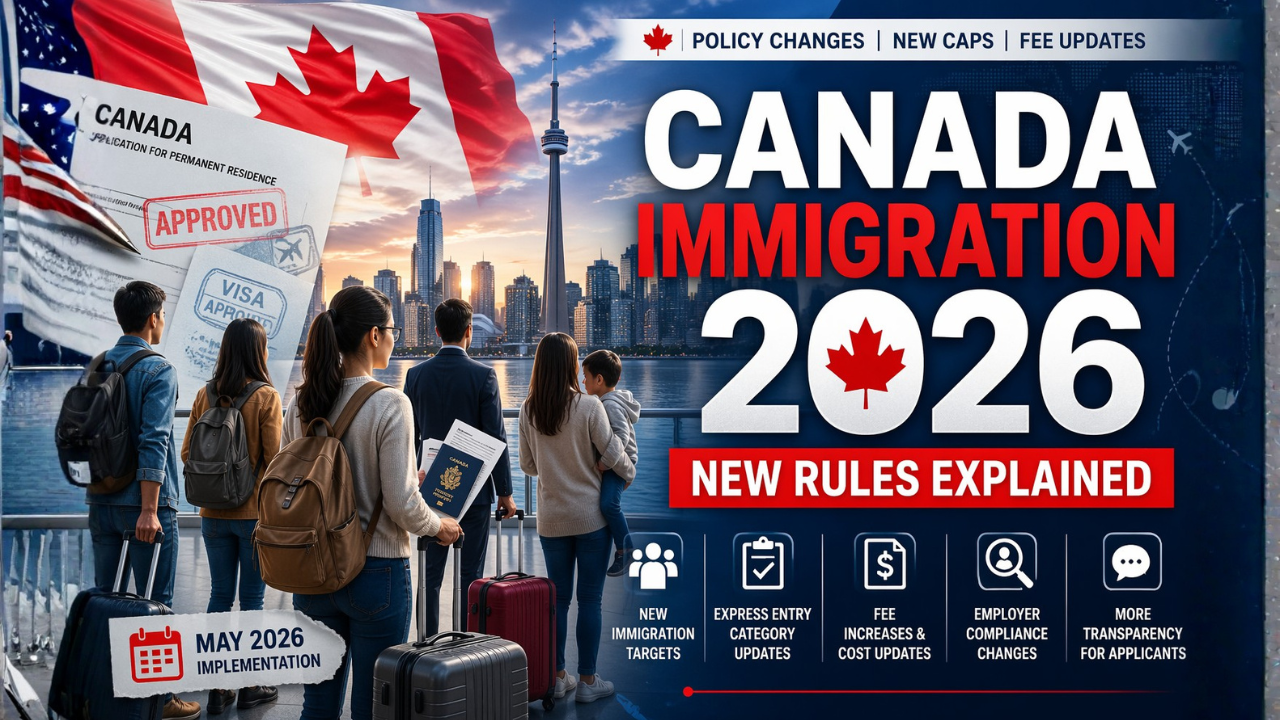
Synopsis: Following the 2025 federal election, Canada’s Liberal government under Prime Minister Mark Carney has reaffirmed a conservative immigration approach. The new policy reduces permanent resident admissions from previous targets of 500,000 to 395,000 in 2025, declining further through 2027. Temporary residents, including international students and foreign workers, will also be capped to reduce their share of the population from 7.25% to 5% by 2027. These measures aim to balance immigration with infrastructure capacity amid public concerns over housing and social services.
Canada’s reputation as a welcoming destination for immigrants is well established, but recent years have revealed growing tensions around the pace and scale of immigration. Housing shortages, stretched healthcare systems, and infrastructure challenges have sparked public debate about the sustainability of current immigration levels. In the wake of the 2025 federal election, Prime Minister Mark Carney’s government has signaled a clear shift toward reducing immigration numbers, aiming for a more balanced approach. Why has Canada chosen this path now, and what does it mean for the country’s future?

What Is the Policy?
The 2025–2027 Immigration Levels Plan released by Immigration, Refugees and Citizenship Canada (IRCC) outlines a phased reduction in immigration targets:
-
Permanent Residents:
The government targets 395,000 new permanent residents in 2025, decreasing to 380,000 in 2026 and 365,000 in 2027 – down from the previously planned 500,000 annually235.
-
Temporary Residents:
For the first time, specific caps are set on temporary residents, including international students and temporary foreign workers, aiming to reduce their proportion of the population from approximately 7.25% in early 2025 to 5% by 2027211.
-
International Students:
Study permits are capped at 437,000 for 2025, a 10% reduction from the previous year, continuing the restrictive measures introduced in 202411.
-
Work Permits:
Temporary foreign worker programs face tighter limits and eligibility criteria to better align with labor market needs2.
The plan also emphasizes prioritizing permanent residency for temporary residents already in Canada, particularly those in economic streams, while maintaining commitments to family reunification and humanitarian admissions17.
Why Now? Causes and Pressures
Several factors have converged to prompt this policy shift:
-
Infrastructure and Housing Strain:
Public concern has grown over housing affordability and shortages, along with pressure on healthcare and education systems. The government aims to ease these pressures by moderating immigration growth2711.
-
Population Growth Management:
Canada’s population is projected to remain stable through 2027, requiring a reduction of roughly one million temporary residents over three years to maintain balance11.
-
Political and Public Pressure:
Voter sentiment has shifted toward favoring more sustainable immigration levels to safeguard social cohesion and public services11.
-
System Integrity:
Reports of misuse of temporary visas, including some international students seeking asylum, have raised calls for stricter controls11.
-
Manifesto Pledges:
The Liberal Party’s 2025 platform commits to stabilizing permanent admissions below 1% of the population annually beyond 2027 and reducing temporary residents to under 5% by the end of 202711.
Who Will Be Affected?
-
Prospective Immigrants:
Permanent residency applicants will face more competitive selection processes due to lower intake targets, potentially leading to longer wait times and stricter criteria27.
-
International Students:
Caps on study permits and tougher post-graduation work permit rules will limit new arrivals and reduce pathways to permanent residency, impacting thousands of students and educational institutions11.
-
Temporary Foreign Workers:
Reduced quotas and eligibility tightening will affect employers relying on temporary labor, especially in caregiving and agriculture2.
-
Educational Institutions and Communities:
Universities and colleges face revenue and enrollment challenges, with sector leaders calling for rebuilding trust and modernizing immigration pathways11.
-
Canadian Society:
The policy aims to relieve pressure on housing, healthcare, and social services, potentially improving quality of life for all residents7.
Expert Opinions
- The Canadian Bureau for International Education (CBIE) acknowledges the sector’s recent challenges and stresses the need to rebuild trust and strategically position international education for Canada’s prosperity11.
- Universities Canada warns that visa processing delays and unclear immigration pathways are eroding Canada’s global reputation in attracting talent11.
- Former Immigration Minister Marc Miller emphasized the importance of cracking down on exploitative recruitment and aligning immigration with community capacity11.
- The Bank of Canada expressed skepticism about meeting the 5% temporary resident target by 2026 but supports efforts to achieve it by 202711.
- Legal and economic analysts caution that while reductions may ease infrastructure strain, they risk slowing economic growth and innovation if not balanced with strategic investments2.
International Comparison
-
Australia:
Plans to halve immigration intake by mid-2025 to about 250,000 annually, with tightened visa rules for students and low-skilled workers1.
-
United States:
Focuses on high-skilled immigration and border security, without broad caps on temporary residents10.
-
United Kingdom:
Employs a points-based immigration system with reductions in low-skilled work visas to balance economic needs and public concerns10.
Canada’s approach reflects a global trend toward more selective and sustainable immigration policies balancing economic benefits with social capacity110.
Better Policy Alternatives
-
Regional Flexibility:
Empower provinces and territories to set immigration targets tailored to local labor market and demographic needs2.
-
Infrastructure Investment:
Parallel investments in housing, healthcare, and education to support immigration growth sustainably7.
-
Streamlined Processing:
Improve visa and permit processing to reduce delays and enhance newcomer integration11.
-
Targeted Temporary Programs:
Focus temporary migration on high-demand sectors with clear pathways to permanent residency2.
-
International Education Reform:
Strengthen oversight of institutions to prevent predatory practices while maintaining Canada’s attractiveness to quality international students11.
Key Takeaways
- Canada’s 2025–2027 immigration plan marks a significant reduction in permanent and temporary migration levels.
- The government aims to stabilize permanent resident admissions below 1% of the population annually and reduce temporary residents to 5% by 2027.
- These changes respond to public concerns about housing, social services, and infrastructure.
- International students and temporary foreign workers face stricter caps and eligibility requirements.
- The policy aligns with international trends but raises concerns about economic and demographic impacts.
- Experts advocate balanced, regionally tailored policies and infrastructure investment to sustain Canada’s prosperity.
Final Thought
Canada’s new immigration policy reflects a complex balancing act: addressing urgent public concerns over infrastructure strain while preserving the country’s historic openness and economic dynamism. The reductions in immigration levels may ease short-term pressures but risk slowing growth and innovation if not paired with strategic investments and regional flexibility. The coming years will test whether this more conservative approach can achieve sustainable, inclusive immigration that continues to enrich Canadian society without overwhelming its capacity.
For detailed information, see the 2025–2027 Immigration Levels Plan, Canadian Bureau for International Education, and Universities Canada.