

Synopsis: Navigating Canada’s international student pathway after July 2026 requires strict planning. With a national cap of 408,000 study permits, mandatory Provincial Attestation Letters (PALs), labour-market-aligned Post-Graduation Work Permits (PGWP), and higher proof-of-funds thresholds, students must prioritise early submissions and strategic program selection to succeed.
While Canada is still one of the most popular choices for international students, if your plans involve applying to Canada after July 2026, it’s crucial to understand this fact: the process is not as accommodating as it once was.
Although there are no new rules that will begin in July 2026, by the end of 2026, students will be facing a completely tightened immigration system. New restrictions on study permits, Provincial Attestation Letters, higher financial requirements, tougher regulations on Post-Graduation Work Permits, and program-based eligibility are now driving the future of Canada’s student pathway.
The biggest error many applicants will be making is last-minute admissions and selecting the wrong program, or thinking that admission alone will suffice. 
Canada Study Permit Rules After July 2026: What Changes for Students?
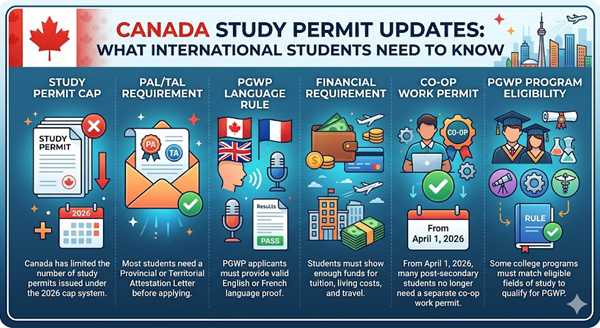
The primary concern of students who have applied after July 2026 is the timing. The study permit system in Canada now operates under the concept of caps by year and allocations under the international student cap, which is allocated to provinces.
In total, up to 408,000 study permits will be issued in Canada in 2026, of which 155,000 are for new international students. This means that competition is high, and that students wishing to make late intakes might be at even higher risk if the province in which they are interested has had most of its intake.
The PAL or Provincial Attestation Letter is the most important document in this system. Most students must have a PAL or TAL before they are able to submit an application for study. It’s essential that if it’s not there, even a legitimate admission offer might not be sufficient.
Key Canada Student Visa Updates for 2026
Why Applying Late Could Be Risky
Students intending to take courses beginning in the Fall of 2026 should be extremely cautious. There are still many institutions that might be available, but the question remains: is the province still going to have PAL capacity?
It’s here that many of the applicants make the mistake. An acceptance letter from a college or university does not mean that you will be granted permission to emigrate. Without the PAL, the study permit process for that intake may become difficult or impossible.
Which is why it’s advisable that students do not procrastinate until the last minute. The selection of the province, availability of PALs, and preparing documents in advance will be paramount.
PGWP Rules Are Now Much Stricter
The Post-Graduation Work Permit has also been made more stringent. If the program requires a valid language test as a requirement, students applying for a PGWP will be required to submit valid test results.
University graduates are usually required to have a level of CLB 7. It is typically CLB 5 for college graduates. This does not allow students to take language testing for granted, to be done as an afterthought.
One more significant aspect is eligibility for the field of study. The program needs to have a connection to a career path that is a field of interest for the college graduate, compatible with the needs of the Canadian labour market. Sectors like healthcare, trades, education and other in-demand occupations are given priority.
That’s right, the program you select now could either determine if you have a work permit after graduation or not.

Proof of Funds: Canada Wants Financially Ready Students
Canada has also increased the financial requirement for foreign students. All applicants are required to demonstrate financial means to pay tuition, expenses and transportation.
The current living cost requirement has significantly increased from previous years for one student. Students should also include the cost for their first-year tuition and any accompanying family members.
Financial planning is thus an essential part of the application. If your bank statements are weak, if you have no clear funds history, or if you make sudden deposits, it could cause problems.
One Positive Change: Co-op Work is Easier
Not all updates are bad, though. Since April 1, 2026, post-secondary international students do not require a separate co-op work permit for mandatory internships or co-op placements.
This eliminates an additional administrative component and will ease student workload for those programs that incorporate hands-on work experience.
But this doesn’t imply “unlimited work rights”. Conditions of the study permit and program continue to apply to students.
What Students Should Do Before Applying
Before applying to Canada after July 2026, students should ask five important questions:
- Is my institution a recognised DLI?
- Can my school issue a valid PAL or TAL?
- Is my program eligible for PGWP?
- Do I meet the language requirement for future PGWP plans?
- Can I clearly prove tuition, living costs, and travel funds?
If the answer to any of these questions is not known, there may be an increased risk with the application.
Final Thoughts
Canada is not shutting the door to international students, but there’s a growing focus on selection. Now the country longs for students who are financially ready, academically sincere, in better programs and adjusted to the demands of the job market. Successful candidates after July 2026 must be well-prepared. The days of picking any college, applying late and hoping for a work permit are over.
The new Canada student visa reality is clear: apply early, choose carefully, verify PGWP eligibility, secure your PAL, and prepare strong financial documents before submitting your application.
In today’s new reality, the Canadian student visa process is quite straightforward: apply early, pick your program wisely, ensure your eligibility for the PGWP, get your PAL and prepare strong financial documents before submission.









One thought on “Applying to Canada After July 2026? Here’s the New Reality for International Students”
I am Mohamed Qaid Ahmed, a high school graduate and a UNHCR-registered refugee currently in Somalia. I am very motivated to join your volunteering projects in Leipzig to build my future and gain international experience.
I tried to apply through the official European Youth Portal, but the system did not allow me to register due to my current location. Since I am a registered refugee, is there an alternative way for me to apply or send my documents to you directly?
I can provide my CV and official refugee documentation (UNHCR ID: 206-15C00162) upon request.
Thank you for your time and for the support you provide to young volunteers.
Best regards,
Mohamed Qaid Ahmed
UNHCR ID: 206-15C00162
Phone: +252611876681