
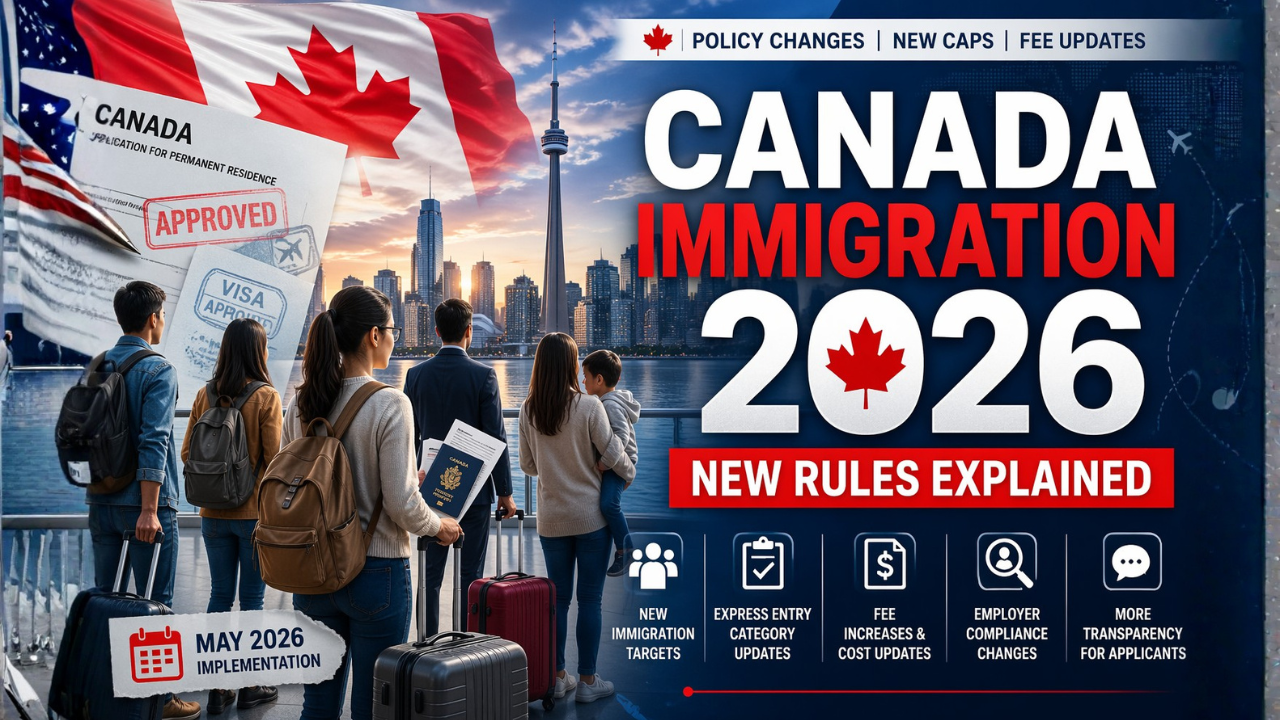
Synopsis: Canada’s May 2026 immigration reforms introduce stricter caps on temporary residents, prioritize PR pathways for experienced workers, and expand Express Entry categories. With new transparency measures, rising costs, and policy restructuring, these changes redefine immigration strategy for international applicants navigating Canada’s evolving migration system.
Introduction
Canada’s immigration system is entering a defining moment in 2026, with sweeping reforms that could significantly reshape global migration flows. For decades, the country has positioned itself as one of the most welcoming destinations for international students, skilled workers, and families. However, the latest policy changes suggest a recalibration—one that prioritizes economic sustainability over rapid population growth. According to Canada immigration policies by IRCC, the government aims to strike a delicate balance between labor market demands, housing capacity, and long-term economic growth.
This raises a critical question: Is Canada becoming more selective, or simply more strategic? For international applicants, understanding these changes is no longer optional—it is essential for success. 
Understanding the Policy/Event
Why It Is Happening
Canada’s immigration policy reset is rooted in a combination of domestic pressures and global economic realities.
Over the past decade, the country has seen unprecedented growth in temporary residents. International students and foreign workers have played a vital role in supporting economic expansion, particularly in sectors like healthcare, construction, and technology. However, this growth has not come without consequences.
Major cities such as Toronto and Vancouver have experienced severe housing shortages, rising rents, and increasing strain on public services. At the same time, there has been a mismatch between immigration inflows and actual labor market needs.
Key factors driving the 2026 reforms include:
- Housing affordability crisis, limiting the ability to absorb new residents
- Overdependence on temporary migration, creating long-term uncertainty
- Labor shortages in high-skill sectors, despite high immigration levels
- Political pressure to control population growth
The government’s response is a shift toward a quality-driven immigration system, focusing on long-term economic contribution rather than short-term population increases.
Key Reforms or Changes
Detailed Breakdown
New Indicator System
One of the most significant developments is the introduction of a new immigration indicator system. This system will track key metrics such as:
- Employment outcomes of immigrants
- Regional distribution and settlement patterns
- Pressure on housing and infrastructure
By leveraging real-time data, policymakers aim to make more informed decisions and quickly adapt to changing economic conditions.
Employer Compliance Transition
Responsibility for employer compliance under the International Mobility Program is being transferred to Canadian employment and workforce compliance authority.
This shift signals a stronger regulatory approach. Employers hiring foreign workers will now face:
- Increased inspections and audits
- Stricter documentation requirements
- Greater accountability for labor standards
For businesses, this means that hiring international talent will require more preparation and compliance checks than ever before.
Increased Refusal Transparency
Another major reform is the introduction of Officer Decision Notes. Previously, applicants often received generic refusal letters with limited explanations.
Now, applicants will gain:
- Detailed reasoning behind rejections
- Insight into application weaknesses
- Guidance for future applications
This change is particularly important for students and skilled workers who rely on precise feedback to improve their chances.
Express Entry Category Expansion
Canada is expanding its Express Entry system to better align with labor market needs.
New targeted categories include:
- Healthcare professionals (especially doctors and specialists)
- Researchers and academic professionals
- Senior managers with Canadian experience
- Transport and logistics workers
- Skilled military recruits
Additionally, the minimum work experience requirement has increased from six months to one year, ensuring that candidates have more substantial experience.
This shift highlights a broader trend: Canada is prioritizing applicants who can immediately contribute to the economy.
Data, Stats, and Trends
What the Numbers Show
Immigration Targets for 2026
The 2026–2028 Immigration Levels Plan introduces stricter caps:
- Permanent Residents: 380,000
- Temporary Residents: Approximately 385,000
- TR to PR Transition: 33,000 individuals
These numbers represent a move toward balancing temporary and permanent migration streams.
Francophone Immigration Strategy
Canada is increasing its focus on French-speaking immigrants outside Quebec. The target is set at 9% of total permanent residents, reflecting the government’s commitment to linguistic diversity and regional development.
Budget Constraints and Operational Impact
According to Canada government immigration spending plans, IRCC faces a budget reduction of approximately $154 million for the 2026–2027 fiscal year.
This could result in:
- Longer processing times
- Increased application backlogs
- Reduced operational capacity
Despite efforts to digitize the system, budget cuts may slow down implementation of reforms.
Fee Increases
Permanent residence application fees have increased, adding financial pressure on applicants. Updated details are available under Canada PR application fee structure and immigration programs.
For many applicants, rising costs could become a barrier, particularly for students transitioning to permanent residency.
Rural Workforce Policy Changes
Rural employers are now allowed to hire up to 15% low-wage foreign workers, an increase from the previous 10%.
This change aims to:
- Address labor shortages in rural areas
- Support regional economic growth
- Reduce dependence on urban labor markets
Impact Assessment
Social, Economic, and Human Consequences
Impact on International Students
International students will likely face stricter regulations and increased scrutiny.
- Study permit approvals may decline
- Financial requirements could rise
- Pathways to permanent residency may become more competitive
This could affect Canada’s position as a top destination for global education.
Impact on Skilled Workers
For skilled workers, the reforms present both opportunities and challenges.
- Targeted Express Entry draws increase chances for high-demand occupations
- However, stricter requirements reduce accessibility for entry-level candidates
Applicants must now focus on building stronger profiles with relevant experience.
Impact on Employers
Employers will face increased regulatory pressure.
- More compliance checks
- Higher administrative costs
- Reduced flexibility in hiring
While this ensures fair labor practices, it may also slow down recruitment processes.
Impact on Communities
At the community level, the reforms could lead to:
- Reduced housing pressure
- Improved infrastructure planning
- Better integration of newcomers
However, there may also be short-term disruptions, particularly in sectors reliant on temporary workers.
Political Background & Stakeholder Reactions
Government, Opposition & Expert Opinions
The Canadian government has framed these reforms as necessary for long-term stability. Officials emphasize that immigration must align with infrastructure capacity and economic priorities.
However, opposition voices argue that:
- Immigration caps could limit economic growth
- Labor shortages may worsen
- Canada’s global reputation could be affected
Industry leaders have expressed concerns about workforce shortages, particularly in healthcare and construction sectors.
Experts suggest that while the reforms are well-intentioned, their success will depend on execution and adaptability.
Global Comparisons
Where This Stands Internationally
Canada’s immigration reforms are part of a broader global trend.
United Kingdom
The UK has tightened immigration rules, increased salary thresholds, and reduced migration targets.
Australia
Australia has introduced:
- Caps on international students
- Higher visa fees
- Stricter eligibility criteria
United States
The U.S. continues to prioritize high-skilled immigration, focusing on employer-sponsored visas.
Compared to these countries, Canada remains relatively open but is clearly moving toward a more selective model.
Critical Analysis
Will It Work?
The effectiveness of Canada’s immigration reforms depends on how well they are implemented.
Strengths
- Data-driven policymaking
- Focus on economic contribution
- Improved transparency
Risks
- Reduced global competitiveness
- Potential delays due to budget cuts
- Increased barriers for applicants
Key Question
Can Canada maintain its global appeal while tightening immigration controls?
If executed effectively, these reforms could strengthen the economy and improve integration outcomes. However, mismanagement could lead to inefficiencies and reduced attractiveness for international talent.
Conclusion
Canada’s 2026 immigration reforms represent a significant shift toward a more controlled and strategic system. By prioritizing skilled workers, introducing stricter caps, and improving transparency, the country is redefining its approach to global migration.
For applicants, success now depends on preparation, strategy, and adaptability. Canada remains a land of opportunity—but only for those who understand and align with its evolving immigration landscape.











One thought on “Canada Immigration 2026 Overhaul: New Caps, Express Entry Shifts, and Policy Reset Explained”
Dear Sir/Madam,
My name is Mohamed Qaid Ahmed, a Yemeni national currently living as a registered refugee in Somalia. I am writing to you with a heart full of hope and a strong desire to build a safe and productive future.
As a high school graduate with a passion for learning and community service, I am highly motivated to contribute my energy and skills to your programs. Being a refugee has taught me resilience, but it has also limited my opportunities. I am seeking a pathway—whether through private sponsorship, volunteering, or educational programs—that would allow me to relocate to a safe environment like Canada or Germany.
I am officially registered with the UNHCR in Somalia, and my details are as follows:
Full Name: Mohamed Qaid Ahmed
UNHCR ID Number: 206-15C00162
Nationality: Yemeni
Current Location: Somalia
Educational Background: High School Graduate
Phone Number/WhatsApp: +252611876681
I am ready to provide all necessary documentation, including my CV and refugee certificate, to prove my eligibility and readiness. I am not just looking for a place to stay; I am looking for a community where I can grow, volunteer, and give back.
Thank you for your time, your empathy, and the incredible work you do for people in my situation. I look forward to hearing from you.
Best regards,
Mohamed Qaid Ahmed
Phone: +252611876681
UNHCR ID: 206-15C00162