
Synopsis: Manitoba has officially discontinued its Career Employment Pathway, shifting its immigration strategy to prioritize long-term local work experience over Canadian education. This pivot heavily impacts international graduates, who must now adapt their permanent residency roadmaps and transition into the Skilled Worker in Manitoba stream to successfully secure PR.
Manitoba made a significant immigration adjustment that may impact thousands of international students who would like to make Canada their home. The province officially discontinued the Career Employment Pathway option in the Manitoba Provincial Nominee Program’s International Education Stream and changed the pathway that international graduates can follow to qualify for permanent residence.
Manitoba was once considered one of the most demanding Canadian provinces to pursue a study-to-PR route. This recent change is quite evident; Manitoba is emphasising actual work experience, long-term employment, and labour market needs more. 
What Has Changed in Manitoba Immigration?
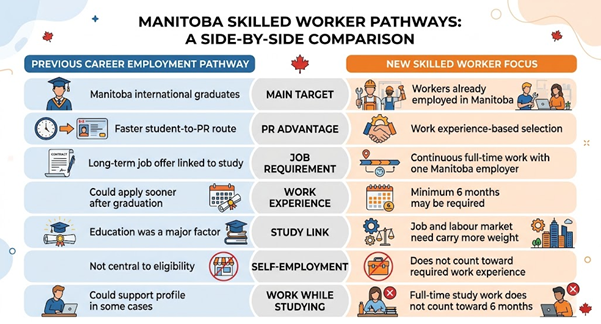
The Manitoba Provincial Nominee Program (MPNP) has closed doors to the CEP (Career Employment Pathway) under the International Education Stream (IES). This pathway was previously available to international graduates from Manitoba institutions receiving a qualifying job offer related to their education and training to apply for a Manitoba nomination upon graduation.
Many international graduates will now have to turn to the Skilled Worker in Manitoba pathway instead. This implies that it will no longer be just about completing a Manitoba qualification. Now, graduates will have to demonstrate that they are already employed in the province and that they are helping the local economy.
This will be a significant shift for certain students who have chosen Manitoba due to its image as a pro-PR location.
Manitoba PR Pathway: Old Route vs New Focus
Why Did Manitoba Close the Career Employment Pathway?
The province claims that the modification is meant to establish more unambiguous and uniform selection criteria. Manitoba is seeking immigration nominations to better address its existing labour market shortages. Or, in other words, the province seeks applicants who are already working in Manitoba and not necessarily someone who only obtained a local diploma or degree.
This reflects a broader Canadian immigration trend. Provinces are becoming more selective, and many are focusing on candidates with good economic integration. This implies that students have to focus beyond the admission letters and graduation certificates. They also need to consider options for their job outcomes, employer support and long-term settlement.

Who Will Be Most Affected?
International students in Manitoba will be impacted the most, particularly those leveraging the Career Employment Pathway as their primary pathway to PR.
Indian students in Canada might be more impacted as India is one of the top countries of origin for international students in Canada. Some students select the provinces to study in Canada due to the post-study work and PR opportunities available in the province. If a dedicated graduate pathway is closed, it could alter the ROI of choosing to study in that province.
If you are still considering taking further studies in Manitoba, it is the time for you to think more seriously about the college you will attend and the programme you will study.
What Should International Graduates Do Now?
Graduates who have an active Expression of Interest profile are advised to review and update their profile as soon as possible. Manitoba has told applicants to submit their Manitoba education credentials and re-evaluate their ranking under the Skilled Worker in Manitoba stream.
It is important that students also develop a solid local employment profile. This can involve securing a real full-time job, having employment with the same employer in Manitoba, obtaining steady work experience, and preparing a good settlement plan.
The province has become more interested in a settlement plan, given that it is now a requirement when applying to become a candidate in Manitoba.
What This Means for Future Students
This update clearly signals that studying in Canada is not enough on its own.
For students who are looking at studying in Manitoba, it’s time to select programs that have great job prospects. They should investigate labour market demand, employer demand, licensing requirements, and if the career is in line with Manitoba’s labour market.
Students should ask themselves the following questions prior to applying to college:
- Is this program connected to real jobs in Manitoba?
- Are employers hiring graduates in this field?
- Will this course support my long-term immigration plan?
- Can I realistically get full-time work after graduation?
Now these questions are as crucial as tuition or campus location or admission criteria.

Key Takeaway
Manitoba’s decision to close the Career Employment Pathway marks a major shift in Canada’s student immigration system. The province is shifting away from the education-based PR path and increasing the emphasis on work experience, connection with employers and economic settlement.
The message to international students is clear: do not base your plans for Canada on studies alone. From the outset, your PR strategy should involve employment and labour market research, and a clear long-term settlement plan. While there are still opportunities for international graduates in Manitoba, the pathway is now more competitive, work-focused and less automatic.