Synopsis: Following its 2025 election win, Australia’s Labor government is enforcing major immigration reforms. These include visa fee hikes, stricter English requirements, and tightened permanent residency pathways for international students and workers, particularly Indians. Despite the crackdown, experts believe Australia remains attractive for its opportunities and long-term stability.
Introduction
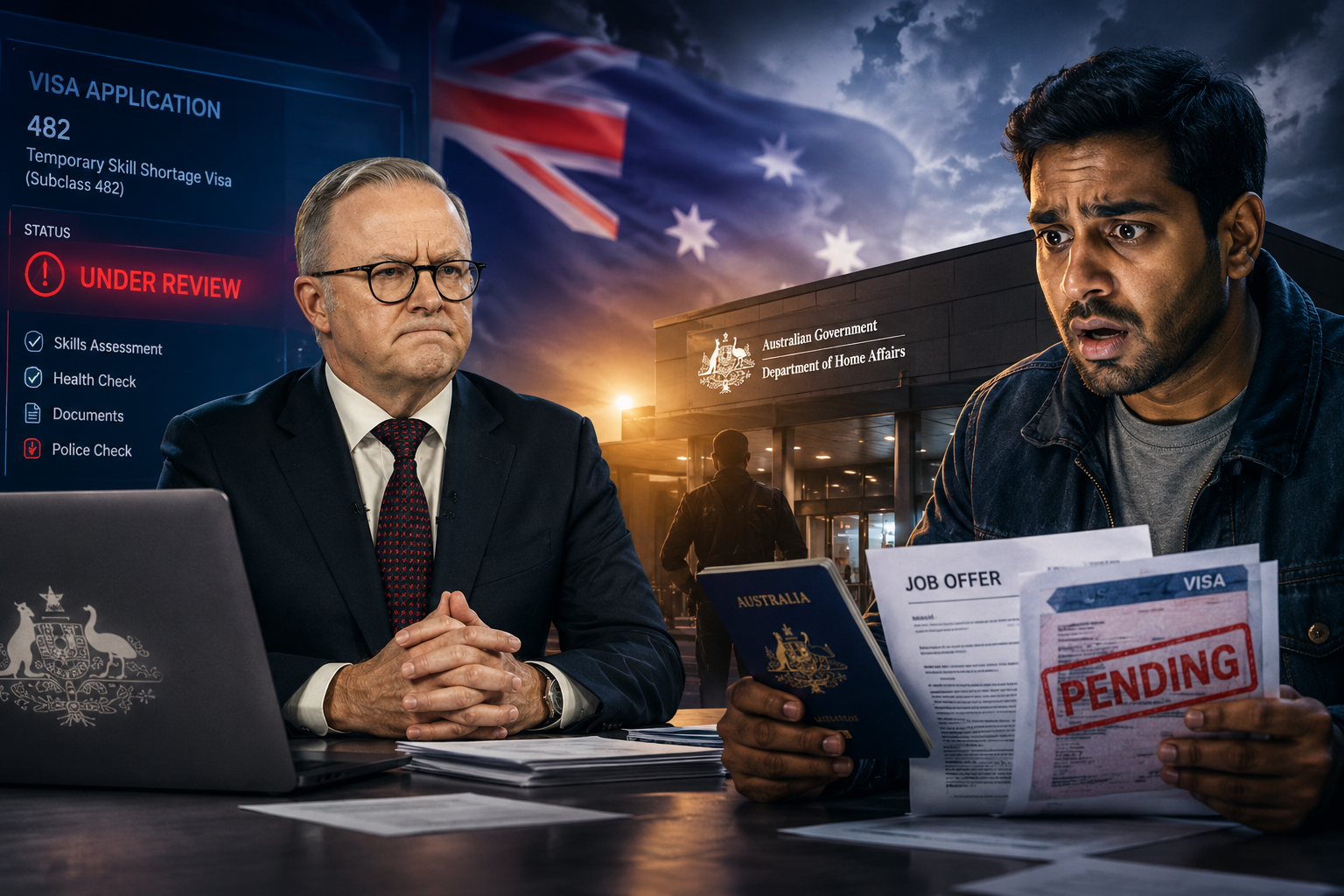
Australia’s open-door reputation is facing a turning point. In 2025, after a landslide re-election victory, Prime Minister Anthony Albanese’s Labor Party announced sweeping immigration changes, reshaping how Indian students, workers, and aspiring residents will access opportunities in the country.
With over 845,000 Indian-born residents in Australia—second only to the UK-born diaspora—the subcontinent’s interest in Australia remains strong. Yet new policies are tightening who gets in, who stays, and under what terms. As visa approvals decline and permanent residency becomes harder to attain, applicants must now navigate a far more complex, selective system than in previous years.
This blog decodes the key updates and their implications for Indian migrants, offering clarity on timelines, costs, and strategic next steps.

What Is the Policy/Issue?
The Australian government is executing a multi-pronged crackdown on immigration, particularly targeting international students and skilled workers. Following criticisms of unsustainable migration numbers—which peaked at over 500,000 in 2023—Labor’s new 10-year strategy focuses on:
- Lowering net overseas migration to 250,000 per year
- Raising visa fees across student and skilled visa categories
- Tightening permanent residency (PR) pathways
- Launching new targeted visa schemes for high-skilled migrants
According to the Department of Home Affairs, these changes aim to rebalance migration in line with Australia’s infrastructure capacity, workforce needs, and educational integrity.
Why Now? (Causes, Pressures, Manifesto Pledges)
Rising Net Migration Pressures
Australia saw a record net migration of 510,000 in 2022–23. Critics argued this overwhelmed public services and housing in urban hubs like Sydney and Melbourne. The Grattan Institute and other policy think tanks flagged unsustainable growth, prompting both major parties to promise migration reform in their election manifestos.
Pre-Election Debate on Immigration
Immigration became a core campaign issue, with opposition leader Peter Dutton criticizing international student flows and temporary visa misuse. The Labor Party responded by committing to lower net migration to 250,000 in 2024–25, followed by 255,000 in 2025–26, and 235,000 in 2026–27, as confirmed in budget estimates.
Failed Legislation, Administrative Clampdown
While a legislative cap on student visas failed to pass, the government turned to fee hikes and regulatory tightening as tools to manage inflow.
Who Will Be Affected?
Indian Students
Visa grants for Indian students have more than halved, falling from 102,696 in 2022–23 to just 50,516 in 2023–24, according to official DHA figures. Fee increases and stricter admission criteria are likely to push more Indian applicants toward Canada, the UK, or Germany.
Skilled Indian Workers
Temporary skilled visa grants to Indians fell by over 30%, dropping from 27,402 to 18,397. New reforms include:
- A 14.75% hike in visa application charges
- Reduced work experience requirement from 2 years to 1
- Tighter labor market testing to ensure Australians are prioritized
Education Providers and Regional Cities
With student visas falling, universities and private colleges could lose billions in international tuition revenue. The government is also redirecting new migrants to regional towns to relieve pressure on big cities, making it harder for students to remain in urban hubs post-study.
Expert Opinions (Legal, Economic, Educational)
Education Experts Raise Alarm
Mamta Shekhawat, founder of Gradding.com, told Business Standard that the sudden increase in student visa fees from €404.50 to €911.55 is aimed at “controlling the growth of the education sector and net migration.”
She noted that tighter English language requirements and new compliance rules for education providers are also intended to
“maintain academic standards and protect students from exploitation.”
Sectoral Analysts Call for Balance
Piyush Kumar, Regional Director for South Asia at IDP Education, acknowledged concerns but said Indian families are “not deterred.”
“They see Labor’s win as a move toward migration sustainability—not exclusion,” Kumar said.
He pointed out that recent developments under the Australia-India Economic Cooperation and Trade Agreement (AI-ECTA), such as extended post-study work rights, signal Australia’s continued openness to Indian talent.
Labor’s Policy Signals Shift Toward Skill-Based Intake
Experts across the board agree that the Labor Party’s post-election immigration approach is highly selective, focusing on admitting migrants with clear economic value—particularly those with STEM and cybersecurity expertise.
“An IT professional with cybersecurity skills may still qualify easily—but the sponsoring employer now faces heavier proof requirements,” said Shekhawat.
International Comparison
How does Australia’s immigration tightening compare globally?
Canada
Canada recently capped student visas for two years, primarily to address housing shortages. However, its approach has been more transparent and supportive, offering clear PR pathways and expanded refugee routes.
United Kingdom
The UK has also introduced student visa reforms, banning most dependants and introducing higher income thresholds for skilled worker applicants. However, the UK has not increased student visa fees as dramatically as Australia.
United States
While the US remains stringent in documentation and interviews, its F-1 visa system has seen no major fee hikes, and post-study work opportunities (OPT/STEM OPT) remain competitive.
Australia’s 125% fee hike stands out internationally, with critics calling it one of the most aggressive financial barriers to student migration in the Western world.
Better Policy Alternatives
1. Cap Admissions Per Institution, Not Per Country
Instead of blanket fee hikes, Australia could limit student intake on a per-institution basis, targeting low-quality providers that inflate migration statistics without contributing to workforce readiness.
2. Introduce Tiered Visa Fees
A tiered fee structure based on the applicant’s field of study or skill category could preserve revenue goals without penalizing students in priority sectors like health and cybersecurity.
3. Invest in Regional Migration Incentives
Redirecting migrants to regional areas is sensible—but should be supported with housing assistance, job guarantees, and infrastructure development, not just regulatory nudges.
4. Rebuild Education Partnerships
Australia can restore trust by expanding bilateral education agreements with countries like India, offering joint scholarships and guaranteed work placements for top graduates.
5. Improve Communication and Transition Support
Policy shifts should be accompanied by clear guidance for students already in Australia. A dedicated migration helpline and transition toolkit would help students adapt to the new requirements without unnecessary confusion or legal jeopardy.
Key Takeaways
- The Labor Party’s post-election win in 2025 has enabled tightened immigration controls, focusing on sustainability and infrastructure pressure relief.
- Indian student visa grants dropped by over 50%, and total temporary visa grants to Indians fell by 171,000.
- Student visa application fees have more than doubled, and another increase is planned for 2025–26.
- New visa programs such as the Mobility Arrangement for Talented Early-Professionals Scheme aim to retain Indian talent selectively.
- Permanent residency transitions have been curtailed, especially for students above 35, and post-study work rights are being shortened.
- Experts advise Indian students to apply early, prepare financially, and choose reputed institutions with strong support services.
Final Thought (Opinionated Wrap-Up)
Australia’s new immigration playbook is clear: fewer migrants, higher barriers, and stricter filters. While this may appease domestic concerns about infrastructure strain and educational quality, it risks alienating the very talent Australia seeks to attract—especially from trusted partners like India.
The 125% increase in student visa fees, the narrowed PR pathways, and stricter criteria for skilled migration may control numbers in the short term—but could hurt Australia’s global reputation and economic competitiveness in the long run.
What remains undeniable is that Australia continues to offer world-class education and career opportunities. The key for Indian applicants is to adapt to the evolving system, stay informed, and plan strategically. For policymakers, the challenge lies in finding the right balance between control and openness—between protecting local interests and embracing global talent.
If Australia gets it right, it can still be a beacon for skilled, ambitious migrants. If it doesn’t, the next generation of Indian students and professionals may choose Canada, the UK, or Germany instead.