Synopsis: Australia’s immigration debate enters a critical phase as the federal government warns that drastic migrant cuts could severely impact housing construction, healthcare, and regional workforces. While targeting a reduction to 225,000 arrivals annually, the policy aims to balance housing pressures with economic demands, prioritising skilled workers in high-shortage industries over sudden, sweeping visa restrictions.
Australia’s immigration debate has moved into a new stage with the federal government warning that a monumental drop in migrants could cause significant issues for Australia, particularly in the housing, healthcare, regional services and workforce supply sectors.
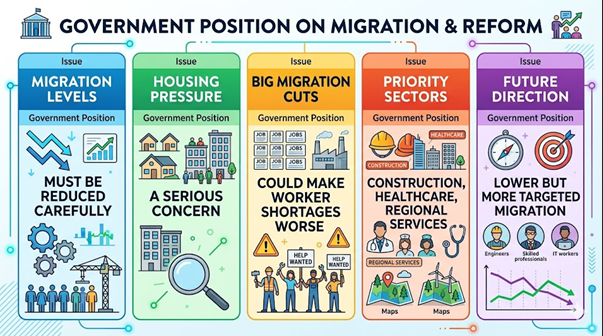
Immigration Minister Tony Burke has said the government is already reducing migration levels, but the cuts must be managed carefully. According to Burke, Australia has reduced net migration by around 45% and is continuing to bring numbers down in a way that matches the “needs of the nation”.
The government, however, warns that any drastic reduction in immigration could have a negative effect. 
Why Australia Says It Still Needs Immigration
The core argument put forward by the government is that Australia requires people in critical industries.
Burke said, though housing pressure is very much a public concern, the wrong migration policy could make the housing situation worse. Australia could find itself in a situation where it has an insufficiently skilled workforce to build new homes after reducing the intake of migrants without adequate preparation.
This is particularly important as construction workers are required to boost the housing supply. Meanwhile, many regional communities are dependent on doctors, nurses, aged carers and other skilled migrants.

Migration and Housing: The Big Policy Challenge
Australia’s housing shortage has become one of the biggest political issues in the country. High rates of migration cause an increased demand for housing, rent, infrastructure and public services, which is a concern for many voters.
The government acknowledges there has been an imbalance between migration and housing supply. However, it says it is not enough to just reduce the number of immigrants.
Rather, the government asserts that migration should be “tailored” to the needs of the nation, and housing supply should be expanded.
While Australia would like fewer migrants than during the post-pandemic surge, it would still like the right migrants in the right sectors.
Australia’s Net Migration Target
The federal government is aiming for a net migration of about 225,000 people annually over the next three years.
This is a huge reduction from the previous year.

These figures illustrate that Australia is already heading down the road to reduced migration. But the government is attempting to prevent any sudden cuts that might harm the labour market.
Opposition Parties Push for Tougher Migration Cuts
The Coalition and One Nation are demanding more stringent measures on migration.
Opposition Leader Angus Taylor has called for immigration numbers to be tied to the construction of houses annually. The concept is that migration should not be increasing at a faster rate than Australia’s capacity to supply housing.
One Nation has put forward a much lower proposal of 130,000 visas per year.
Those who want more restrictive migration levels say the less that is allowed in, the less pressure on housing, rents, infrastructure and public services. The government, however, has indicated that it could create new problems if it results in a reduction in the number of skilled people in Australia.

What This Means for Migrants and Visa Applicants
The debate highlights the increasing selectivity of Australia’s immigration system for migrants.
While the overall numbers of migrants could be further reduced, skilled workers in priority sectors may continue to be important to the government. This may be helpful to applicants in industries like construction, healthcare, regional services, engineering and other occupations experiencing shortages.
But applicants must also be prepared for increased planning requirements, increased competition and tougher policy regulation as Australia attempts to manage migration in relation to housing and economic capacity.
Key Takeaways
Here is the simple breakdown:
Final Thoughts
Australia is not rejecting immigration completely. But the government, on the other hand, is attempting to limit migration while maintaining the impetus for certain sectors of the economy that rely on skilled workers.
The difficulty is to maintain balance.
Continued high migration may lead to pressures on housing and services. However, if there is a significant reduction in migration, Australia could face a shortage of people to construct houses, contribute to regional hospitals and address important labour shortages.
The message to visa applicants is clear: Australia will still require migrants, but the system will probably be more targeted, more competitive, and more national workforce-oriented.