
Synopsis: This comprehensive analysis breaks down the shifting landscape of Australian skilled migration in 2026. As the government transitions toward economic contribution over academic credentials, this guide explores the latest Subclass 189 invitation trends, impending Points Test reforms, and crucial Subclass 482 employer-sponsored data to help prospective migrants strategically plan their PR pathway.
Australia’s skilled migration system may be heading towards one of its most significant recalibrations in recent years.
Recent updates to the Subclass 189 invitation rounds, proposed points test reforms, and new Skills in Demand visa and Subclass 482 visa suggest a common trend across Australia’s immigration landscape.
While many of the proposed changes remain under review, policymakers appear increasingly focused on attracting migrants who possess in-demand skills, relevant work experience, and a proven ability to contribute to Australia’s economy.
For skilled workers, international students, and prospective migrants, understanding this direction could be just as important as understanding the rules themselves. 
Subclass 189 Invitation Round: June 2026 Updates
The most recent Subclass 189 Skilled Independent visa invitation change was made on Thursday, 4 June 2026, making it what may be the final round of the current financial year.
Although official SkillSelect figures are yet to be released, early reports indicate that invitations continued to favour occupations linked to construction, healthcare, and education. Several other professional occupations also appear to have received invitations, though applicants should treat unofficial figures carefully until confirmed by government data.
Key Occupation Sectors: Healthcare, Teaching, and Construction
| Occupation Group | Reported Invitation Activity |
|---|---|
| Construction | Strong |
| Healthcare | Strong |
| Teaching | Strong |
| Other Professional Occupations | Moderate |
The Subclass 189 visa remains one of Australia’s most competitive migration pathways because applicants do not require state nomination or employer sponsorship. As a result, invitation outcomes can fluctuate significantly depending on occupation ceilings, points scored, and government priorities.
For applicants already in the system, keeping an Expression of Interest (EOI) accurate and up to date remains essential. Expired English tests, outdated skills assessments, or incorrect employment details can create complications if you receive an invitation unexpectedly.
Is Australia Overhauling the Skilled Migration Points Test?
Another major development attracting attention is the renewed discussion around reforming Australia’s skilled migration points system.
Recent policy commentary has questioned whether the current framework effectively identifies migrants who achieve strong economic outcomes after settling in Australia. Several existing points categories have come under scrutiny, including community language credentials, regional study, professional year programmes, specialist education, and partner skills.
Importantly, none of these categories have been removed. At present, they remain part of the migration framework. However, ongoing discussions provide insight into the factors that policymakers may prioritise in future reforms.
Top Points Test Categories Under Government Scrutiny
| Categories | Status |
|---|---|
| Community Language | Under review |
| Regional Study | Under review |
| Professional Year | Under review |
| Specialist Education | Under review |
| Partner Skills | Under review |
The major question being explored is whether these factors genuinely predict long-term workforce success or whether other indicators would provide a more accurate measure of a migrant’s future contribution.
The Three Proposed Policy Models to Replace the Current System
The reform discussion appears to focus on three possible approaches.
The first approach would still use traditional human capital factors such as age, education and English ability but would place stronger importance on relevant work experience. This would benefit applicants who are already working in their nominated occupation rather than relying only on qualifications.
The second approach would give more weight to specific occupations that Australia needs. This is not a new idea. Australia previously used occupation demand lists to give extra priority to certain roles. However, this approach must be handled carefully because it can encourage students to flood into certain courses simply because those occupations are temporarily in demand.
The third approach is more income-based. This would consider what a temporary migrant is actually earning in Australia before granting permanent residency. Supporters argue that income can show whether a person is contributing economically and working in a skilled role. Critics argue that many essential occupations, especially in care, education and community services, are not always highly paid despite being badly needed.
Why Verified Work Experience is Overtaking Academic Qualifications
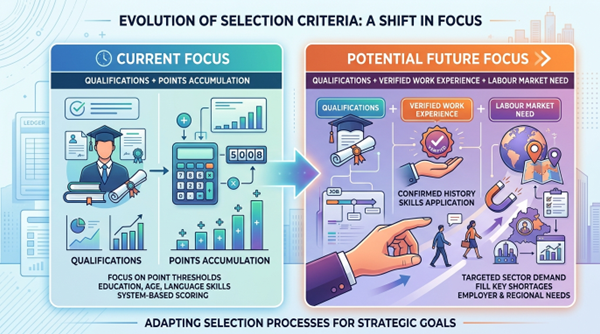
Among all proposed reforms, increased recognition of work experience appears to be gaining the most support.
Rather than rewarding applicants primarily for qualifications and supplementary points categories, future reforms could place greater emphasis on recent and relevant employment history.
Reform Models Under Discussion
While no official changes have been announced, policy discussions appear to be centred around three potential directions for the future skilled migration system.
| Model | Focus | Pros | Cons |
|---|---|---|---|
| Experience-Based | Relevant work history | Rewards proven skills | May not suit recent grads |
| Occupation-Based | Labour shortage | Addresses workforce gaps | Can create demand-driven choices |
| Income-Based | Earnings and economic contributions | Measures workforce success | May overlook socially important professions |
Supporters argue that this approach would better identify migrants who are already demonstrating their skills in real workplaces rather than simply accumulating migration points through study pathways. But critics believe that many essential professions in healthcare, education, childcare, and community services are not always the highest-paid occupations despite their importance to society.
For international students, this could represent an important shift. Choosing a course solely because it appears favourable for migration may become a less effective strategy than building practical experience and employable skills within a chosen profession.
The Subclass 482 Skill in Demand Visa: Top Sponsored Occupations Revealed
Recent data from the Skills in Demand framework under the Subclass 482 visa provides a clear snapshot of where Australian employers are actively seeking overseas talent.
The figure suggests that demand remains widespread across multiple sectors rather than being concentrated in a handful of industries.
Core Skills Stream: Tech, Engineering, and Business Services
| Sector | Key Occupations |
|---|---|
| Healthcare | Registered nurses, residential medical officers |
| Technology | Software engineers, ICT business analysts, ICT support engineers |
| Education | Secondary school teachers |
| Childcare | Childcare workers |
| Engineering & Trades | Motor mechanics, mechanical engineering technicians |
| Business Services | Accountants, recruitment consultants, auditors |
| Hospitality | Chefs, cooks |
| Marketing | Marketing specialists |
The breadth of occupations appearing in sponsorship data highlights an important reality: Australia’s workforce challenges extend far beyond a single industry. For skilled workers, this means they have a stronger chance of receiving employer sponsorship, especially if they have a genuine job offer in hand.
Critical Workforce Pressures: The Demand for Childcare and Aged Care Workers
Among all categories, childcare and aged care continue to be the leading sponsored occupations.
The data reflects ongoing recruitment difficulties across these sectors. Demand for qualified workers has continued to increase while workforce supply has struggled to keep pace.
Aged care presents an even larger challenge.
With the growing senior citizen population in Australia, demand for care services is expected to rise sharply over the coming decades. Workforce projections suggest the sector could require hundreds of thousands of additional workers by mid-century.
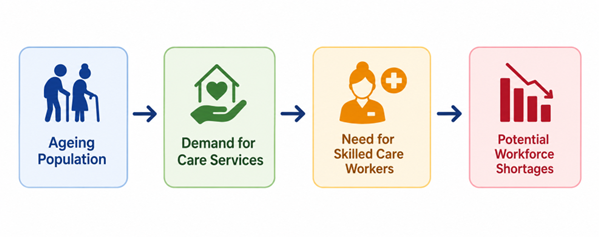
This creates a difficult balancing act for policymakers. Australia wants to maintain control over migration levels while also ensuring that critical sectors have access to the workers needed to support future economic and social demands.
It also highlights one of the concerns surrounding income-based migration models. Many care-related occupations provide essential services but do not always offer salaries comparable to other skilled professions.
Strategic Roadmap: What These Changes Mean for Visa Applicants
For individuals considering skilled migration, the current discussions are not a cause for concern, but they do highlight the importance of planning ahead.
If you intend to pursue a skilled visa, start by evaluating whether your occupation aligns with Australia’s migration priorities.
- Review the relevant occupation lists
- Understand the skills assessment process
- Higher English language scores
- Look for opportunities to strengthen your profile
As policymakers explore ways to better align migration outcomes with labour market needs, applicants may benefit from focusing on the following areas:
| Priority Area | Why It Matters |
|---|---|
| English Language Scores | Improves competitiveness across visa categories |
| Relevant Work Experience | Increasingly aligned with policy direction |
| Skill Assessments | Essential for most skilled pathways |
| Professional Registration | Required in many regulated occupations |
| Local Industry Experience | Demonstrates workforce integration |
For those planning to work and live in Australia, accumulating relevant local experience is important. The factors that can contribute to a more competitive migration pathway includes:
- Internships
- Industry placements
- Professional accreditation
- Strong local references
Applicants exploring the Subclass 482 visa should also recognise that eligibility extends beyond having an occupation on the approved list. While the final direction of Australia’s skilled migration reform remains uncertain, applicants need a genuine job offer from an Australian business for a role that meets sponsorship requirements and relevant qualifications or work experiences.
Actionable Advice for Onshore International Students
For international students, the latest developments reinforce an important lesson: migration policies can change far more quickly than degree programmes.
A qualification that appears attractive from a migration perspective today may not offer the same benefits several years from now.
This is why education decisions should be based on long-term career opportunities rather than short-term migration speculation.
Before committing to a course, students should evaluate not only student visa pathways but also employment prospects, industry demands, licensing requirements, practical training opportunities, and future earning potential.
Questions to Ask Before Selecting a Course
- Does this qualification lead to sustainable employment opportunities?
- Is the occupation likely to remain in demand over the long term?
- Will professional registration or licensing be required?
- Are internship or industry placements available?
- Does the career pathway support future migration goals?
Students who focus on employability first are often better positioned to benefit from future migration opportunities, regardless of policy changes.
Frequently Asked Questions
What is the Subclass 189 Skilled Independent visa in Australia?
The subclass 189 visa is a points-tested permanent residency visa for skilled workers. It doesn’t require employer sponsorship or state nomination. Applicants are invited based on occupation demand and points ranking under SkillSelect.
What is SkillSelect in Australian immigration?
SkillSelect is an online system used by the Australian government to manage skilled migration applications. Applicants submit an Expression of Interest (EOI) and may receive invitations based on ranking and occupation demand.
When is the next 189 visa invitation round in Australia?
Invitation rounds of the subclass 189 visa system are not fixed and are released periodically by the Australian government. The timing depends on occupation ceilings, migration planning levels, and labour market demand.
Is Australia planning to change the skilled migration points system?
Yes, the point system is currently under policy review discussions. Proposed changes focused on giving more weight to real work experience, labour market demand, and economic contribution.
What are the minimum points required for Australia PR in 2026?
There is no fixed universal minimum, but higher-ranked applicants are typically invited first. Competitive occupations often require 65+ points or significantly higher depending on demand.
Can a Subclass 482 visa lead to permanent residency in Australia?
Yes, many 482 visa holders may transition to permanent residency through employer-sponsored PR pathways, provided they meet work experience, occupation, and sponsorship requirements.
Can international students get PR in Australia easily?
PR is not automatic for international students. It depends on occupation demand, qualifications, English score, work experience, and eligibility for skilled visa pathways after graduation.
Final Thoughts
Although the details of the reforms may not be very clear, the overall direction of Australian skilled migration is becoming evident.
Recent Subclass 189 invitation trends, ongoing points test discussions, and employer sponsorship data all point towards a system that places greater value on practical workforce contribution rather than simply accumulating migration points.
For migrants, students, and skilled workers, the message is not necessarily that migration is becoming harder. Rather, it is becoming more closely aligned with Australia’s workforce needs.
Those who invest in genuine skills, relevant experience, and long-term employability are likely to be in the strongest position as the system continues to evolve.
As always, applicants should distinguish between policy discussion and official policy. Until changes are formally announced by the Australian government, major decisions should be based on confirmed information rather than speculation.