Synopsis: Australia’s 2026 immigration settings mark the strictest era for international students. From the new GSR test to a 295,000-visa cap and deeper financial and academic scrutiny, this analysis explains what’s changed, who still qualifies, and practical steps to strengthen applications, document intent, and reduce the risk of rejection.
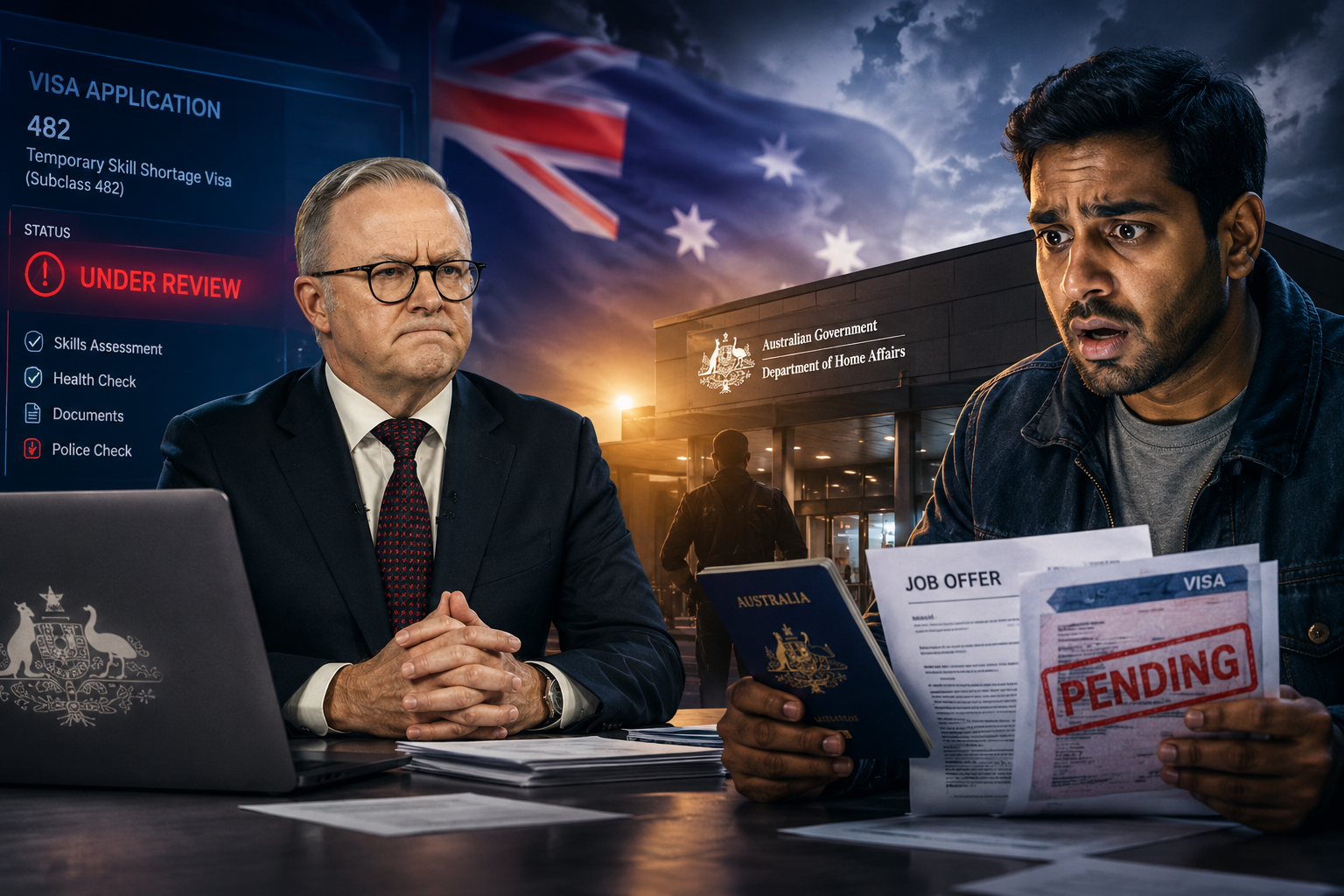
Australia student visa crackdown 2026 will introduce one of the most restrictive student-visa frameworks in the country’s history. Aimed at curbing misuse of the Simplified Student Visa Framework (SSVF), the Australia student visa crackdown 2026 specifically targets loopholes exploited by unregulated agents, influencers, and low-tier colleges.
According to the Department of Home Affairs, these measures form the Australia student visa crackdown 2026 package designed to ensure only genuine international students enter Australia’s education system and to protect academic integrity and national interest. But the consequences are severe: despite Australia’s appeal to South Asian students, the Australia student visa crackdown 2026 could leave more than two-thirds of applicants disappointed.
Let’s break down the real picture—why applying to study in Australia will be harder than ever under the Australia student visa crackdown 2026.

What’s Changing in Student Visa Rules
Australia’s student-visa hierarchy is structured by risk assessment levels. Countries are ranked between Level 1 (lowest risk) and Level 3 (highest risk), based on historical compliance and visa outcomes.
Shift in India’s Risk Category
Until 2024, India was classified as a Level 3 nation, meaning applicants faced intensive document verification and mandatory English-language evidence.
As of 2025, India has been upgraded to Level 2—a relief on paper, but a mixed blessing in practice.
|
Risk Level |
Typical Requirements |
Example Countries |
Implications for Students |
|
Level 1 |
Minimal financial & English proof |
UK, Singapore |
Fast processing |
|
Level 2 |
Moderate checks, partial exemptions |
India, Nepal (2025) |
Selective relaxation |
|
Level 3 |
Full documentation & high scrutiny |
Pakistan, Nigeria |
High rejection rates |
While Level 2 technically reduces the paperwork burden, Australian authorities are simultaneously tightening qualitative checks. It’s no longer enough to show a clean bank statement or IELTS score—the applicant’s entire purpose of study and post-graduation intent will be investigated.
Relaxation or Red Flag?
Many education agents now advertise “no IELTS” or “no funds needed” pathways. These claims are misleading. The risk tool may list fewer mandatory uploads, but universities and visa officers still verify authenticity at the final stage. In short, the leniency is procedural, not substantial.
The 295,000 Visa Cap Explained
Perhaps the most consequential update for 2026 is Australia’s national student-visa issuance cap—set at 295,000 approvals per year.
That means even if a million students apply, only the first quarter of them may actually receive visas.
|
Year |
Total Applications (Projected) |
Visa Cap |
Estimated Rejections |
|
2024 |
850,000 |
None |
120,000 |
|
2025 |
1,050,000 |
330,000 |
720,000 |
|
2026 |
1,200,000 + |
295,000 |
900,000 + |
According to Australian Bureau of Statistics data, education exports contribute over AUD 48 billion annually. Yet, the government is under domestic pressure to reduce population growth, housing demand, and labour exploitation in the student sector.
By capping visas, Canberra hopes to achieve:
- Better regulation of low-tier colleges
- Reduction in student-visa misuse for work migration
- Stabilisation of rental markets in major cities
- Higher education-quality standards
However, this move effectively transforms the student-visa process into a competitive race—only the most credible, well-funded, and academically consistent applicants will make it through.
The New GSR Test and Rejection Reasons
What Is the GSR?
Replacing the earlier Genuine Temporary Entrant (GTE) requirement, the Genuine Student Requirement (GSR) is a structured evaluation designed to test an applicant’s motivation, academic fit, and ties to their home country.
The Australian Government Gazette describes GSR as a “holistic integrity measure” assessing both intent and eligibility.
Key Criteria Under GSR
|
Evaluation Area |
What Officers Look For |
Common Rejection Triggers |
|
Academic Link |
Coherence between past and proposed studies |
Switching unrelated fields |
|
Purpose of Study |
Career relevance & clarity of goals |
Vague or copied statements |
|
Home-Country Ties |
Family, assets, career prospects |
No tangible reason to return |
|
Financial Capability |
Proof of tuition and living costs |
Inconsistent or unverifiable funds |
|
Immigration History |
Compliance with prior visas |
Overstays or previous refusals |
Officers now examine the applicant’s “story of intent.” For instance:
- Why Australia, and not Canada or the UK?
- How does the chosen program relate to prior qualifications?
- What career outcome will it lead to upon return home?
If even one of these questions lacks coherence, the application risks rejection—regardless of IELTS band or bank balance.
English-Language and Fund Verification
Although certain Level 2 universities may not require IELTS or upfront fund proof, the Department of Home Affairs can still request it at the decision stage. Applicants without verifiable English proficiency or financial evidence will face refusal under GSR clause 6.3.
In 2024 alone, over 38% of visa denials cited insufficient evidence of genuine study intent, while 22% were due to financial inconsistency, according to internal data referenced by the Grattan Institute.
Who Should Still Apply in 2026
Despite the tightened framework, genuine, well-prepared applicants still have strong prospects. The key is alignment—academic, financial, and professional.
Ideal Applicant Profile
|
Parameter |
Recommended Benchmark |
|
Academic Background |
Consistent field of study (no large gaps) |
|
English Proficiency |
IELTS 6.5 + or equivalent |
|
Funds Availability |
At least AUD 30,000 – 45,000 for first year |
|
University Tier |
Group of Eight or top-ranked regional universities |
|
Intent |
Clear post-study plan & home-country commitment |
Strategic Advice
- Avoid low-tier or unaccredited institutions. Their acceptance rates are declining fastest.
- Prepare a strong Statement of Purpose (SOP) detailing professional goals linked to your program.
- Provide documented proof of financial capacity—even if not listed as mandatory.
- Address any study gaps with certificates, internships, or employment records.
- Seek transparent counsellors—avoid agents promising “guaranteed visas.”
As competition tightens, self-representation becomes increasingly important. Applicants who personally demonstrate credibility in their GSR interviews fare significantly better than those relying on template-based submissions.
The Rise of the National Innovation Visa (Direct PR Route)
For many aspirants, the long-term goal isn’t just education—it’s settlement. If that’s your case, the National Innovation Visa (NIV) may be a better route.
Overview of the NIV Program
Introduced as part of the National Reconstruction Fund agenda, the NIV (formerly Global Talent Visa) directly grants permanent residency to exceptional individuals in sectors vital to Australia’s economic growth.
|
Category |
Key Fields |
Requirements |
Outcome |
|
NIV-Stream A |
Science, AI, Renewable Energy, MedTech |
Proven record + Australian nominator |
Direct PR |
|
NIV-Stream B |
Digital, Agri-Tech, Advanced Manufacturing |
Strong portfolio + skills assessment |
PR within 12 months |
|
NIV-Stream C |
Academia & Research |
PhD or equivalent + institutional endorsement |
PR + research rights |
Unlike the points-tested Skilled Independent visa (subclass 189), NIV applicants do not need to accumulate scores or spend years studying in Australia. A strong résumé and a credible Australian nominator can yield PR in under a year.
Why NIV May Outperform the Student Route
|
Factor |
Student Visa |
National Innovation Visa |
|
Duration to PR |
4–6 years (study + work) |
6–12 months |
|
Cost |
AUD 60,000 + |
< AUD 10,000 |
|
Dependents |
Conditional |
Fully included |
|
Points Requirement |
Yes |
No |
|
Post-Study Uncertainty |
High |
None |
For skilled professionals in technology, research, or entrepreneurship, NIV offers direct access to permanent residence—no lengthy academic detours required.
Lessons From 2025: What Applicants Are Doing Wrong
Australia’s Department of Education recently flagged alarming trends in visa misuse. A growing number of applicants falsify documents or use “ghost agents.” Influencer-led misinformation on social media has worsened the issue.
Common pitfalls include:
- Submitting fake bank statements for “show funds.”
- Applying to low-reputation colleges with no campus infrastructure.
- Relying on agents promising “visa on admission.”
- Ignoring English-language verification till the final stage.
In 2025, nearly 72,000 student-visa refusals were linked to unverifiable documentation. These patterns led to the government’s decision to integrate AI-based risk assessment into visa processing from 2026 onward.
Illustration: How AI Risk Profiling Works
Applicant Data → Academic Match → Financial Verification → GSR Scoring → Risk Flag → Decision Outcome
Each application will be auto-scored using an internal “Visa Integrity Index.”
Low scores trigger human review, further delaying processing times.
What International Students Can Expect in 2026
Processing Timeline and Costs
|
Stage |
Typical Duration |
Key Cost (AUD) |
Notes |
|
University Offer Letter |
1–3 weeks |
Application fees 150–200 |
Fast for top universities |
|
COE & Health Check |
2–4 weeks |
350 – 500 |
Must clear medical exam |
|
Visa Lodgement & Interview |
4–8 weeks |
710 visa fee + biometrics |
GSR test integrated |
|
Final Decision |
2–4 months |
— |
Subject to cap quota |
Policy Impact Summary
- Higher Rejection Probability: Projected ≈ 70 % for unqualified applicants.
- Fewer Part-Time Work Rights: Post-study work limited to critical sectors.
- Stricter Attendance & Compliance Monitoring.
- Potential Fee Increase: Student-visa charge may rise beyond AUD 800.
For many students, these changes transform the journey into an elite-only pathway, much like the UK’s tightening of its Graduate Route.
Why Australia Is Doing This: The Bigger Policy Picture
Behind every policy shift lies domestic politics. Australia’s housing crisis, rising rents, and underemployment among local graduates have fuelled public debate.
According to the Parliament of Australia Research Paper Series, temporary migration—including students—now accounts for nearly 6 % of the national population. Political consensus is emerging to prioritise “quality over quantity.”
Key Government Objectives
- Reduce net migration by 35 % by 2027.
- Rebuild trust in the education export sector.
- Support domestic workforce development.
- Counter exploitation by unscrupulous education providers.
This realignment follows similar measures in Canada and the UK, where both countries have tightened post-study pathways in 2024–2025. Australia is, effectively, following suit.
Should You Still Choose Australia in 2026?
Yes—but with preparation and realism. The golden rule is authenticity. Australia’s doors remain open to genuine scholars and innovators who contribute positively to society.
Step-by-Step Readiness Checklist
|
Requirement |
Action Point |
Verification Source |
|
English Proof |
Take IELTS/TOEFL/PTE |
|
|
Financial Capacity |
Maintain audited bank statements |
Bank/Loan letter |
|
Academic Coherence |
Align course with past degree |
University transcripts |
|
SOP / Intent |
Write an original, detailed SOP |
Self-draft or certified editor |
|
Post-Study Plan |
Define career link to home country |
Employment/Business plan |
Remember: Genuine intent is now measurable. The GSR system analyses consistency between your narrative, qualifications, and financial reality.
The Long-Term Alternative: Skill-Based Migration Pathways
For those primarily seeking permanent settlement, several skill-migration options are preferable to the student route.
|
Visa |
Pathway |
Key Benefit |
PR Timeline |
|
Skilled Independent (189) |
High-demand occupations |
No sponsorship required |
12–18 months |
|
Skilled Nominated (190) |
State-nominated |
Bonus points + PR |
1–2 years |
|
Regional (491) |
Rural sponsorship |
Lower cost, higher chance |
3 years |
|
NIV (Direct PR) |
Exceptional talent |
No points test |
< 1 year |
Applicants with technical, research, or digital skills should evaluate these alternatives before investing in expensive degrees.
Illustration: Comparative Cost of Visa Pathways
|
Visa Type |
Tuition/Cost (AUD) |
Duration |
PR Eligibility |
Risk Level |
|
Student Visa |
60,000 + |
2–4 years |
Conditional |
High |
|
Graduate Visa |
25,000 |
2 years work |
Indirect |
Medium |
|
Skilled 189/190 |
8,000 – 10,000 |
1–2 years |
Direct |
Moderate |
|
National Innovation Visa |
< 10,000 |
6–12 months |
Direct |
Low |
The Human Impact: Voices From the Ground
Recent testimonies from student associations paint a mixed picture.
“Our members are confused—agents still promise easy approvals while universities give contradictory advice,” says Dr Mira Patel, spokesperson for the Australian International Students Forum (AISF).
A report by Universities Australia shows that dropout rates among first-year international students rose 18 % in 2024 due to financial stress and lack of post-study opportunities.
The 2026 reforms aim to filter out such vulnerable cases early—but they may also deter deserving applicants.
How to Strengthen Your Profile Before Applying
- Upgrade your academic credentials. Take short professional courses aligned with your target degree.
- Secure a pre-admission scholarship or merit certificate. It adds credibility to your intent.
- Show community or professional engagement in your home country to prove return motivation.
- Maintain transparent digital footprints. Visa officers now review LinkedIn and online profiles for authenticity.
- Use verified education agents listed on the official Australian Government’s MARA Register.
By demonstrating preparedness, you improve your GSR score even before lodging the visa.
Final Advice Before Applying
The bottom line is clear: Australia still values international education—but no longer tolerates shortcuts.
If you’re committed, academically qualified, and financially ready, your chances remain strong.
However, if you’re relying solely on influencer advice or hoping for a “no-IELTS, no-funds” miracle, 2026 will likely end in rejection.
“Don’t come to Australia without realizing the direction things are moving,” warns multiple education experts.
Each refusal not only wastes a year but also leaves a permanent mark on your immigration record.
Key Takeaways: The 2026 Student Visa Reality Check
|
Issue |
2025 Status |
2026 Change |
Impact |
|
Risk Level (India) |
Level 3 |
Level 2 |
Fewer docs, more scrutiny |
|
Visa Cap |
330,000 |
295,000 |
Intense competition |
|
GSR Requirement |
Optional GTE |
Mandatory Test |
High-stakes screening |
|
IELTS/Funds |
Flexible |
Case-by-case verification |
Rejections up |
|
Alternative Route |
Graduate Visa |
National Innovation Visa |
Direct PR option |
The Future of Studying in Australia
Australia’s education landscape is evolving from open-door to selective-entry.
For genuine, high-achieving students, opportunities remain abundant. But for those seeking easy migration loopholes, the system has closed.
Before applying in 2026, ask yourself:
- Does my academic path make sense?
- Can I justify my financial and career plans?
- Am I prepared for a more rigorous integrity test?
If the answer is yes, proceed confidently—Australia still welcomes genuine talent. If not, pause, prepare, and rebuild your profile first.
Because in 2026, Australia won’t reject you for lack of luck—it will reject you for lack of credibility.