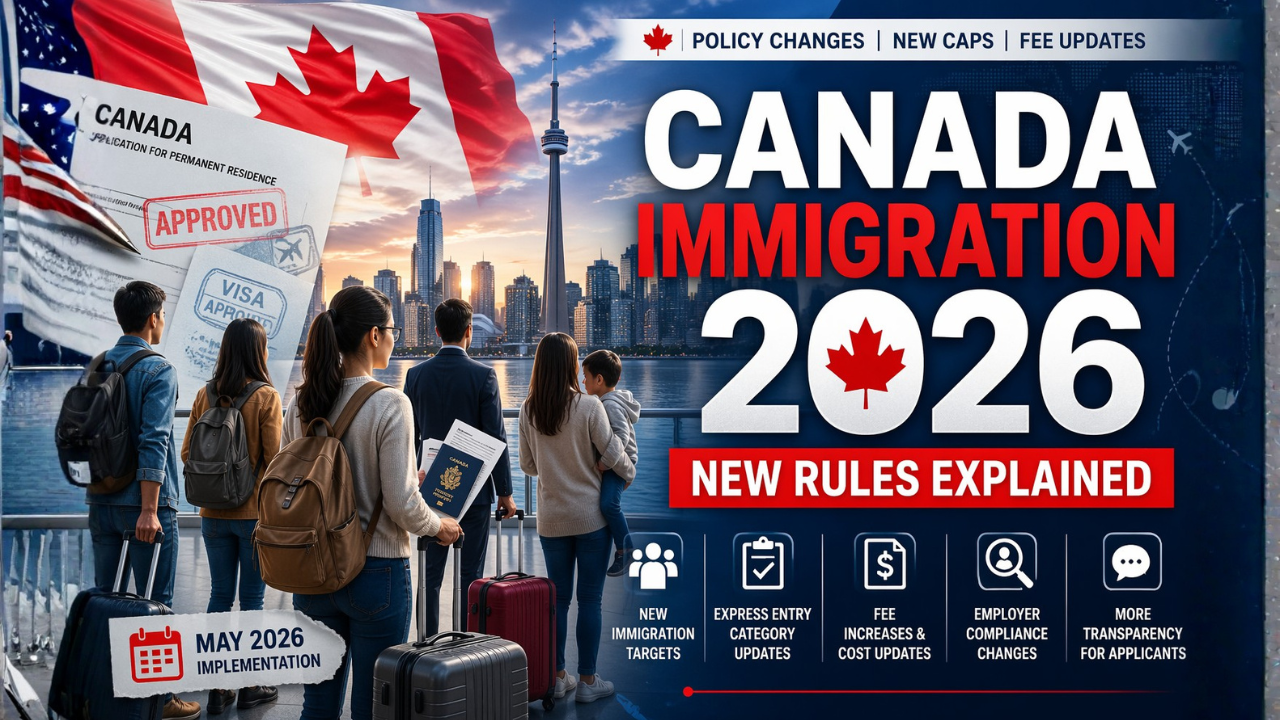
Synopsis: Canada’s new Liberal government under Mark Carney will stabilize immigration by capping permanent and temporary resident levels, prioritize Francophone immigration outside Quebec, modernize processing, and enhance border security-balancing economic needs with housing and infrastructure pressures.
Canada stands at a pivotal crossroads in its immigration journey. Following the 2025 federal election, the Liberal Party, led by Mark Carney, is set to form a government with a bold mandate: to recalibrate Canada’s immigration system for sustainable growth, economic resilience, and social harmony. With immigration having shaped the country’s demographic and economic landscape for decades, the proposed reforms signal a significant shift in both tone and substance.
This in-depth blog unpacks the Carney government’s vision, the rationale behind the changes, and what these policies mean for newcomers, employers, and Canadian society at large.
Table of Contents
- Introduction: The Context for Change
- The Liberal Vision: Balancing Growth and Sustainability
- Permanent Resident Admissions: A New Cap
- Temporary Residents: Reducing the Proportion
- Francophone Immigration: Building French-Speaking Communities
- Economic Immigration: Supporting Labour Market Needs
- Modernizing the System: Digital Tools and Efficiency
- Asylum, Refugees, and Legal Aid
- Border Security and Integrity
- Comparing Liberal and Conservative Approaches
- Implications for Stakeholders
- Conclusion

The Context for Change
Immigration has long been a cornerstone of Canada’s identity and economic strategy. In recent years, however, surging immigration levels-especially during and after the COVID-19 pandemic-have sparked public debate about housing shortages, infrastructure strain, and social cohesion. As of early 2025, temporary residents made up approximately 7.25% of the population, and permanent resident admissions were at all-time highs127.
Mark Carney, a former Bank of Canada and Bank of England governor, now takes the helm as Prime Minister, promising to align immigration with the country’s capacity to absorb newcomers. “We had much higher levels of foreign workers, students, and new Canadians coming in than we could absorb-than we had housing for, healthcare for, social services for, and than we have opportunities for,” Carney stated in late 20245.
The Liberal Vision: Balancing Growth and Sustainability
The Liberal Party’s 2025 platform acknowledges that previous policies led to “unsustainable” immigration levels, straining public services and housing21315. Their new approach seeks to:
- Stabilize permanent resident admissions at less than 1% of Canada’s population annually beyond 2027.
- Reduce temporary residents to below 5% of the population by end of 2027.
- Increase Francophone immigration outside Quebec to 12% by 2029.
- Modernize immigration processing through digital tools.
- Enhance border enforcement and integrity.
This vision is rooted in the belief that immigration should support economic growth without overwhelming infrastructure or social systems.
“Immigration caps will remain in place until we’ve expanded housing, and we’ve reabsorbed the levels of immigration that have happened in our country (during the pandemic).”
Permanent Resident Admissions: A New Cap
Stabilizing Numbers
The Liberals plan to cap annual permanent resident (PR) admissions at less than 1% of the national population beyond 2027-a move that aligns with the current Immigration Levels Plan1246131516. For context:
| Year | PR Target | % of Population (est. 41.5M in 2025) |
| 2025 | 395,000 | 0.95% |
| 2026 | 380,000 | 0.91% |
| 2027 | 365,000 | 0.88% |
This represents a measured decrease from pandemic-era peaks, aiming to “get back on track” and ease pressure on housing and services2131516.
Economic Class Focus
By 2027, nearly 62% of PR admissions will be in the economic class, prioritizing skilled workers, healthcare professionals, and trades467. Over 40% of new PRs are expected to be former temporary residents already in Canada, reflecting a shift toward “in-Canada” transitions47.
Family Reunification and Humanitarian Streams
Family reunification remains a priority, with about 22% of PR spots reserved for spouses, partners, children, parents, and grandparents. Humanitarian admissions-including refugees and protected persons-are targeted at 68,350 in 2025, falling to 58,650 by 202767.
Temporary Residents: Reducing the Proportion
Canada’s temporary resident population-including international students and temporary foreign workers-has surged in recent years, reaching 7.25% of the population in early 2025127. The Carney government aims to reduce this to below 5% by the end of 202712717.
How Will This Be Achieved?
- Capping new arrivals: Targets for new temporary resident arrivals are set at 673,650 in 2025, 516,600 in 2026, and 543,600 in 20277.
- Transitioning to PR: Many temporary residents will be encouraged to transition to permanent status, especially those already working or studying in Canada47.
- Permit Expiry and Departures: Others will leave as their permits expire, particularly with tighter eligibility for study and work permits7.
Policy Levers
- Study Permit Caps: Intake caps on most study permit applications, higher cost-of-living requirements for students, and stricter eligibility for post-graduation work permits716.
- Temporary Foreign Worker Program (TFWP): New restrictions on the low-wage stream and alignment with labor market needs7.
- International Mobility Program (IMP): Adjustments to spouse and open work permits for international students and foreign workers7.
Francophone Immigration: Building French-Speaking Communities
A major pillar of the Liberal platform is to increase Francophone immigration outside Quebec to 12% by 2029-well above current federal targets of 8.5% in 2025, 9.5% in 2026, and 10% in 202712614. This aims to:
- Strengthen French-speaking communities across Canada.
- Address demographic and economic needs in minority Francophone regions.
- Support national bilingualism and cultural diversity.
Recent Data: In 2024, Canada exceeded its Francophone immigration target for the first time, reaching 7.21% of admissions outside Quebec14.
“Canada’s Express Entry system, immigration targets, and federal funding all reflect a shift toward supporting Francophone minority communities and ensuring French speakers have more accessible immigration pathways.”
Immigration, Refugees and Citizenship Canada14
Express Entry Advantage for French Speakers
In 2025, French-speaking candidates received Invitations to Apply (ITAs) at much lower Comprehensive Ranking System (CRS) scores than other applicants, making French proficiency a significant advantage14.
Economic Immigration: Supporting Labour Market Needs
The government’s approach to economic immigration is twofold:
- Prioritize in-Canada applicants: Over 40% of new PRs will be former temporary residents, especially those with Canadian work or study experience47.
Global Skills Strategy
The Liberals plan to update the Global Skills Strategy to help employers attract international talent through fast-track work permit processing2815. This includes:
- Two-week processing times for qualifying firms.
- Work permit exemptions for high-skilled foreign nationals on short-term assignments8.
- Simplified credential recognition for skilled workers from the U.S. and elsewhere15.
Modernizing the System: Digital Tools and Efficiency
Processing delays and backlogs have plagued Canada’s immigration system. The Carney government is committed to leveraging digital tools to improve efficiency2915.
Key Initiatives
- Online application status trackers for Express Entry, Provincial Nominee Program, and family sponsorships9.
- Expanded digital services for applicants and representatives.
- Automated information sharing with the U.S. for faster, more secure screening12.
“Improving online tools is critical to the Government of Canada’s efforts to improve customer service.”
Immigration, Refugees and Citizenship Canada9
Asylum, Refugees, and Legal Aid
Canada remains committed to humanitarian immigration, with targets for refugees and protected persons at 58,350 in 202767. The Liberals also pledge to:
- Provide legal aid to asylum seekers and refugees for timely access to legal advice.
Legal Aid Ontario and similar agencies will continue to support claimants through hearings, appeals, and judicial reviews, ensuring access to justice for vulnerable newcomers10.
Border Security and Integrity
Border management is a top priority for the new government. Recent measures include:
- $1.3 billion investment to strengthen the Canada-U.S. border, including new drones, surveillance towers, and advanced screening technology11.
- Enhanced information sharing with U.S. authorities for visa and immigration data12.
- New powers for immigration officers to cancel temporary resident documents (eTAs, TRVs) in cases of inadmissibility or fraud12.
“Border security is a top priority across the Government of Canada. The progress on the immigration integrity side complements enforcement action, as well as new detection and deterrence tools, and contingency plans should there be an increase in irregular migration at the border.”
The Honourable David J. McGuinty, Minister of Public Safety11
Comparing Liberal and Conservative Approaches
Immigration was a defining issue in the 2025 federal election. While both major parties recognized the need for reform, their approaches diverged:
| Policy Area | Liberal Party (Carney) | Conservative Party (Poilievre) |
| PR Admissions | Cap at <1% of population post-2027 | Significant reductions |
| Temporary Residents | Reduce to <5% of population by 2027 | Stricter controls, lower caps |
| Economic Immigration | Prioritize in-Canada transitions, critical sectors | More selective, focus on capacity |
| Francophone Immigration | Increase to 12% outside Quebec by 2029 | Less emphasis |
| System Modernization | Digital tools, faster processing | Efficiency, but stricter vetting |
| Border Security | Tech investments, info-sharing, removals | More enforcement, tighter borders |
Both parties agree on the need for sustainable growth, but the Liberals emphasize balancing economic needs with infrastructure, while Conservatives focus on capacity and stricter controls3.
Implications for Stakeholders
For Newcomers
- PR applicants should expect more competitive selection, especially for economic and Francophone streams.
- Temporary residents (students, workers) will face tighter eligibility and caps.
- French-speaking candidates have a clear advantage in Express Entry and some PNPs14.
For Employers
- Critical sectors (healthcare, trades, tech) will benefit from streamlined pathways.
- Credential recognition improvements will help recruit U.S. and international talent15.
- Global Skills Strategy updates will allow faster hiring for in-demand roles8.
For Canadian Society
- Housing and public services may see relief as immigration levels stabilize.
- Francophone communities outside Quebec will grow, supporting bilingualism and cultural diversity.
- Border security enhancements aim to maintain public trust in the system.
Conclusion
Mark Carney’s Liberal government is embarking on the most significant recalibration of Canada’s immigration policies in a generation. By capping permanent and temporary resident levels, prioritizing Francophone and economic-class immigration, modernizing processing, and investing in border security, the new administration seeks to balance the country’s economic ambitions with its capacity to welcome and integrate newcomers.
As implementation unfolds, the world will watch how Canada navigates the complex interplay of growth, inclusion, and sustainability-a model for immigration reform in the 21st century.
“We must preserve the integrity of our immigration system so it remains well-managed, sustainable and trusted by Canadians.” The Honourable Marc Miller, Minister of Immigration, Refugees and Citizenship11