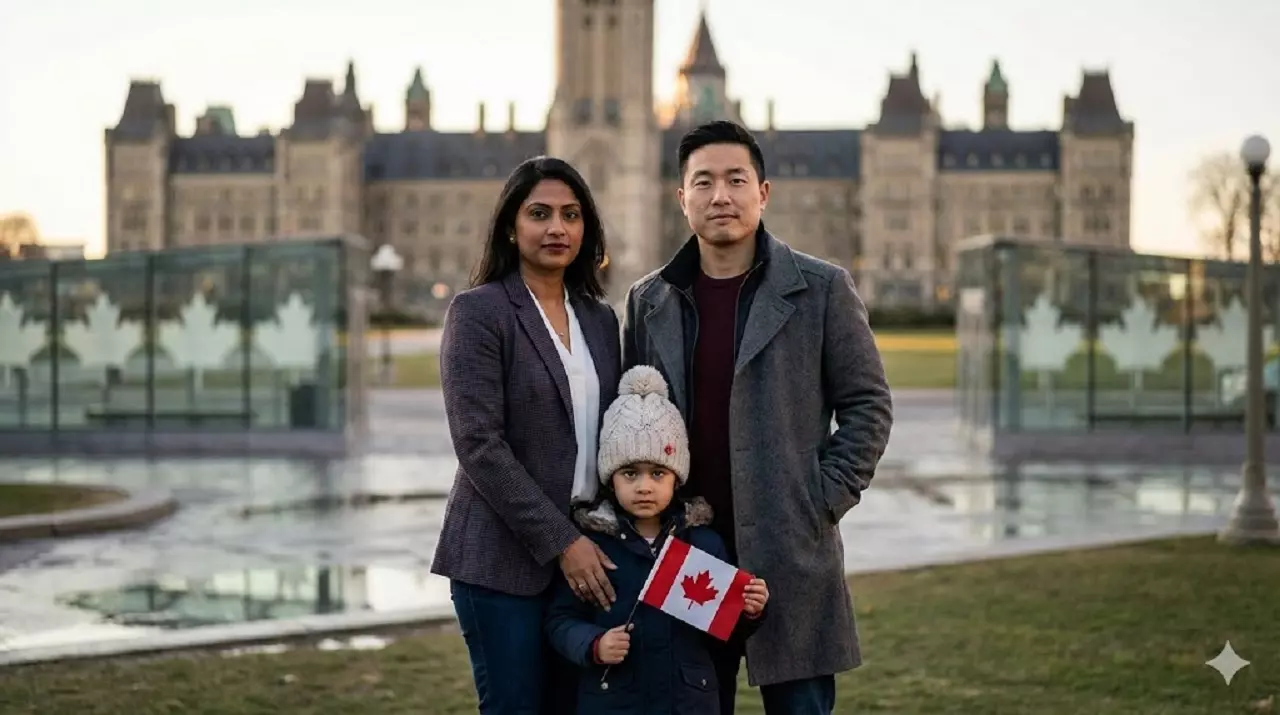
Synopsis: Canada’s Bill C-3 marks a major shift in citizenship law, correcting decades of exclusion caused by the first-generation limit. By restoring citizenship rights and introducing a clearer, fairer framework for families abroad, the reform reshapes how Canadian identity, belonging, and legal ties are defined in a globalised world.
Canada’s New Citizenship Law Ends the First-Generation Limit for Families Abroad
Canada’s citizenship framework has quietly but decisively crossed a historic threshold. With Bill C-3 now in force, thousands of people once excluded by technicalities are finally recognised as Canadians, while future generations gain a clearer and fairer path to citizenship by descent. This reform carries urgency because it directly addresses constitutional failings, family separation, and long-standing legal uncertainty—issues that have affected Canadians worldwide for over a decade. The changes align Canada’s citizenship law with modern family realities and global mobility, as outlined by the Government of Canada and detailed on the official Immigration, Refugees and Citizenship Canada (IRCC) website.
At stake is more than paperwork. Citizenship determines political rights, mobility, access to services, and a sense of belonging. For families split across borders, these reforms resolve years of confusion and, in many cases, injustice. Why did the old rules fail? What exactly has changed? And will this new framework stand the test of time?

Understanding the Policy/Event
Canada’s citizenship rules have evolved unevenly since the first Citizenship Act of 1947. While early legislation sought to define a national identity distinct from Britain, it also embedded rigid assumptions about residence, legitimacy, and lineage. Over time, these assumptions clashed with global migration, dual citizenship, and increasingly international family structures.
Bill C-3, which came into effect on December 15, 2025, amends the Citizenship Act to address one of its most controversial features: the first-generation limit to citizenship by descent. Introduced in 2009, this rule prevented Canadian parents who themselves were born or adopted abroad from automatically passing citizenship to their children born outside Canada.
The result? Entire families discovered—often years later—that their children were not Canadian in law, despite deep and genuine ties to the country.
Why It Is Happening
The immediate catalyst for reform was legal, not political. In December 2023, the Ontario Superior Court of Justice ruled that key aspects of the first-generation limit were unconstitutional, finding that they produced unfair and discriminatory outcomes for children of Canadians born abroad. The federal government chose not to appeal, effectively acknowledging that the law no longer met constitutional or social standards.
But the deeper reason lies in demographic and social change:
- Canadians increasingly study, work, and form families abroad
- Dual citizenship and transnational households are now common
- Rigid descent rules failed to reflect lived realities
In this context, the old law was not merely outdated—it was actively harmful.
Key Reforms or Changes
Bill C-3 introduces two core reforms: retrospective recognition and a prospective framework for citizenship by descent. Together, they reshape how citizenship is acquired, restored, and transmitted across generations.
First, individuals born before December 15, 2025, who would have been citizens if not for the first-generation limit or other obsolete provisions, are now legally recognised as Canadian citizens. They may apply for proof of citizenship without re-litigating their status.
Second, the law establishes a consistent rule for future cases, allowing citizenship to pass beyond the first generation under defined conditions.
Detailed Breakdown
The new framework can be summarised as follows:
1. Restoration of citizenship
People previously excluded due to the first-generation limit are now deemed Canadian citizens in law. This includes many individuals commonly referred to as “Lost Canadians.”
2. A three-year presence requirement
A Canadian parent born or adopted abroad may pass citizenship to a child born or adopted outside Canada if they can demonstrate at least three years of physical presence in Canada before the child’s birth or adoption.
3. No need for reapplication
Applicants who already submitted citizenship certificate applications under interim measures do not need to reapply. Their cases will be processed under the new law.
4. Emphasis on real ties to Canada
The reform reinforces the principle that citizenship by descent should reflect genuine connections—not mere formal status.
For legal clarity, these changes are embedded directly into the Citizenship Act, ensuring statutory rather than discretionary protection.
Data, Stats, and Trends
Understanding the significance of Bill C-3 requires context. Canada has repeatedly revisited citizenship rules to correct unintended exclusions, often years after harm occurred.
The 1947 Citizenship Act stripped or denied citizenship to many groups, including women who married foreign nationals and children born abroad under restrictive conditions. Subsequent reforms in 2009 and 2015 attempted to address these gaps but introduced new problems.
What the Numbers Show
Several data points illustrate the scale of the issue:
- Around 20,000 people sought proof of citizenship following the 2009 and 2015 amendments
- Thousands more were affected by the first-generation limit between 2009 and 2023
- A significant proportion of affected families were living abroad due to education, employment, or caregiving obligations
Legal scholars note that many cases only surfaced when individuals applied for passports, security clearances, or social benefits—sometimes decades after birth.
The 2023 court ruling highlighted how these numbers were not merely administrative anomalies but indicators of systemic exclusion.
Impact Assessment
The real impact of Bill C-3 is human. Citizenship law may appear technical, but its consequences shape daily life, opportunity, and identity.
For families abroad, the reform resolves uncertainty. For individuals long excluded, it restores dignity and legal recognition. For Canada, it reaffirms a commitment to inclusive citizenship grounded in fairness rather than accident of birthplace.
Social, Economic, and Human Consequences
Social impact
Families separated by citizenship status can now plan futures with greater certainty. Children previously treated as foreigners in their parents’ country gain full recognition.
Economic impact
Citizenship status affects access to employment, education, and mobility. By resolving ambiguous status, the reform reduces long-term administrative and legal costs for both individuals and the state.
Human consequences
Perhaps most importantly, the reform addresses psychological harm. Many affected individuals described feeling “conditionally Canadian” under the old law. Bill C-3 removes that conditionality.
These outcomes align with broader international norms emphasising child rights and family unity, principles long championed by bodies such as the United Nations Convention on the Rights of the Child.
Political Background & Stakeholder Reactions
Politically, Bill C-3 represents an unusual moment of consensus. While immigration policy is often polarising, this reform attracted broad agreement across parties and institutions.
The government’s decision not to appeal the 2023 ruling signalled a clear acceptance that the law had failed in practice. Stakeholders ranging from immigration lawyers to diaspora groups welcomed the change, though some raised concerns about implementation.
Government, Opposition & Expert Opinions
The Minister of Immigration framed the reform as a reflection of modern Canadian life, emphasising that mobility does not weaken national ties. Opposition parties largely supported the bill, though some questioned whether the three-year presence requirement might still exclude certain families.
Legal experts broadly endorsed the reform while noting that future litigation could test its boundaries—particularly around evidence of physical presence and adoption scenarios.
Civil society groups representing Canadians abroad praised the clarity of the new rules, calling them a long-overdue correction.
Global Comparisons
Canada is not alone in grappling with citizenship by descent in a globalised era. Many countries have revised nationality laws to balance inclusivity with meaningful connection.
Where This Stands Internationally
Comparatively:
- United Kingdom: Allows citizenship transmission abroad but imposes complex residence and registration requirements
- Australia: Limits descent but provides discretionary pathways based on parental ties
- India: Does not allow citizenship by descent beyond specific categories, relying instead on overseas citizenship schemes
Canada’s approach under Bill C-3 places it among jurisdictions seeking a middle ground—neither unlimited transmission nor rigid exclusion.
By embedding a clear presence requirement, Canada aligns citizenship with lived connection rather than symbolic lineage, a principle increasingly reflected in comparative nationality law scholarship published by institutions such as the Migration Policy Institute.
Critical Analysis
While Bill C-3 corrects major flaws, no citizenship framework is beyond critique. The three-year presence requirement, though clearer than previous rules, may still disadvantage families with complex migration histories.
Questions remain:
- How strictly will physical presence be interpreted?
- Will documentation requirements create new barriers?
- Could future governments revisit or narrow these provisions?
The law’s success will depend less on its text than on its administration.
Will It Work?
In principle, Bill C-3 addresses the constitutional defects identified by the courts and restores fairness to citizenship by descent. Its effectiveness will hinge on consistent processing, clear guidance, and a willingness to interpret ties to Canada realistically rather than rigidly.
If implemented thoughtfully, the reform has the potential to become a durable model—one that recognises both national sovereignty and global family life.
Conclusion
Bill C-3 represents a decisive recalibration of Canadian citizenship law. By ending the harshest effects of the first-generation limit and restoring rights to those long excluded, Canada has taken a significant step toward fairness, clarity, and constitutional integrity.
For Canadians at home and abroad, the message is clear: citizenship is not diminished by mobility. Instead, it is strengthened when law reflects lived reality. As applications are processed under the new rules, the true measure of this reform will be whether it delivers not just legal status, but lasting trust in Canada’s citizenship system.