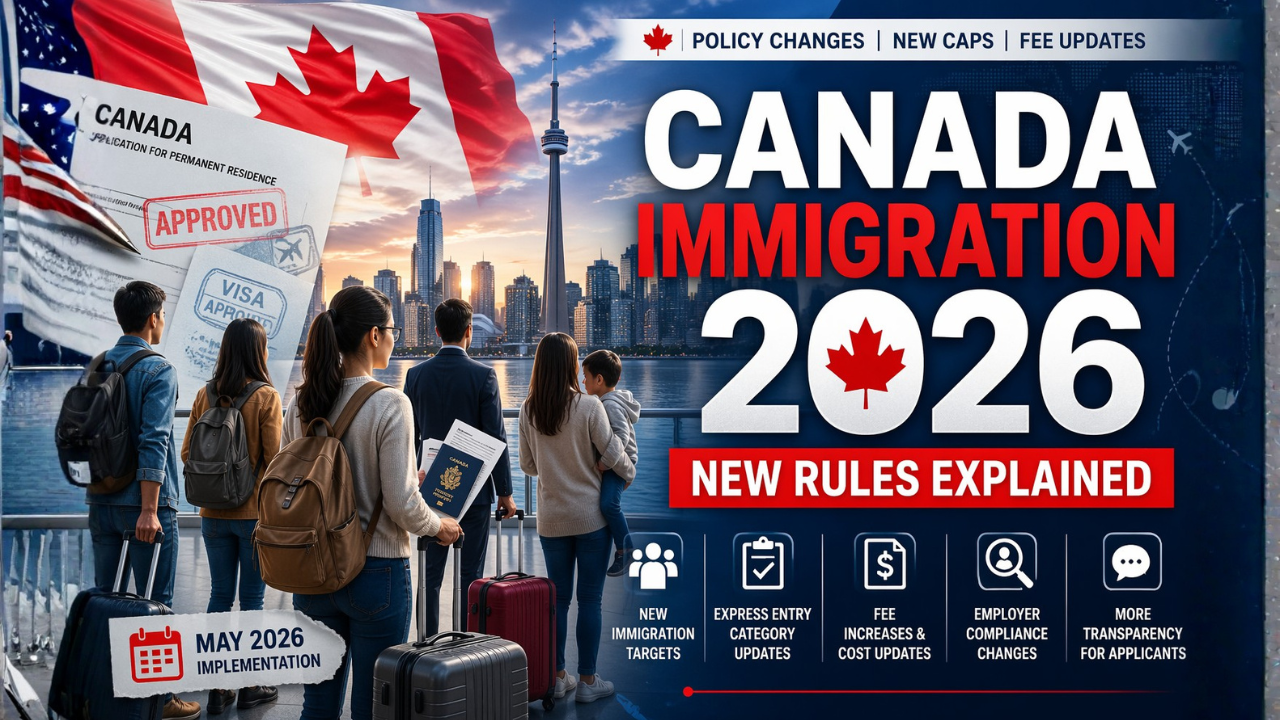
Synopsis: Canada’s 2026 immigration reset introduces new Express Entry categories for researchers, transport workers, senior managers, and military recruits while reducing temporary residents and tightening asylum rules. The reforms aim to restore public confidence, ease housing pressure, and align immigration with labour shortages and national priorities.
Introduction
Canada’s immigration system is entering one of its most significant recalibration phases in modern history. After record population growth, housing strain, and mounting public debate, the federal government has unveiled major 2026 Express Entry reforms aimed at restoring balance and rebuilding trust. According to official updates from Immigration, Refugees and Citizenship Canada (IRCC), the government is shifting from expansion-driven immigration to disciplined, targeted selection aligned with national capacity.
The government successfully met its 2025 permanent resident target of 393,500 admissions. However, the new framework reduces temporary resident levels, tightens asylum pathways, and introduces occupation-specific categories within Express Entry.
Is this a correction — or a structural transformation?
This long-form analysis examines the policy reset in detail.

Understanding the Policy/Event
Canada’s February 18, 2026 announcement introduces new Express Entry categories while reinforcing population stabilization targets.
Express Entry remains Canada’s primary economic immigration system, managing:
- Canadian Experience Class
- Federal Skilled Worker Program
- Federal Skilled Trades Program
Candidates are ranked using the Comprehensive Ranking System (CRS).
However, the broader policy shift includes:
- Reducing permanent resident intake to below 1% of total population
- Lowering temporary residents to under 5% by 2027
- Modernizing asylum rules
- Prioritizing high-impact sectors
Why It Is Happening
Post-pandemic immigration accelerated sharply to address labour shortages and economic recovery. But rapid population growth also intensified:
- Housing supply shortages
- Infrastructure strain
- Public service congestion
Recent data from Statistics Canada confirms record population growth in the post-pandemic period, adding urgency to policy recalibration.
The government’s mandate is clear:
Restore control.
Reduce temporary overstretch.
Rebuild public confidence.
Key Reforms or Changes
The 2026 Express Entry reforms sharpen occupational targeting.
Detailed Breakdown
Continued Priority Categories
IRCC will continue category-based draws for:
- French-speaking candidates
- Healthcare professionals
- Skilled trades
- STEM occupations
Healthcare includes nurse practitioners, dentists, pharmacists, and psychologists. Trades include carpenters and machinists. STEM includes engineers and cybersecurity specialists.
New Express Entry Categories for 2026
The most significant updates include:
- Researchers and Senior Managers with Canadian Experience
This aligns with Canada’s $1.7 billion innovation initiative announced through Innovation, Science and Economic Development Canada. - Transport Occupations
Including pilots, aircraft mechanics, and inspectors — strengthening supply chains and trade resilience. - Skilled Military Recruits
Foreign applicants with job offers from the Canadian Armed Forces may qualify, subject to security vetting under the Immigration and Refugee Protection Act.
- Foreign Medical Doctors with Canadian Experience
A dedicated pathway supports retention of physicians and improves healthcare access nationwide.
Temporary Resident Reduction Strategy
The government is reducing:
- International student intake
- Temporary foreign worker arrivals
Temporary residents are targeted to fall below 5 percent of Canada’s total population by 2027.
However, caps have been lifted for:
- Graduate programs
- PhD-level international students
This indicates a quality-focused rather than volume-focused strategy.
Asylum Modernization
Canada remains a signatory to the UN Refugee Convention. However, the government is tightening visa integrity measures.
According to official asylum statistics published by the Canada Border Services Agency, asylum claims declined by roughly one-third in 2025 following stricter screening measures.
New legislative proposals restrict eligibility for individuals who have remained in Canada for extended periods without filing claims.
Data, Stats, and Trends
Policy recalibration is supported by measurable indicators.
What the Numbers Show
Key figures include:
- 393,500 permanent residents admitted in 2025
- Over 50% reduction in temporary worker and student arrivals compared to 2024
- One-third decline in asylum claims
- Nearly 9% francophone immigration outside Quebec
Rental markets in Toronto and other major cities have shown early stabilization signs amid lower intake levels.
Economic evidence shows:
- Immigrants have founded more than half of Canada’s billion-dollar companies
- International graduates earn approximately $35,000 more annually than non-Canadian educated peers
The policy goal is not to reduce contribution — but to manage pace.
Impact Assessment
The consequences of these reforms extend across sectors.
Social, Economic, and Human Consequences
Housing
Lower intake may ease rental pressures in urban centres.
Labour Market
Targeted categories aim to:
- Fill healthcare shortages
- Support infrastructure projects
- Expand AI and advanced technology sectors
Universities
International student caps introduced in 2024 created funding pressures. The removal of caps for graduate and PhD students reflects strategic prioritization of research talent.
Employers
Predictability is central. Stable targets allow workforce planning without abrupt policy shifts.
Political Background & Stakeholder Reactions
Immigration intersects with national security, housing, and economic growth.
Government, Opposition & Expert Opinions
The government frames the reforms as disciplined correction.
Business leaders welcome:
- Faster 14-day processing for researchers
- Clearer category-based draws
Provincial leaders support improved collaboration and credential recognition reforms.
Critics warn of:
- Population decline risks
- University revenue shortfalls
Public sentiment has increasingly favoured stabilization over rapid expansion.
Global Comparisons
Canada’s approach differs from peers.
Where This Stands Internationally
The United States continues to face employment-based visa backlogs under U.S. Citizenship and Immigration Services.
The United Kingdom has tightened net migration under the UK Home Office.
Australia has recalibrated skilled migration through the Australian Department of Home Affairs.
Canada’s distinguishing characteristics include:
- Rapid policy adjustment
- Transparent numeric targets
- Sector-based selection
Rather than closing its doors, Canada is narrowing its focus.
Critical Analysis
The core question remains:
Can Canada reduce intake while maintaining global competitiveness?
Will It Work?
Strengths:
- Clear population caps
- Alignment with housing capacity
- Focus on healthcare and innovation
- Reinforced public confidence
Risks:
- Labour shortages if reductions overshoot
- University financial strain
- Slower GDP growth if population declines sharply
Execution will determine outcomes.
Policy design is strong.
Implementation discipline will decide success.
Conclusion
Canada’s 2026 Express Entry reforms represent a strategic pivot, not a retreat.
The government has:
- Met 2025 targets
- Reduced temporary inflows
- Introduced new occupation-based categories
- Tightened asylum integrity
For international workers and students, the message is clear:
Canada remains open — but selectively, strategically, and sustainably.
The coming years will determine whether this disciplined reset strengthens Canada’s long-term economic position while restoring public confidence in one of the country’s most defining policy areas.