
Synopsis: This comprehensive guide examines Statement of Changes HC 259 and its critical impact on UK ILR applications for children. Designed for families and legal practitioners ahead of the 3 August 2026 effective date, it breaks down the latest rule modifications, practical eligibility criteria, inherent legal risks, and essential documentary evidence needed to navigate discretionary Home Office thresholds successfully.
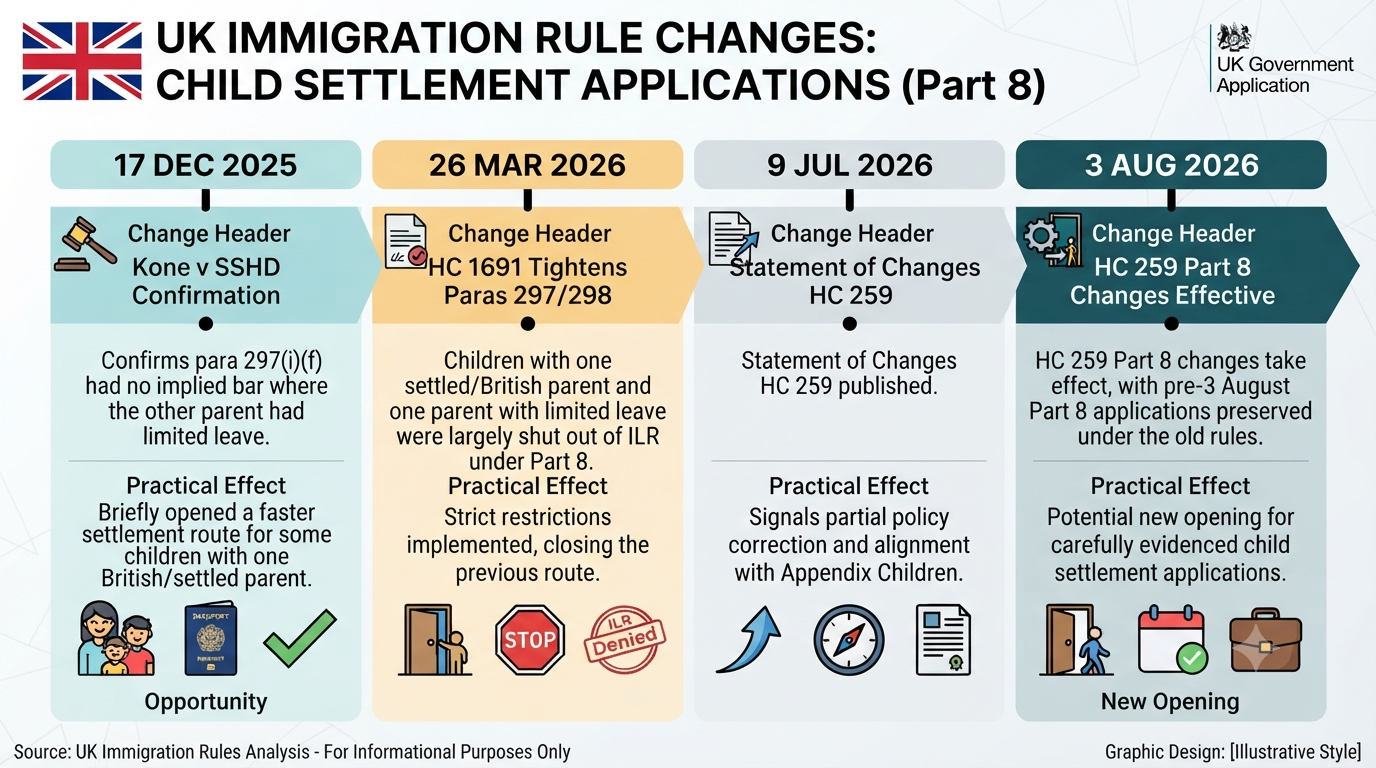
A narrow but significant pathway to UK ILR may be reopened for children from 3 August 2026, provided they have one settled or British parent and the other parent has limited leave. The change is relevant because in the case of Kone v SSHD, the Court of Appeal ruled that the previous interpretation of paragraph 297(i)(f) did not automatically debar settlement, but in March 2026, the Home Office tightened the rules. This is at least partially reversed by HC 259 as it is now, but the new drafting is still unclear and could lead to more restrictive casework by the Home Office or to another amendment.

What Changed in the Settlement Rules 2026
In Kone v SSHD [2025] EWCA Civ 1653, the Court of Appeal held that there was no implied rule in paragraph 297(i)(f) that the other parent had to be in the United Kingdom or that he or she should not have unlimited leave to enter the United Kingdom and that the Home Office could not circumvent the settlement application by granting only limited leave under Appendix FM.
The amendment to HC 1691 that came into effect on 26 March 2026 (paragraph 297(i)(f)) was replaced by the following wording: “one parent or a close relative” to be settled, the other parent not to have limited leave, and there must be “serious and compelling reasons” to grant settlement. This was because of its long-standing policy on a child not settling where one parent is British or settled and the other has temporary permission, the Home Office stated.
The rule has now been rewritten in HC 259, which was laid on 9 July 2026 and will come into effect for these Part 8 changes on 3 August 2026, to provide that one settled parent may qualify where the other parent has no limited leave, “unless there are serious and compelling reasons” to grant settlement. It also eliminates the close relatives from that limb and adds new independent close-relative paragraphs 297(i)(g) and 298(i)(e).
Practical Eligibility, Risks and Recommended Action
The obvious target scenario for families looking to secure ILR for children is where a child has one parent who is British or otherwise settled and one parent who has limited leave, where there are serious and compelling reasons to grant settlement. The Home Office’s own guidance in Appendix Children places the best interests of the child at the top of the list of considerations for decision-making and considers evidence, including why the other parent is not coming, why the child should not live with them abroad, and whether written consent is given.
The primary risk is the ambiguity of the drafting. The Home Office defines HC 259 as a “minor change” to ensure consistency with CHI 4.3(b) Appendix Children, which implies a legitimate and compelling exception will be retained, not an automatic route. But practitioners have already commented on the fact that the words might be interpreted more broadly, allowing for more amendment and/or narrow caseworking simply to be possible.
What must be done, therefore, is not theoretical but practical:
- Take legal advice before 3 August 2026 or as soon as practicable
- Audit the Child’s Immigration History
- Obtain Proof of Settled/British Parent’s Status
- Proof of the Other Parent’s Leave
- Proof of the Parent-Child Relationship
- Proof of Care and Accommodation Arrangements
- School and Medical Records
- Evidence of Why Settlement is in the Child’s Best Interests
That is the evidence profile already expected by the Home Office in serious-and-compelling child cases.

FAQs
Who will be the main beneficiaries of HC 259?
Children whose one parent is settled or British and the other parent is on limited leave, particularly where there is good evidence of serious and compelling reasons to award settlement to the child.
Does HC 259 guarantee ILR from 3 August 2026?
No. Although the wording strengthens the position, it continues to refer to a discretionary, evidence-based test and is likely to be interpreted restrictively by the Home Office.
Which evidence must be prepared first?
The status documents of both parents, evidence of birth, consent, care/accommodation arrangements and evidence to explain why it is not in the child’s best interests to remain outside the other parent.
Are the rules going to change before or after 3 August 2026?
Yes. This is the current version of the draft, which is subject to further correction and challenge due to recent litigation. Therefore, timing and legal advice are at the centre of the issue.