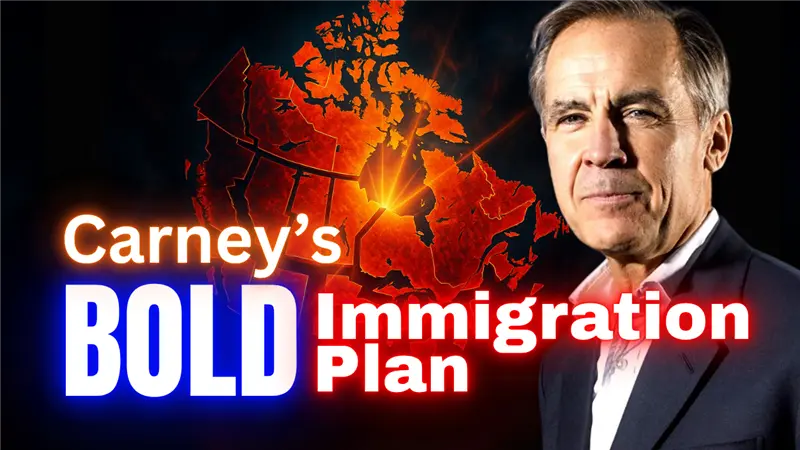
Synopsis: Prime Minister Mark Carney’s first mandate letter reshapes Canada’s immigration policy, prioritising economic contribution over growth. While attracting top global talent remains vital, the focus now includes cutting immigration to sustainable levels, easing pressure on housing and services, and tightly linking migration with productivity, labour gaps, and national capacity.
Canada is at a crossroads and immigration policy is front and centre. In his first mandate letter, Prime Minister Mark Carney has laid out a clear and transformative agenda, where immigration will serve economic growth, but within the boundaries of national capacity, housing supply, and fiscal sustainability.
Gone is the ambition to break records with migration figures. In its place is a disciplined, pragmatic approach, designed to align immigration with workforce needs, infrastructure readiness, and the government’s broader productivity agenda.
Let’s break down what this shift means for skilled workers, prospective immigrants, Canadian employers, and the country’s long-term vision.
Topics Discussed
- Sustainable Immigration: New Targets for PR Admissions
- Canada’s Focus Shifts to Talent and Contribution
- Link to Housing Affordability and Infrastructure Planning
- Economic Immigration: Skilled Trades, Tech, and Construction in Focus
- National Security and Border Controls: Stricter Vetting Ahead
- Fiscal Restraint in Immigration Processing and Services
- A Mandate Letter That Reads Like a Business Plan
- What Carney’s Direction Means for Future Applicants

Sustainable Immigration: New Targets for PR Admissions
From Record-High to Controlled Growth
Carney’s letter outlines a clear deviation from past targets. Canada will now:
- Admit 395,000 permanent residents in 2025
- Drop to 380,000 in 2026
- Cap at 365,000 in 2027
This trajectory keeps intake under 1% of Canada’s projected population of 41.5 million, marking a reversal from the former Liberal government’s 500,000+ annual PR targets.
View the Immigration Levels Plan 2025–2027 for official figures.
This pivot reflects growing concern about the stress migration places on:
- Housing affordability
- Healthcare capacity
- Public transit and infrastructure
Canada’s Focus Shifts to Talent and Contribution
Quality Over Quantity
Carney’s mandate continues to support economic immigration, but within a redefined scope. The new criteria include:
- Attracting individuals with proven contributions to key sectors
- Emphasising foreign credential recognition to reduce underemployment
- Streamlining the Global Skills Strategy (GSS) to fast-track top global talent
The direction is clear: immigration must serve the economy—not strain it.
Learn about the Global Talent Stream and priority processing updates.
Link to Housing Affordability and Infrastructure Planning
Labour, Housing, and Immigration Interconnected
The housing crisis is now embedded in immigration policy. The mandate sets out:
- Plans to reshape the construction industry
- Greater use of public-private partnerships
- Tighter coordination between immigration intake and housing starts
This means skilled workers in construction trades will remain in high demand—but with a more targeted intake model that aligns workers with actual demand.
For housing statistics, consult Canada Mortgage and Housing Corporation (CMHC).
Economic Immigration: Skilled Trades, Tech, and Construction in Focus
Prioritising High-Impact Sectors
The new government aims to strategically support:
- Skilled tradespeople for infrastructure development
- Tech talent to boost innovation and productivity
- Healthcare professionals to close labour gaps in public services
This continues the trend seen in recent Express Entry draws that favour candidates in sector-specific categories.
Stay informed via IRCC’s Express Entry news.
National Security and Border Controls: Stricter Vetting Ahead
Immigration Enforcement and Screening Under Review
The mandate highlights a renewed commitment to:
- Modernising border controls
- Increasing law enforcement coordination
- Enhancing vetting mechanisms for both PR and temporary entrants
While not directly targeting refugees or asylum claimants, this reflects a broader effort to secure Canada’s immigration system and reduce fraudulent applications.
Read about IRCC’s fraud prevention programs.
Fiscal Restraint in Immigration Processing and Services
Leaner Government, Streamlined Services
Immigration reform will also be shaped by Carney’s focus on:
- Cost reduction in government operations
- AI-driven improvements to immigration processing
- Shifting service delivery to private partnerships where feasible
This could mean faster processing for high-priority visas, but potentially longer waits for low-priority or less urgent categories.
Review IRCC’s processing times by visa type.
A Mandate Letter That Reads Like a Business Plan
Strategic Tone, Measurable Deliverables
Unlike previous mandates that were broad and aspirational, Carney’s document is:
- Concise and sharply worded
- Focused on seven high-level priorities
- Rooted in data-driven accountability
This reflects his background as Governor of the Bank of Canada and Governor of the Bank of England, where fiscal clarity and discipline were paramount.
Read the full Prime Minister’s Mandate Letter for ministerial responsibilities.
What Carney’s Direction Means for Future Applicants
Higher Bar, Clearer Focus
If you’re planning to immigrate to Canada, you should:
- Expect stricter eligibility criteria and sector alignment
- Prioritise economic pathways like Express Entry, PNPs, and the GSS
- Prepare documentation that proves labour market relevance, credential validity, and economic impact
The new mandate underscores that immigration is no longer just about numbers. It’s about fit, contribution, and capacity.
Start with IRCC’s Come to Canada tool to assess your eligibility under the new policy context.
Conclusion: Immigration, Reimagined For Impact, Not Volume
Mark Carney’s first mandate letter marks a philosophical and operational shift in Canada’s immigration story. While open to talent, the new government is no longer open to unchecked growth.
Immigration will remain central to Canada’s prosperity—but only when it is sustainable, sector-driven, and aligned with national goals. For applicants, this means a sharper focus on preparation, relevance, and compliance.
The door to Canada is still open—but the path is now narrower, and the expectations are higher.