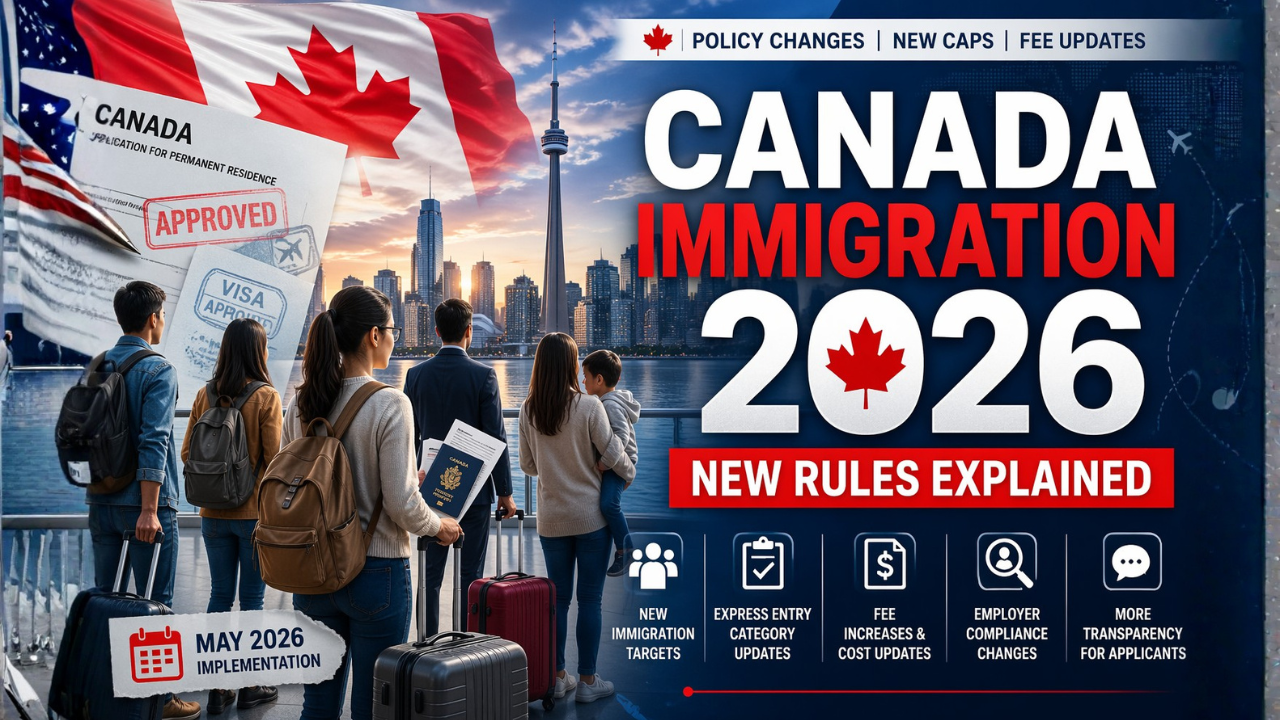
Synopsis: Canada immigration 2025 forces tighter PR targets, category-based Express Entry draws, and a premium on French and critical sectors. This guide explains draw patterns, provincial quotas, and practical steps—language training, NOC alignment, and PNP strategies—to help applicants design a resilient, evidence-based pathway to permanent residency in the new era. effectively.
Canada’s immigration settings in 2025 are shifting from long-running expansion to tighter, more selective intake—with clearer preferences for French language ability and essential occupations. If you’re in the pool (or planning to be), this is the year to get strategic. Ottawa has signalled a smaller permanent-resident intake and a lower share of temporary residents, and Express Entry continues to be steered by category-based rounds that prioritize French, health, trades, and education. To make informed choices, start with Canada’s 2025–2027 Immigration Levels Plan, which lays out the new approach and the rationale behind it.

The Policy Pivot You Can’t Ignore
Two official signals define 2025:
- Fewer overall seats. The 2025–2027 Immigration Levels Plan confirms a leaner permanent-resident intake than in the expansion years, framed as a “rebalancing” to relieve pressure on housing and services.
- A smaller share of temporary residents. The IRCC Departmental Plan 2025–26 sets a concrete objective: reduce the proportion of temporary residents to 5 percent of the population by end-2026.
If you’re a student, worker, or visitor trying to convert to PR, the implication is clear—competition is rising while options narrow. The new reality rewards proactive alignment, not passive waiting.
What Category-Based Selection Really Means
Since mid-2023, Express Entry has included category-based rounds targeting French language ability and specific occupations. In 2025, IRCC reconfirmed that focus in its category-based selection overview, listing French, healthcare, STEM, trades, transport, and education as priority areas.
Why this matters:
- If you fit a priority category, your odds improve even at moderate CRS scores.
- If you don’t, you must engineer eligibility—learn French, secure an in-demand occupation, or pursue a province-linked route.
- Category rounds reallocate invitations rather than increase the total number, tightening competition in general draws.
In October 2025, for instance, the healthcare-specific draw invited 2,500 candidates with a CRS cut-off of 472 — proof that occupation-fit now trumps overall score. For non-category candidates, that draw was invisible.
The Math Behind the Anxiety
Let’s quantify the challenge. Statistics Canada’s non-permanent resident estimates show 3 million plus people living in Canada on temporary status as of July 2025. Add new arrivals each semester and the pool keeps growing.
By contrast, the Levels Plan allocates roughly 230,000 economic-class admissions—about 7–8 percent of that temporary population. Even if only half of those residents seek PR, supply dwarfs demand.
Implication: rely on multiple pathways. Build French proficiency, anchor your case with a province, and identify a category that fits your experience. One route rarely suffices anymore.
Weekly Draws Are Cool—But Categories Decide Who Eats
Each Express Entry Round of Invitations now alternates between general, provincial-nominee-only, and category-based draws. Analysts tracking the 2025 schedule note a rhythm: healthcare, trades, education, and especially French receive recurring invitations, while Canadian Experience Class (CEC) draws remain sporadic.
Strategy: forecast your “eligibility gates,” not last week’s CRS. A score of 520 is useless if your NOC and language scores fail to match any active category.
Why French Is No Longer Optional
Ottawa’s priority on Francophone immigration is both economic and political. Francophone population targets outside Quebec are legally embedded in federal policy, and each iteration of Express Entry doubles down on that aim.
Candidates achieving NCLC 7 or higher in French qualify for dedicated rounds under the category-based selection overview, often at CRS scores 50-70 points lower than general draws.
Quick action plan:
- Take a TEF or TCF diagnostic; map your baseline to NCLC levels.
- Focus on listening and speaking—IRCC data show they yield the quickest gains.
- Combine English CLB 9 + French NCLC 7 for significant CRS synergy.
Healthcare, Trades, and Education: The Anchors of Labour Policy
Canada’s labour shortages remain most acute in healthcare, skilled trades, and early-childhood education—sectors central to community stability. The category-based selection overview confirms repeated invitations for these occupations.
If you fall near these categories:
- Credential alignment: Map foreign titles to Canadian NOC codes and licensing bodies.
- Bridging programs: Use provincial upgrading or supervised practice streams.
- Employer partnerships: Genuine job offers dramatically strengthen both PNP and federal profiles.
The Provincial Nominee Program in Tight Times
Late-year announcements of additional nomination capacity in BC, Manitoba, and Nova Scotia reflect IRCC’s minor redistributions, not new generosity. Those extra seats mainly clear backlogs.
Your real edge comes from alignment with provincial economic plans—not just being in the Express Entry pool.
How to leverage it:
- Pick 1–2 provinces where your NOC is actively hiring (verify via job boards).
- Craft a region-specific résumé and settlement statement.
- Monitor rural or Francophone community programs that match your language level.
Don’t Chase the CRS—Build Eligibility
Too many applicants watch the cut-offs without changing fundamentals. Focus on the variables under your control:
|
Lever |
Target |
Why It Matters |
|---|---|---|
|
English |
CLB 9–10 |
Maximizes skill-transfer points |
|
French |
NCLC 7 + |
Opens category-based draws |
|
Occupation Fit |
Correct NOC Duties |
Prevents refusal for misclassification |
|
Experience Proof |
Paid, full-time, verifiable |
Avoids integrity flags |
|
POF |
Liquid & recent |
Failsafe against review delays |
Treat your application as a compliance audit, not a résumé. Every inconsistency across past forms can trigger a Procedural Fairness Letter.
Documentation Discipline: The New Gatekeeper
Refusals in 2025 often trace back to weak proof, not weak profiles.
- Undisclosed history. Leaving out previous work or studies in earlier applications undermines credibility.
- Cash salary. Legal, yes—but only if you can produce payment vouchers, ledgers, or tax filings.
- Copy-paste NOCs. Officers instantly detect identical duty lists lifted from official descriptions.
Consistency across all submissions—study, work, PR—is now a decisive credibility factor.
If You’re a CEC Candidate
Canadian Experience Class profiles once dominated draws; in 2025, they’re squeezed by category priorities. With fewer general rounds, CRS scores above 520 still sit idle.
Your hedge:
- Add French to pivot into a category draw.
- Explore PNP routes where provincial demand overlaps your NOC.
- Keep your work authorization continuous—use visitor records only as short bridges, never as strategy.
For International Students and Recent Graduates
The “study first, plan later” model no longer works. Caps, attestation requirements, and the 5 percent temporary-resident ceiling from the IRCC Departmental Plan 2025–26 shrink the funnel.
Plan backwards:
- Choose programs leading to high-demand NOCs.
- Verify PGWP eligibility before enrollment.
- Track provincial pathways tied to your field (education, healthcare, trades).
- Start French training in Year 1 to qualify for Francophone or community streams.
For Outland Applicants: Don’t Assume You’re Invisible
Category-based rounds welcome qualified outland candidates, particularly in healthcare, STEM, and education. The October 2025 healthcare round under the Express Entry Rounds of Invitations invited 2,500 applicants worldwide. If you meet the NOC criteria and can prove licensing readiness, your location isn’t a disqualifier.
When Refusals Happen: Reconsideration vs. Judicial Review
If IRCC refuses your application, know your remedies:
- Reconsideration request: Ask the same office to correct a clear factual or legal error. It’s discretionary.
- Judicial review: A formal Federal Court process, time-bound (15 days inside Canada, 60 days outside).
Neither guarantees reversal, but both depend on the clarity and integrity of your original documentation.
Six-Month Action Blueprint
Months 1–2: Diagnostics
- Take mock IELTS/TEF tests, identify score gaps.
- Map your duties to correct NOC codes.
- Choose 2 target provinces; research their employer needs.
- List evidence gaps (letters, contracts, pay slips).
Months 3–4: Build Eligibility
- Book language tests.
- Reach out to potential employers or recruitment networks.
- Gather updated bank letters and statements.
- For cash pay, collect vouchers and affidavits from employers.
Months 5–6: Submission Ready
- Finalize reference letters with verifiable contact details.
- Update your Express Entry profile to match active categories.
- Pre-fill PNP applications for your target provinces—submit within 24–48 hours of new intakes.
Ten High-Leverage Moves
- Achieve NCLC 7 + French proficiency.
- Align your NOC with category-eligible occupations.
- Target specific provinces and employers.
- Provide robust proof for cash-based work.
- Ensure NOC accuracy.
- Optimize spouse as principal applicant where beneficial.
- Maintain liquid proof of funds.
- Complete any required licensing steps.
- Set milestone deadlines (test dates, draw tracking).
- Rely on official sources over social media hearsay.
Your Core Framework: Eligibility → Evidence → Exposure
- Eligibility: Engineer your profile to meet a category and a province’s needs.
- Evidence: Submit audit-quality documentation consistent across all forms.
- Exposure: Apply strategically across PNP streams and Express Entry categories to diversify risk.
Bottom Line
Canada’s 2025 immigration landscape is more demanding but also more transparent. The government’s published targets, departmental plan, and Express Entry logs reveal exactly what matters: French ability, verifiable work history, and category alignment. Build around those pillars and you’ll navigate a tighter system with confidence instead of guesswork.