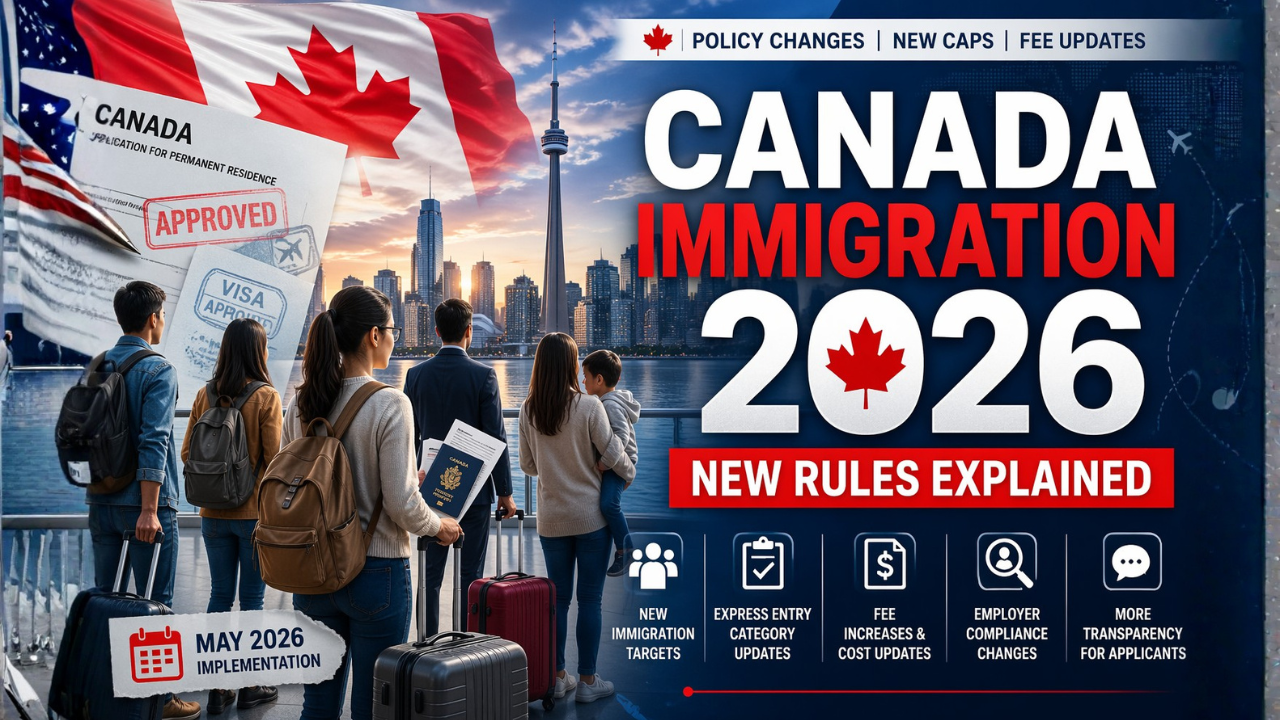
Synopsis: The 2025–2028 IRCC Immigration Plan, unveiled by Minister Lena Metlege Diab, balances immigration levels with infrastructure capacity, prioritizes economic integration, and enhances digital services through controlled PR and temporary‑resident targets.
Canada’s 2025–2028 Immigration Plan: Balancing Growth, Integration, and Digital Transformation
Why Canada’s New Immigration Direction Matters
In a critical policy shift, Canada has announced a detailed three-year roadmap for Immigration, Refugees and Citizenship Canada (IRCC) under Minister Lena Metlege Diab. Released in June 2025, the Departmental Plan for 2025–2028 addresses growing pressures on infrastructure, public services, and social cohesion. It aims to realign immigration with national priorities—without compromising Canada’s humanitarian commitments.
This plan marks a turning point in how Canada approaches immigration, emphasizing quality over quantity, integration over intake, and digitization over paper-based inefficiencies. With arrival targets for both permanent and temporary residents, it sets measurable goals for economic contribution, community readiness, and public support.

A Strategic Shift: IRCC’s New Immigration Vision
Managing Growth Within National Capacity
At the core of the plan is a commitment to sustainability. Unlike previous years marked by record-breaking immigration numbers, Canada is now seeking balance:
- Reduce temporary residents to 5% of the population by 2026
- Keep PR admissions under 1% of the population beyond 2027
- Prioritize settlement services for underrepresented groups
This signals a more measured approach, where immigration growth is aligned with Canada’s ability to provide housing, jobs, and social support.
Permanent Resident Admissions: Slower, Smarter Expansion
Yearly PR Intake Targets
IRCC plans to gradually scale down permanent resident admissions:
- 2025: 395,000
- 2026: 380,000
- 2027: 365,000
By 2027, 62% of these will be economic immigrants, reinforcing a merit-based selection aligned with Canada’s labor shortages. The remaining distribution:
- 22%: Family reunification
- 15%: Refugees and protected persons
- 1.2%: Other immigration categories
More than 40% of 2025 PRs are expected to come from existing international students and temporary workers transitioning through Express Entry or Provincial Nominee Programs.
Prioritized Immigration Pathways
Key economic programs will continue to dominate, such as:
- Express Entry, focusing on sectors like healthcare, skilled trades, French-language ability, and education.
- Provincial Nominee Program (PNP) and Atlantic Immigration Program, particularly for candidates already in Canada.
- Start-Up Visa and Self-Employed Persons Program for entrepreneurs.
- Spousal reunification, with faster overseas application processing.
These streams are designed to favor individuals with Canadian work experience or who meet specific labor market demands.
Temporary Residents: Capping and Restructuring
New Arrival Targets for Temporary Residents
For the first time, IRCC has introduced arrival caps for temporary residents, a response to housing pressure and overreliance on temporary migration:
- 2025: 673,650
- 2026: 516,600
- 2027: 543,600
Sub-caps include:
- 305,900 international students annually
- 82,000 under TFWP
- IMP workers: 285,750 (2025), 128,700 (2026), 155,700 (2027)
To ensure quality over quantity, the cost-of-living requirement for students is now indexed annually—set at $20,635 in 2024, not including tuition and travel.
Reforms to Post-Graduation and Spousal Work Permits
In 2024, major reforms to the Post-Graduation Work Permit (PGWP) program were implemented, linking eligible study programs to in-demand sectors. This framework will continue evolving in 2025 to support national and regional labor needs.
Spousal open work permits will also be tied to critical sectors such as construction and healthcare, limiting eligibility for non-priority fields.
Expanding Refugee and Humanitarian Efforts
Global Refugee Resettlement
Canada remains committed to its humanitarian leadership by resettling 12,000 refugees each from Africa, the Middle East, and the Asia-Pacific, and 4,000 from the Americas by 2028. Working with partners such as the UNHCR and Canadian NGOs, IRCC aims to streamline processing and expand coverage under the Interim Federal Health Program.
Crisis Response Framework
Canada’s Crisis Response Framework, recently used in response to emergencies in Gaza and Sudan, will be further strengthened. This includes enhanced coordination with provinces, housing partners, and health authorities to support emergency arrivals.
Strengthening Settlement and Belonging
Who Will Benefit?
Three-year funding agreements with community-based service providers will offer tailored support to:
- Women, racialised groups, and youth
- People with disabilities
- Francophone immigrants via the expanded Welcoming Francophone Communities program
- Newcomer children through school-based programming
Council of Newcomers
A newly established Council of Newcomers will provide policy feedback and co-design future integration programs with IRCC.
Labour Market Integration: Targeting Five Key Sectors
Sectoral Focus and Skill Alignment
IRCC will now tailor immigration flows to match workforce shortages in:
- Healthcare
- Education
- Skilled trades
- Transportation
- STEM fields
To support this, measures include:
- Aligning licensure with immigration criteria
- Recognizing foreign credentials faster
- Providing sector-specific settlement services
- Boosting employer engagement via Immigration Employment Councils
This is in line with Canada’s broader effort to streamline labor market integration, ensuring immigrants can quickly contribute to the economy.
Citizenship and Travel: Modernization on Track
Citizenship Services Go Digital
IRCC aims to maintain an 85% citizenship uptake rate among eligible PRs. New initiatives include:
- Fully online citizenship applications
- Blended virtual and in-person ceremonies
- Increased processing speeds for passport services
- Improved digital access for rural communities
These upgrades reflect Canada’s effort to make citizenship more accessible and efficient.
IRCC Digital Transformation: The Backbone of Future Policy
Digital Platform Modernization (DPM)
By 2027, IRCC will be fully transformed into a modern digital-first department, powered by:
- A unified client portal offering real-time updates, forms, and support
- A new Case Management Platform replacing outdated legacy systems
- AI-assisted analytics for triaging applications and detecting fraud
IRCC is also testing an AI model called GeoMatch, developed with Stanford University, to help Express Entry candidates find the best Canadian region to succeed economically. Importantly, AI will not be used for making final decisions—only for support functions.
IRCC Budget and Staffing Trends Through 2028
Planned Budget Reductions
Reflecting scaled-back immigration numbers and program conclusions, IRCC’s budget will decline:
- $5.17B in 2025–26
- $4.07B in 2026–27
- $3.60B in 2027–28
The largest spending area remains permanent and refugee immigration, accounting for over $4 billion in 2025–26.
Staffing Changes
Staffing will also reduce gradually:
- 12,689 FTEs (2025–26)
- 11,257 FTEs (2027–28)
This reflects not only lower application volumes but also increased efficiency due to digitization and the end of emergency refugee programs.
Key Risks and How IRCC Plans to Manage Them
Challenges Acknowledged
The IRCC highlights multiple risks:
- Rising backlogs, even with lower immigration levels
- Public dissatisfaction due to housing constraints
- Capacity issues among service providers
- Cybersecurity threats to digital platforms
Mitigation Strategies
To manage these, IRCC will:
- Use advanced analytics for faster processing
- Strengthen partnerships with provinces and NGOs
- Expand cybersecurity infrastructure to protect applicant data
- Ensure flexibility in service delivery for emergencies
Conclusion: A Pragmatic, Future-Focused Immigration Strategy
Canada’s 2025–2028 IRCC plan under Minister Lena Metlege Diab signals a thoughtful rebalancing of the immigration system. With sustainability, economic need, and digital transformation at its core, the plan acknowledges public concerns without abandoning Canada’s global leadership in welcoming newcomers. By scaling responsibly, Canada is building a system where immigration enhances—not strains—national capacity.
The future of Canadian immigration is not about cutting numbers, but about managing them wisely—for the benefit of both newcomers and the country as a whole.
Frequently Asked Questions (FAQs)
What are the new permanent residence (PR) targets in Canada from 2025 to 2027?
Canada is scaling back its permanent resident admissions to reflect concerns about housing, infrastructure, and service capacity. According to the IRCC 2025–2028 plan, the targets are:
- 395,000 new PRs in 2025
- 380,000 in 2026
- 365,000 in 2027
Why is Canada reducing the number of temporary residents by 2026?
To address concerns about overpopulation, housing shortages, and strained services, Canada aims to reduce temporary residents to 5% of the population by the end of 2026, capping international students, TFWP workers, and IMP participants.
How will Express Entry change under the new IRCC plan?
Express Entry will continue to play a central role in economic immigration, but with an increased focus on category-based selection. The government is prioritizing candidates with Canadian work experience, French-language skills, and occupations in healthcare, trades, STEM, education, and transportation. These reforms help meet Canada’s labor shortages more effectively. Additionally, advanced analytics tools will be used to help identify high-potential candidates, though decision-making will remain human-led.
Will international students still be able to apply for permanent residency?
Yes, international students remain a vital part of Canada’s immigration pipeline. Over 40% of 2025 PR admissions are expected to come from current or former international students. However, new rules like a cost-of-living threshold ($20,635 in 2024) and tighter PGWP eligibility mean only those in high-demand study programs may transition easily. Canada is emphasizing pathways for students in fields linked to national and regional skill shortages. Students are encouraged to choose institutions and programs that align with Canada’s labor market priorities..
What is changing with the Post-Graduation Work Permit (PGWP) program?
The PGWP program is being restructured to align more directly with labor market needs. Starting in 2025, only graduates from specific high-demand programs will be eligible for PGWPs. This includes fields like healthcare, trades, and technology. The government is tightening access to ensure work permits lead to meaningful employment outcomes. Spouses of PGWP holders will also face new eligibility rules, especially in sectors where labor demand is low or saturated.
How is Canada supporting French-speaking immigrants outside Quebec?
Canada is expanding its Francophone immigration strategy under the 2025–2028 plan. This includes:
- Launching a Francophone Student Pilot Program in 2025
- Expanding the Welcoming Francophone Communities initiative
- Prioritizing French-speaking candidates in Express Entry draws
- Offering tailored integration services for Francophones
These efforts aim to boost French-language retention in minority communities and meet bilingualism goals outside Quebec.
What digital changes can immigrants expect from IRCC by 2027?
By 2027, IRCC plans to be a fully modernized digital department. Applicants will benefit from:
- Unified online client portal with real-time updates
- A new Case Management Platform replacing outdated systems
- AI tools like GeoMatch to suggest best regions for success
- Digitized citizenship applications and ceremonies
While AI will not make decisions, it will help triage and detect potential fraud. These tools are expected to significantly improve processing times and transparency.
How is Canada handling the refugee and humanitarian crisis in 2025–2028?
Canada remains committed to refugee protection. Between now and 2028, the country will resettle:
- 12,000 refugees each from Africa, the Middle East, and Asia-Pacific
- 4,000 from the Americas
It will also enhance its Crisis Response Framework to better handle emergencies like Gaza or Sudan. Additionally, the Private Sponsorship of Refugees Program will see faster processing, and healthcare support will expand under the Interim Federal Health Program.
What sectors will be prioritized for skilled immigration in Canada?
Canada has identified five key sectors for targeted immigration selection:
- Healthcare
- Education
- Skilled trades
- Transportation
- STEM
Candidates with skills or credentials in these areas will have an advantage in Express Entry and Provincial Nominee Program (PNP) selections. The government is also working to align licensing processes with immigration to speed up workforce entry, especially for healthcare workers.
Will Canada’s immigration cuts affect citizenship and passport services?
No, citizenship and travel services are actually being expanded and digitized. IRCC is committed to:
- Maintaining an 85% citizenship uptake rate
- Delivering 90% passport service standards
- Offering fully online citizenship applications
- Blending in-person and virtual ceremonies
These enhancements are designed to ensure permanent residents transition smoothly into full Canadian citizenship and that digital exclusion is minimized through accessible e-services.