
Synopsis: This article provides an essential breakdown of the UK immigration rule changes effective from August 2026. We detail critical updates to Skilled Worker visa requirements, stricter suitability rules, and enforcement measures regarding deportation and asylum claims. Learn how these regulatory shifts impact application deadlines and why monitoring your Certificate of Sponsorship (CoS) issue date is now vital for compliance.
Why the Visa Application Deadline Matters
For anyone preparing a UK immigration application this summer, the timing of submission could make a significant difference. It is no longer just a matter of completing paperwork on time, but of understanding which immigration rules will apply. The Statement of Changes HC 259, laid before Parliament on 9 July 2026, establishes a phased commencement schedule. The amendments relating to Appendix EU and Appendix EU (Family Permit) will take effect on 30 July 2026, whereas the majority of other changes will commence on 3 August 2026. Applications submitted prior to 3 August will, in most cases, be determined under the rules in force immediately before the changes take effect. 
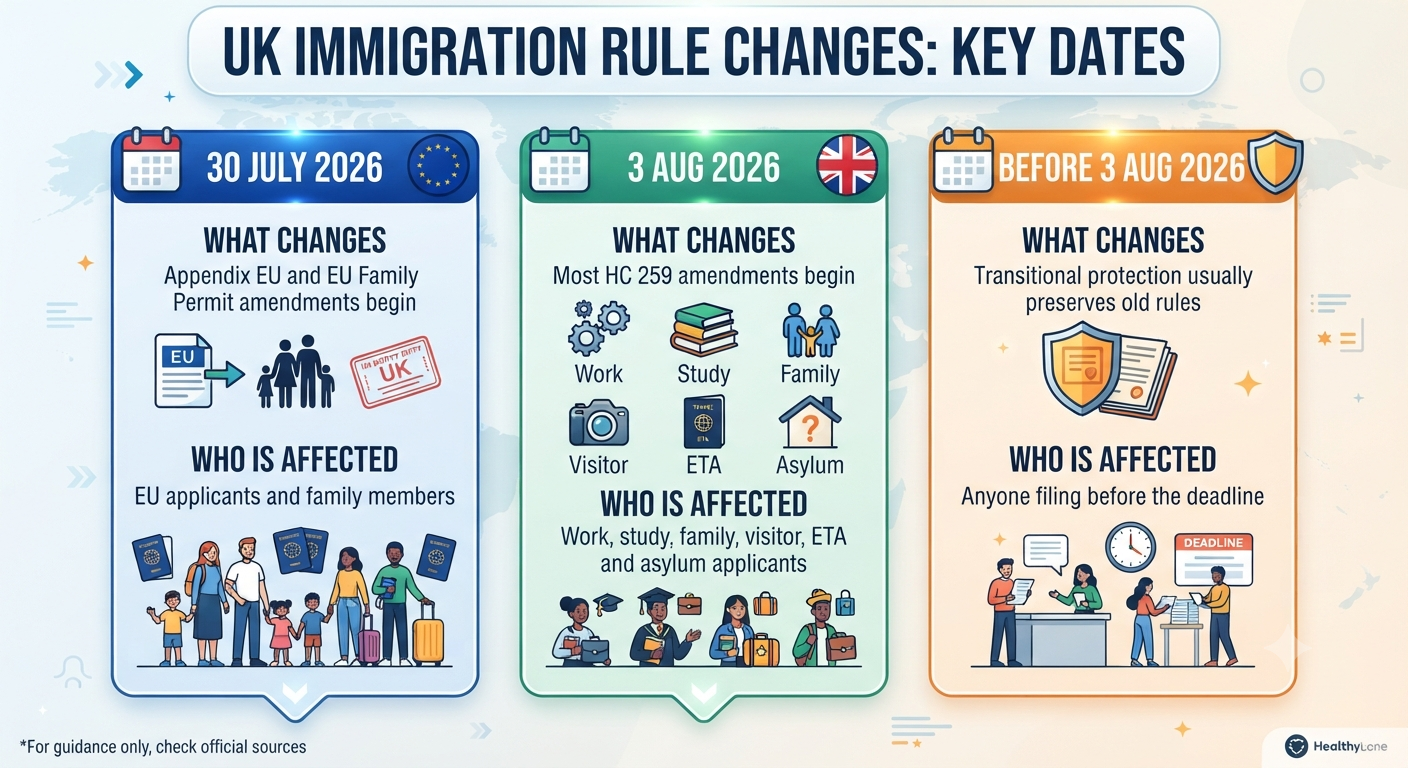
These dates are important as the Home Office has been rolling out the immigration white paper of 2025 in phases rather than in one hit. The wider programme has already resulted in stricter B2 English requirements for some work routes, increased compliance from student sponsors, and further changes to the rules for B2 English are being consulted on and are in the process of being finalised.
What Changes in Practice
Skilled Worker Changes and Suitability Rules
One of the most significant Skilled Worker amendments is the length of time restrictions and immigration bail are now uniformly expressed in terms of the rule text, covering a broad spectrum of migration pathways such as work, study, visitor and family. The key date for some future Skilled Worker salary protections appears to be shifting from the visa application date to the Certificate of Sponsorship date, which could significantly affect transitional cases in 2027 and 2028. Neonatal leave is now included in scale-up rules.
The tighter drafting is consistent with the broader Home Office trend to limit sponsorship flexibility, increase the skills requirements and reduce the ability to be flexible by route. According to good legal analysis, there are still some details of salary and settlement in the downstream that are not specified.
Deportation, Asylum and Family Route Tightening
HC 259 also strengthens enforcement measures. Deportation (with limited exceptions) is possible for foreign nationals sentenced to custody or suspended custody of 12 months or more from 22 March 2026. The same “or suspended” language applies to ETA and Child Student refusals. Finally, asylum for clearly unfounded claims may be determined without a personal interview for asylum seekers who are EEA or Swiss nationals. Care and accommodation in family cases involving children must be in line with UK law.

FAQ
Does my application avoid the new rules if I apply before 3 August 2026?
Generally, yes. Applications submitted before 3 August 2026 are usually decided under the rules in force on 2 August 2026.
Are these the same as the 2025 white paper proposals?
Not exactly. These are live rule changes, while parts of the 2025 white paper remain broader policy direction or are still awaiting final implementation.
What is the biggest risk for Skilled Worker applicants?
The biggest risk is assuming the filing date is all that matters. In some transition cases, the CoS issue date may now be decisive.
Are settlement impacts fully clear yet?
No. Several future settlement and salary-related details remain unspecified in public guidance.