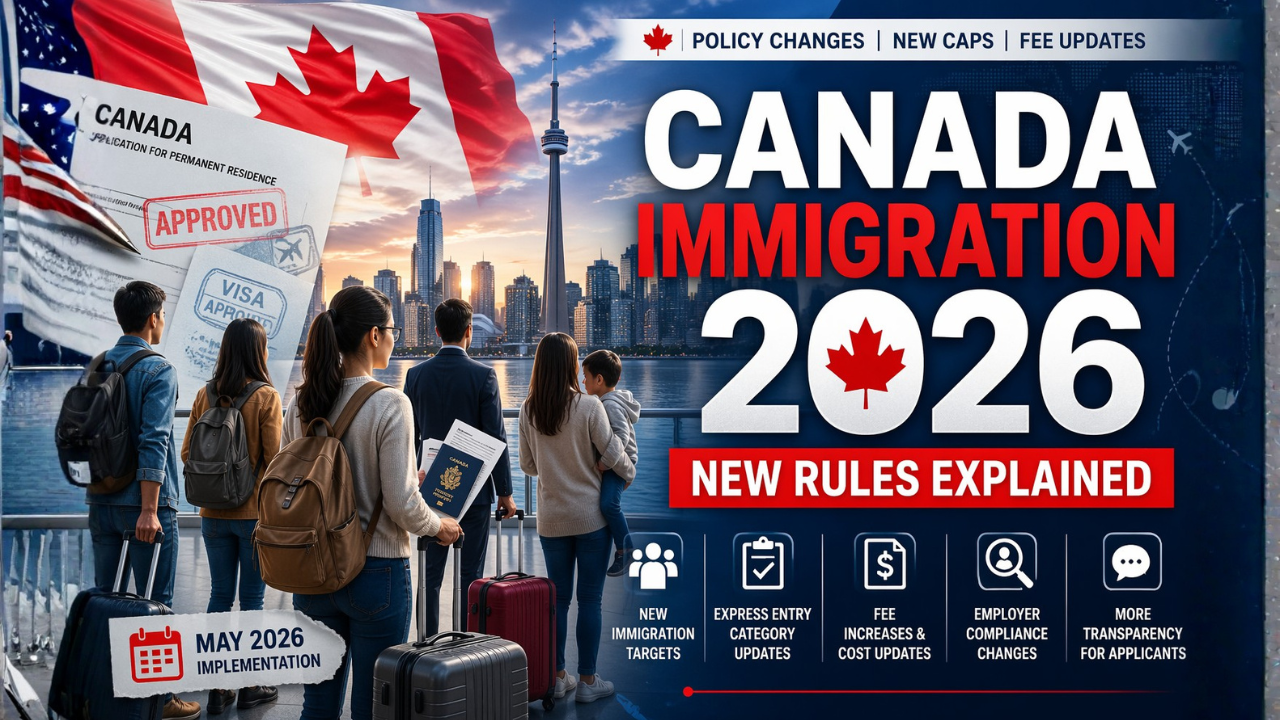
Synopsis: Canada’s Major Study Visa Policy Shift for 2025–2026 marks a major turning point for international graduate applicants. The new reforms eliminate the PAL requirement for Master’s and PhD students, introduce 14-day priority processing for PhD permits, and allow families to apply together for the first time. These changes are designed to restore approval rates, attract top research talent, and strengthen Canada’s long-term immigration and innovation goals. This analysis breaks down every key update and explains how students can strategically benefit during the 2026 intakes.
A New Era for Canada’s Graduate Study Visa Pathways: Why the 2026 Reforms Matter More Than Ever
Canada has finally announced the most anticipated relief for international graduate applicants after a long period of uncertainty, extremely low approval rates, and overwhelming procedural hurdles. For over a year, Canada’s student visa success rate hovered at just 25%, with refusal rates climbing above 80% — a trend that deeply discouraged prospective students and raised concerns among universities and policymakers. These new reforms, aligned with Canada’s strategic talent-driven immigration priorities and supported by insights from sources such as the Immigration, Refugees and Citizenship Canada (IRCC) official updates, aim to reverse the downturn and re-establish Canada as a reliable destination for high-achieving graduate students.
Starting January 1, 2026, transformative changes will apply to all new Master’s and PhD study permit applications. These reforms do not merely simplify paperwork; they reposition Canada’s graduate programs as an accessible and attractive route for skilled researchers, families, and future professionals. This long-form analysis breaks down each change and examines what the new policy means for international mobility, institutional planning, and students considering Canada as a long-term migration pathway.

Canada’s 2026 Reforms for Graduate Students
Removal of Provincial Attestation Letter (PAL) for Master’s & PhD Programs
One of the biggest hurdles in the study permit process has been the Provincial Attestation Letter (PAL) — a document introduced in 2024 as part of Canada’s effort to regulate international student intake. PAL has been mandatory for most applicants and has significantly contributed to application delays and refusals, mainly because availability varied by province and was tied to strict caps.
From January 1, 2026, Master’s and PhD students will no longer require a PAL, marking a decisive policy shift. This exemption is more than administrative convenience — it places graduate students at the centre of Canada’s economic and research agenda. The PAL exemption recognizes:
- Graduate students’ higher academic profiles
- Stronger labour market potential
- Greater likelihood of contributing to Canada’s knowledge-based sectors
- Lower risk of misuse of the study permit system
This change also aligns with broader federal objectives outlined in the 2025–2027 Immigration Levels Plan and provincial research funding priorities. Removing PAL is expected to dramatically improve application turnaround times and increase approval rates for advanced-degree applicants, especially those from India, Pakistan, Nigeria, the Philippines, Sri Lanka, Bangladesh, and other high-volume regions.
Family Reunification Gets Easier for Graduate Students
New Rule Allows Spouses and Children to Apply Together
Until now, one of the biggest frustrations for Master’s and PhD applicants was the lack of clarity around family accompaniment. Spouses often applied separately due to program restrictions or risked refusals because officers were unconvinced about the applicant’s genuine temporary intent.
The new update completely changes the equation:
Graduate students can now apply together with their spouse and dependent children in a single application package.
This reform serves several strategic purposes:
- Encourages long-term, stable settlement patterns
- Attracts candidates who are mid-career professionals with families
- Supports Canada’s labour market needs through spousal open work permits
- Reduces emotional and financial strain on families separated by borders
The move also mirrors findings from the OECD Education at a Glance report, which consistently highlights the importance of family stability for international student success. Canada’s reform is therefore both humane and economically sensible, inviting more diverse and experienced applicants into graduate programs nationwide.
14-Day Priority Processing for PhD Study Permits
Accelerated Decision Timelines for Research-Based Applicants
Perhaps the most remarkable announcement is the 14-day processing guarantee for PhD applicants after biometrics. This commitment is unprecedented in Canada’s international education landscape.
Why is this so significant?
- It dramatically improves predictability for research students
- It allows universities to confidently issue assistantships and funding
- It reduces the risk of losing high-value PhD candidates to the US or the UK
- It supports Canada’s long-term science, healthcare, and innovation goals
Research students often undertake work directly tied to national priorities, such as healthcare innovation, AI, climate resilience, and clean energy. Studies published by the Council of Canadian Academies highlight the acute need for advanced researchers across Canadian universities and laboratories. Faster processing acknowledges this need and gives Canada a competitive advantage in attracting global talent.
Master’s students, however, are not included in the 14-day guarantee. IRCC has only stated that efforts will be made to “improve processing times” for Master’s applicants. While this gap may raise concerns, the prioritization of PhD students aligns with global trends where research-intensive candidates are given preferential processing.
English Tests, PTE Requirements, Funds, and GIC: What Stays the Same
No Relaxation in Core Eligibility Criteria
Despite the significant reforms, several foundational requirements remain unchanged. This ensures that Canada maintains academic integrity and upholds the quality of its international student intake.
Key requirements that still apply include:
1. Language Proficiency (IELTS / PTE)
Master’s and PhD applicants must still meet high English language standards. While exact cut-offs vary by institution, a typical requirement includes:
- IELTS 6.5 overall with no band below 6
- PTE score of 60 or higher for graduate programs
2. Proof of Funds
Applicants must still demonstrate their ability to support themselves and their families. This includes tuition + living cost estimates that align with the financial guidelines published by the Government of Canada’s Study in Canada framework.
3. Guaranteed Investment Certificate (GIC)
The GIC requirement remains mandatory for SDS applicants. This ensures students have secured living expenses for their first year in Canada.
4. Program Eligibility & Academic Background
Graduate programs continue to require strong academic histories, research intent, and relevant undergraduate degrees.
These stable requirements are essential safeguards in a system experiencing structural adjustments.
Expected Improvement in Success Rates for 2026 Graduate Applicants
Why Approval Rates Are Likely to Increase
A dramatic improvement in success rates is anticipated from 2026 onward—especially for Master’s and PhD applicants. The reasons are structural:
- PAL exemption reduces administrative bottlenecks
- Family co-applications demonstrate stronger ties and financial capability
- Graduate students are statistically more compliant with visa rules
- Canada’s labour shortages are heavily concentrated in research and specialized roles
Canada is actively looking for advanced talent, including:
- Data scientists
- Healthcare researchers
- Engineers
- Climate scientists
- AI professionals
- Academic faculty
- Policy researchers
According to labour market projections by Statistics Canada, the country will face significant demographic and skills shortages over the next decade. Encouraging graduate-level immigration is a strategic solution.
Strategic Advice for Graduate Applicants
Why Master’s Should Be the First Choice for Many Students
For undergraduate students hoping to secure a future in Canada, the guidance is clear:
Prioritize a Master’s degree over diplomas or short-term programs.
Here’s why:
- Higher approval chances
- Stronger pathway to PR (via PGWP → Express Entry)
- Graduate programs align with Canada’s labour market needs
- Family sponsorship becomes easier
- No PAL requirement
- More competitiveness even with average profiles (e.g., IELTS 6 each or PTE 60)
Applicants with minor profile weaknesses (“19/20 issue” as often termed in South Asian contexts) may still succeed if they choose a well-aligned Master’s program and a suitable province.
Why Canada Is Prioritizing Graduate-Level Applicants
The Economic and Policy Logic Behind the Reforms
To understand the 2026 reforms, it is essential to see the broader context. Canada’s economy is entering a period of transformation:
- Aging population
- Shrinking domestic graduate school enrollment
- Shortage of advanced researchers
- Increased international competition from the US, UK, Australia
Canada wants not just students, but skilled, research-driven immigrants who can contribute to innovation, healthcare, public policy, infrastructure, and sustainability.
Graduate students fit this requirement perfectly.
These reforms are therefore not random relaxations — they are targeted policy interventions meant to:
- Fill labour gaps
- Strengthen university research output
- Support innovation ecosystems
- Reduce exploitation in private colleges
- Attract mature, financially stable students
Implications for International Students Planning to Apply
Key Takeaways for 2026 Intakes
If you are planning for the 2026 intake, here’s what you must keep in mind:
1. Start Early
Graduate admissions take time. Begin your university shortlisting and SOP preparation at least 8–10 months in advance.
2. Target Provinces Strategically
Choose provinces aligned with your field—Ontario for tech, Alberta for AI, British Columbia for sustainability, Nova Scotia for research.
3. Prepare Family Documentation
Since co-applications are now possible, ensure spouse and dependent documentation is accurate and complete.
4. Demonstrate Genuine Research Intent (for PhD applicants)
Strong research proposals will be crucial, especially with the new 14-day processing advantage.
5. Strengthen Your Financial Proof
Show funds clearly to avoid refusals on financial grounds.
Broader Impact on Canada’s Education Sector
Universities, Employers, and Policymakers Will Benefit
The reforms are expected to bring stability to Canada’s education ecosystem. Key benefits include:
- Higher-quality student intake
- Increased research productivity
- Stronger global competitiveness
- Enhanced diversity in graduate cohorts
- Better labour market outcomes due to skilled graduates
Universities are likely to redesign their recruitment strategies, focusing more strongly on graduate talent from South Asia, Africa, and East Asia.
Conclusion: A Landmark Moment for Canada’s Graduate Pathways
Canada’s 2026 study visa reforms mark one of the most student-friendly policy shifts in recent years. After a difficult phase characterized by low approval rates and widespread frustration, the new rules offer clarity, accessibility, and long-term opportunity for qualified applicants.
By removing PAL for Master’s and PhD programs, allowing families to apply together, and providing 14-day processing for PhD applicants, Canada is sending a clear message:
Highly skilled graduate students are welcome, valued, and needed.
For students planning their next academic move, this is the moment to prepare strategically, align with the new requirements, and take advantage of a policy environment designed to support academic excellence and long-term migration possibilities.