
Synopsis: Robert Jenrick has outlined Reform UK’s proposed Migrant Labour Levy, a progressive annual fee designed to disincentivise the recruitment of overseas staff. The policy introduces a sliding-scale tax that aggressively targets low-wage sectors like social care and hospitality while protecting high-tech roles. We break down the shifting political debate, potential business overheads, and future compliance challenges for UK employers and visa holders.
The UK immigration debate has moved to a new and much firmer level. Robert Jenrick has pledged to bring an end to the “mass migration era” and will announce a key policy shift that could change the way foreign workers are recruited for jobs in Britain.
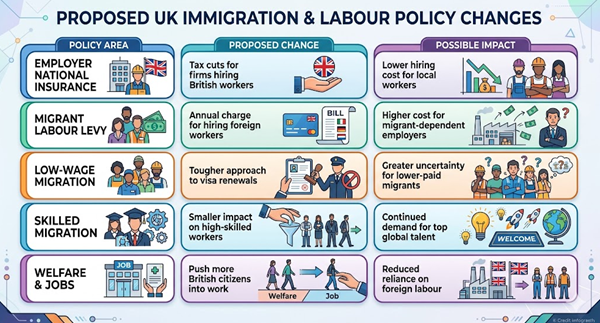
The core purpose of the idea is a new migrant labour levy, an annual charge on businesses. It’s a straightforward but highly controversial concept: reduce the cost for companies to hire British workers and increase the cost for companies to hire migrant workers.
It could be one of the biggest immigration policy issues to look out for employers in the UK, international graduates, overseas workers, and visa holders. 
What is the Migrant Labour Levy?
The migrant labour levy is a proposed tax or annual fee for employers to pay for each worker that they take on as a migrant worker. Reform UK says this will replace or modify the current immigration skills charge system and make companies more financially motivated to recruit British staff before they recruit foreigners.
The proposal calls for a levy on migrants that would not apply to every migrant. The charge would be the highest for low-skilled foreign workers and lower for the high-skilled.
This could put pressure on sectors that make extensive use of overseas workers, including care homes, hospitality, warehouses, logistics, food production and food distribution centres.
Key Points of the Proposal
Why Reform UK Says This is Needed
The UK has been over-dependent on low-paid immigrants for too long, Jenrick says. He says businesses were able to replace many British citizens on welfare or not in the labour market with lower-cost overseas workers.
The policy is being presented as a way to:
- Prioritise British workers
- Reduce pressure on housing, schools, roads, and public services
- Lower the welfare bill
- Raise wages for local workers
- Move away from a cheap labour economy
Reform UK calls for a change in the UK economy from migration-led growth to domestic employment, training and productivity.
Which Migrants Could Be Most Affected?
Lower-paid foreign workers would probably be the most severely affected. This can encompass migrant workers in social care, food processing, delivery, hospitality, retail support, labour-intensive roles, and warehouses, among other areas.
But Reform UK has proposed that highly skilled workers should be treated differently. There may be many other sectors, like science and artificial intelligence, finance and investment, advanced technology and specialist industries, where workers’ burden will not be so heavy.
That gives a clear impression that the UK could allow high-skilled migration, but it is likely that low-skilled migration will be much more tightly restricted in the future.

What This Means for Employers
This idea could increase hiring costs exponentially for companies. Businesses with a reliance on foreign workers may need to rethink their recruitment, pay, training, automation and staffing strategies.
Small businesses, care providers, hospitality operators and logistics companies may have particular worries, as they often find it difficult to recruit locally.
If such a levy became law, employers may need to:
- Review their foreign worker dependency
- Invest more in British recruitment
- Increase training budgets
- Offer better wages to attract local workers
- Prepare for higher visa-related employment costs
What This Means for Migrants
Uncertainty is the primary issue for migrant workers. When the expenses for employing foreign workers are going up, employers might cut back on sponsorship, refrain from renewing visas, or hire local workers.
This may impact future visa applicants from outside the UK for the Skilled Worker visa, existing visa holders who are close to the end of their visa, and overseas workers who want to move to the UK.
Political debate has also been held on stiffer settlement conditions and the prospect of changes to indefinite leave to remain. These are not yet in law, but they do indicate a change in immigration policy which will be more stringent and politically charged in the near future in the UK.

Is This Policy Confirmed?
No. This is not yet a law but a political proposal. Whether it becomes official policy would be determined based on future elections, parliamentary approval, legal review, business consultation, and economic modelling.
But it is important even as a proposal, as it demonstrates the direction of the UK immigration debate: fewer low-wage routes, more pressure on the employers, and more emphasis on the quality of British work.
Final Thoughts
The migrant labour levy that Robert Jenrick has proposed isn’t solely a matter of immigration. It’s a matter of the future of the UK labour market, salaries, welfare, business costs, and economic direction.
The warning for migrants is obvious: the UK might still be interested in the highly skilled, but the entry of low-skilled workers may be more difficult.
Employers should take heed: relying on overseas labour may become more expensive and politically risky.
The UK immigration system is becoming more focused, and this is just the latest sign that the next major challenge could not come from the border; it could come from the workplace.
FAQs
Is the migrant labour levy already in place?
No. It is currently a political proposal and has not become law.
Who would pay the migrant labour levy?
Employers hiring foreign workers would pay the proposed levy.
Would highly skilled migrants be affected?
They may be affected less than low-wage workers, according to the proposal.
Which sectors could be hit hardest?
Care, hospitality, logistics, warehouses, food production, and other labour-heavy industries could face the biggest impact.
Should current UK visa holders worry?
Current rules have not changed yet, but migrants should closely monitor future policy updates, especially around visa renewals and settlement.