
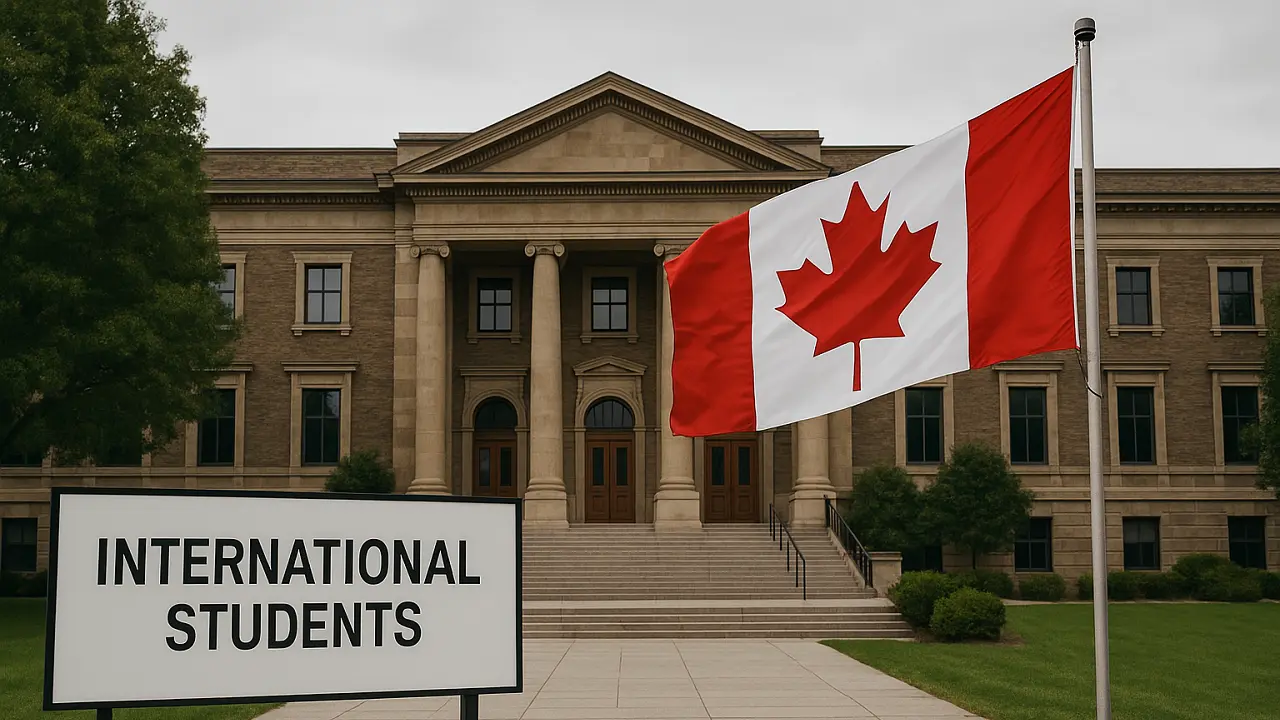
Synopsis: Canada’s international student arrivals plunged in 2025, shrinking by 88,000 students. This analysis examines study-permit caps, lower approval rates, and funding hurdles, assesses impacts on universities, labour markets and regional economies, and outlines policy and institutional responses to stabilize enrollment and preserve Canada’s education sector competitiveness.
A Sudden Reversal in Canada’s International Education Boom
For over a decade, Canada has been one of the world’s most attractive destinations for international students. Its open immigration pathways, globally ranked universities, and post-study work opportunities positioned the country as a leader in global education mobility. But 2025 marks a turning point. According to official data from Immigration, Refugees and Citizenship Canada (IRCC), Canada admitted 88,000 fewer international students in the first half of the year compared with the same period in 2024.
Between January and June 2025, only 36,417 students entered Canada—a 71% drop compared with 125,025 arrivals in the first six months of 2024. This sharp decline coincides with a series of policy reforms introduced under Canada’s 2025–2027 Immigration Levels Plan, which aims to reduce the country’s temporary resident population, including students and workers, to below 5% of the national population.
What explains this sudden downturn? How will it reshape Canada’s universities, labor markets, and immigration strategies? And crucially, what does it mean for students considering Canada as their study destination?
This blog provides an in-depth analysis of the data, causes, and consequences of this significant policy shift.

Canada’s Policy Shift Toward “Sustainable Immigration Levels”
The 2025–2027 Immigration Levels Plan
The Canadian government has consistently emphasized balancing economic needs with immigration sustainability. Under the 2025–2027 plan, IRCC committed to limiting temporary residents—including international students—to less than 5% of the population.
This is a direct response to concerns about:
- Overstretched housing markets in cities like Toronto and Vancouver.
- Rising healthcare and public infrastructure pressures.
- A growing perception that temporary residents are fueling wage competition in entry-level sectors.
By capping inflows, the government is signaling that Canada’s immigration growth must be carefully managed, even if that means reshaping its global reputation as a top study-abroad destination.
Study Permit Caps and Provincial Attestation Letters
In early 2024, Ottawa introduced a cap on study permit applications for post-secondary education below the master’s level. This was accompanied by a requirement for Provincial Attestation Letters (PALs)—a quota-based system where provinces issue limited confirmations allowing students to apply.
The cap has particularly affected:
- College-level programs, which traditionally host the largest share of international students.
- Private institutions, many of which depended heavily on international enrollments for revenue.
- Indian and Nigerian students, who make up a significant proportion of undergraduate applicants.
While the master’s and PhD levels remain less restricted, the majority of Canada’s international education sector has faced a sudden supply squeeze.
The Numbers Behind the Decline
A 71% Drop in Student Arrivals
IRCC data paints a stark picture:
- January–June 2024 arrivals: 125,025
- January–June 2025 arrivals: 36,417
- Net difference: 88,608 fewer students
- Percentage change: –71%
This is one of the steepest year-on-year declines in Canada’s recent history of international education.
Study Permit and Work Permit Holders
The decline is not limited to new arrivals. IRCC also reported reductions in permit holders:
- Study permits: down 19.6% (from 679,887 in January 2024)
- Study + work permits: down 9.3% (from 344,024 in January 2024)
These declines suggest that not only are fewer students entering, but many existing permits are not being renewed or extended.
Why Are Fewer Students Arriving?
Declining Approval Rates
Perhaps the most immediate driver of reduced arrivals is falling approval rates for study permit applications. According to analysis by education platform ApplyBoard:
- 2024 approval rate: dropped to 48%
- Early 2025 approval rate: declined even further in the first four months
This means that more than half of applicants are being rejected, significantly reducing intake capacity.
Common Refusal Reasons
Refusal letters from visa officers commonly cite:
- Immigration intent doubts: In 76% of refusals, officers said they were unconvinced that applicants would leave Canada after their studies.
- Financial insufficiency: Applicants failed to show enough funds for tuition and living expenses.
- Document authenticity concerns: Around 13,000 students in 2024 were refused over authenticity doubts.
While the last category remains relatively small, financial and intent concerns are now widespread rejection grounds.
Existing Application Backlogs
Another factor is Canada’s backlog of pending applications. As IRCC noted in its statement, many applications filed before the 2024 reforms are still being processed under older rules. This creates a time lag: the full force of new measures will only appear in late 2025.
Broader Implications for Canada
Universities and Colleges
Colleges and universities are among the hardest hit. Many mid-sized institutions outside major cities depend heavily on international students for tuition revenue. A sharp fall in arrivals could lead to:
- Budget deficits at institutions with >40% international student reliance.
- Cuts to programs and staff if enrollment falls below sustainable levels.
- Regional inequality, as rural campuses—already struggling to attract domestic students—lose critical revenue streams.
The Labor Market
Canada has long leveraged international students as a pipeline into the labor force through the Post-Graduation Work Permit (PGWP) and subsequent permanent residency pathways.
With fewer students arriving, employers in:
- Hospitality,
- Healthcare, and
- Entry-level services
may face intensified labor shortages. This is particularly concerning in provinces like Nova Scotia and Manitoba, where international students have been integral to community revitalization.
Housing and Infrastructure Pressure
From a policy standpoint, reducing arrivals is meant to relieve housing demand. However, housing affordability issues are structural, tied to construction bottlenecks, speculative investments, and zoning restrictions. Cutting international student numbers may slow demand, but it risks harming universities and the economy while offering only limited housing relief.
Global Competitiveness: Is Canada Losing Its Edge?
Canada competes with other major study destinations: the United States, United Kingdom, and Australia.
- The U.S. continues to attract strong numbers, aided by an expanding Optional Practical Training (OPT) program.
- The UK, despite visa tightening under its Home Office policies, still saw strong postgraduate enrollment in 2024.
- Australia, after doubling student visa fees in 2024, has also introduced stricter controls, but maintains a larger intake base.
If Canada sustains high refusal rates and caps, it risks ceding market share to these competitors, potentially undermining its global reputation as a welcoming education hub.
The Human Impact: Student Aspirations and Frustrations
For international students, the new landscape is daunting:
- Uncertainty: Applicants face unclear odds of approval, even with strong academic and financial profiles.
- Financial loss: Rejected students lose application fees, deposit payments, and sometimes face sunk costs in preparation.
- Emotional stress: Families who planned for years to study in Canada are left scrambling for alternatives.
Stories of students who receive rejections despite full compliance with requirements are spreading rapidly on social media, potentially discouraging future applicants.
What Comes Next?
IRCC has acknowledged that the fuller impact of reforms will become clearer in upcoming data sets. This suggests that declines may deepen in late 2025 and 2026.
Policy-watchers expect:
- Continued tight approval rates in 2025.
- A possible recalibration in 2026 if economic sectors report severe skill shortages.
- Stronger reliance on domestic enrollment to fill university seats.
Canada’s long-term immigration plan remains committed to permanent residents, but the role of temporary streams—students and workers—is being recalibrated in unprecedented ways.
Conclusion: A Critical Balancing Act
Canada’s drastic reduction in international student arrivals reflects a deliberate government effort to rebalance immigration, relieve housing pressure, and limit temporary resident dependence. Yet this comes at significant cost: universities face budget risks, employers lose skilled pipelines, and Canada’s global education reputation is at stake.
The question now is whether policymakers can strike a balance between sustainability and opportunity—or whether Canada will lose its competitive edge to other destinations.








One thought on “Canada International Student Arrivals 2025: Sharp Drop”
It’s been over 70 days since I did my biometrics , I got correspondent on 19 Aug and college auto deferred my intake for January , so far IRCC hasn’t requested any ADR , I had strong profile , SOP , financial and academics . Without any update from them it’s giving me unsureness and anxiety , hope they do things fast