
Synopsis: Significant policy changes are shifting the UK international student pathway between late 2026 and 2027. This expert guide details the upcoming reduction of the Graduate Visa (post-study work route) from 2 years down to 18 months for all applications submitted on or after January 1, 2027. We analyse why the critical December 31, 2026, deadline creates an intake trap for September 2026 Master’s students, how universities are tightening pre-CAS compliance screening to protect their licences, and the strategic adjustments students must make to successfully transition into sponsored Skilled Worker roles.
The UK student visa route is evolving once again, and with the deadline quickly approaching for international students wishing to study in the UK from July 2026, timing is crucial. But the primary issue is no longer simply admission or a CAS letter. Students must now consider the timing of their course, when it finishes, and which rules will come into place post-study work after graduation.
The UK immigration system will be tougher for international students, universities, and employers in the coming months, from late 2026 into 2027. Many applicants will find that the Graduate Visa period will be shorter; there will be tougher requirements to meet for universities, particularly for those who do not have strong job prospects; and it will be more difficult for those on a student visa to transition to a work visa. 
What is Changing for UK International Students in 2026 and 2027?
The biggest change is associated with the UK Graduate Visa (also referred to as the post-study work visa). This pathway provides the opportunity for eligible international students to stay in the UK following their degree.
As of now, the Bachelor’s and Master’s graduates are allowed to stay for a period of up to 2 years, and the PhD and doctoral graduates can stay for a period of 3 years. But, if the Graduate Visa application has been filed on or after January 1, 2027, most of the Bachelor’s and Master’s holders will be granted only 18 months, instead of 2 years.
It’s a slight reduction, but in reality, it’s a significant change! Six months less means less time to find a job and less time to convince an employer to sponsor.
Key UK Student Visa Timeline
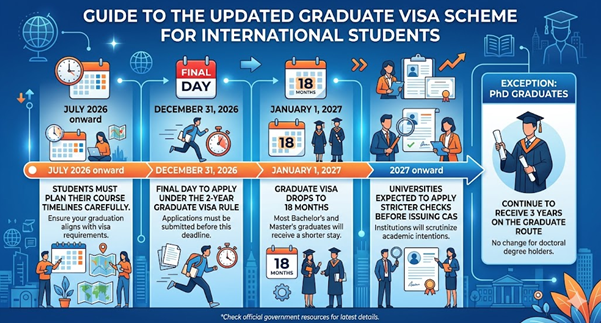
Why the December 31, 2026, Deadline Matters
The deadline for students to recall is December 31, 2026. A student who applies for a Graduate Visa by this date may be able to obtain the 2-year Graduate Visa as well.
However, there’s a big catch.
If you start your 1-year Master’s degree in September 2026, your course could possibly end by December 31, 2026. This means it is possible that you will not be able to apply for the Graduate Visa in time. The new 18-month rule may be in effect by the end of your course.
That’s why course start dates and course completion dates are now more critical than ever. Students need to reflect on the question, “Which university should I choose?” They should also enquire, “Will my graduation date fall under the old or the new rules?”
The 18-Month Graduate Visa: Why It Creates Pressure
From January 1, 2027, most Bachelor’s and Master’s graduates applying for the Graduate Visa will receive 18 months. Since the Graduate Visa cannot be extended, students will need to use that time wisely.
In practical terms, students may only have around 12 to 14 months to find a suitable job and move toward Skilled Worker visa sponsorship. This is because job hunting, interviews, employer checks, Certificate of Sponsorship processing, and visa preparation all take time.
For students in competitive sectors, this shorter window could create serious pressure. Employers may also become more selective because they know graduates have less time remaining on their visa.

Universities May Become More Careful With CAS Letters
Students could feel a bigger impact, even before they arrive in the UK. The Home Office will be more rigorous in its oversight of universities. Institutions with high visa refusal, student non-continuation rates, compliance issues, and/or unusual patterns may experience serious consequences.
Moreover, universities might be more cautious about awarding CAS letters. Students are likely to get more rigorous checks, such as credibility interviews, financial document checks, academic background checks, and enquiries about student plans.
This doesn’t mean that an offer from the university is not required. Students will need to be able to demonstrate they are sincere, able to afford it, academically acceptable, and have a clear vision of their plans.
Skilled Worker Visa Will Be the Real Challenge
For many students, it’s not just about studying in the UK. The usual long-term plan is to move from a Student Visa to a Graduate Visa and then to a Skilled Worker Visa.
Here’s where it gets tougher. Typically, applicants for skilled worker visas require a licensed employer, a suitable job, and a salary at or above the threshold or going rate. Due to already high salary levels, graduates must start thinking about their careers at an early stage of study.
Selecting the right course, gaining UK work experience, honing interview skills and targeting sponsor-licensed employers will be key.

What Should Students Do Now?
Students who are going to enrol in August/September 2026, January 2027 or later should plan ahead. Look at your course end date, figure out which of the Graduate Visa rules you might be eligible for, review your finances, and select a course that will lead to a meaningful career path.
Although the UK remains a popular study abroad choice, it is getting tougher. The earlier the students plan, the better chance they will have to make the best use of their study and post-study work opportunities
Final Thoughts
The UK Student Visa route is not closing; it is just becoming more selective. The transition from a 2-year Graduate Visa to an 18-month pathway from January 2027 changes the entire planning approach for international students.
If you are going to study in the UK in 2026 or 2027, don’t just check the university ranking or tuition fee. Check your intake date, course length, Graduate Visa eligibility, job market and Skilled Worker sponsorship chances.
Your timeline may determine your future in the UK.