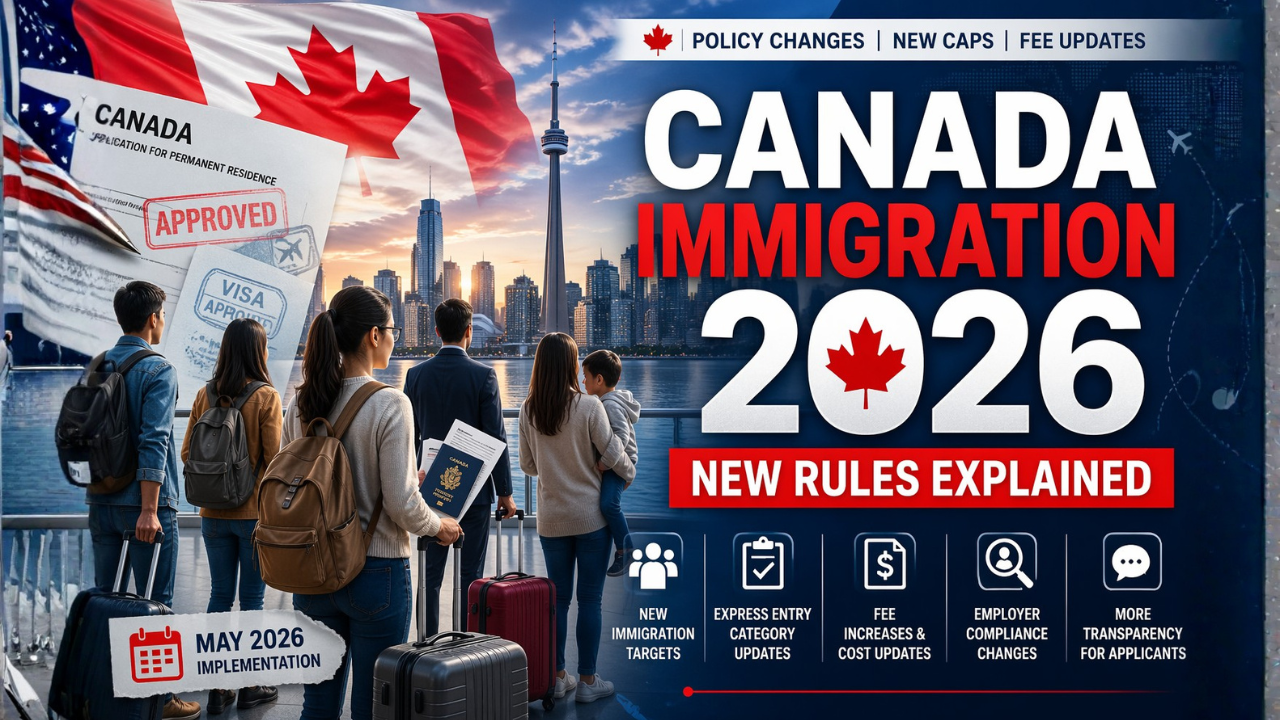
Synopsis: Canada is fundamentally reshaping its immigration system in 2026. With reduced permanent residence targets, deep cuts to student intakes, stricter work permits, and experience-based selection, this recalibration signals a decisive shift from volume to control. This analysis explains what is changing, why it matters, and who is most affected.
Canada’s Immigration Recalibration 2026: Why the Era of Easy Entry Is Ending
Canada’s immigration model, once defined by rapid expansion and record-breaking intakes, is entering a moment of reckoning. From January 2026, the federal government is implementing what it openly calls a “recalibration” of the system—one that prioritises control, sustainability, and labour-market alignment over sheer numbers. For migrants, students, and employers alike, this shift is not cosmetic; it is structural, permanent, and consequential. According to official policy guidance from Immigration, Refugees and Citizenship Canada, the coming years will be defined by tighter caps, sharper selection tools, and fewer fallback options for those already inside the country.
This is not a sudden reversal but the culmination of pressures that have been building for years: housing shortages, strained healthcare systems, public backlash, and a ballooning temporary resident population. The 2026 reforms draw a clear line under the post-pandemic expansion phase and mark the beginning of a more restrictive era. For anyone planning to study, work, or settle in Canada, understanding this recalibration is no longer optional—it is essential.

Understanding the Policy/Event
Canada’s 2026 immigration recalibration represents a strategic reset rather than a single policy change. It cuts across permanent residence planning, temporary migration, student pathways, citizenship transmission, and labour-market access. At its core, the government is attempting to correct what critics describe as an “overheated” immigration system.
In practical terms, this means fewer new entrants, tighter eligibility rules, and a stronger preference for applicants who already have Canadian experience or fill critical shortages. While the system remains points-based and rules-driven, discretion and selectivity now play a far larger role than they did between 2021 and 2024.
This recalibration also signals a shift in messaging. Canada is no longer presenting itself as a destination of open-ended opportunity. Instead, the emphasis is on contribution, retention, and alignment with national capacity.
Why It Is Happening
Several converging pressures explain why Canada has chosen 2026 as the turning point.
First, housing supply has failed to keep pace with population growth. Rental vacancy rates in major cities have collapsed, and affordability has become a dominant political issue. Second, healthcare and social services are under visible strain, particularly in provinces with high newcomer concentrations.
Third, the temporary resident population has expanded faster than any long-term settlement pathway. International students, temporary foreign workers, and visitors transitioning status now number in the millions. The federal government has acknowledged that this growth has outpaced planning assumptions.
Finally, public sentiment has shifted. While Canada remains broadly pro-immigration, support has become conditional—focused on skills, integration, and limits. The 2026 recalibration is the policy response to that changing mood.
Key Reforms or Changes
The 2026 reforms are not isolated tweaks; they form a coordinated package aimed at reducing inflows while improving selection quality.
At the headline level, three changes dominate: lower permanent residence targets, sharply reduced international student intakes, and stricter work permit eligibility. Alongside these, targeted benefits for specific groups—such as graduate students and physicians—signal where Canada still wants to attract talent.
Detailed Breakdown
Reduced permanent residence targets
Under the 2026–2028 Immigration Levels Plan, Canada will admit a maximum of 380,000 new permanent residents in 2026. This is a deliberate reduction from the 395,000 target set for 2025 and a clear departure from the growth trajectory of previous years. While the cut may appear modest on paper, it has significant downstream effects on competitiveness across all PR programs.
International student caps
The most dramatic shift is in international education. New study permits are capped at 155,000 for 2026, down from 437,000 in 2025. This represents not just a policy adjustment but a fundamental contraction of the student migration pipeline. Colleges and private institutions are expected to be hardest hit.
Graduate student exemptions
In contrast, master’s and doctoral students at public institutions gain preferential treatment. From January 1, 2026, they are exempt from the study permit cap and no longer require a Provincial Attestation Letter. This exemption signals a clear hierarchy within the student system, favouring advanced research and skills over volume enrolments.
Citizenship transmission under Bill C-3
Provisions of Bill C-3, effective from late 2025, now allow Canadian parents born abroad to pass citizenship to children born or adopted outside Canada, provided they meet a “substantial connection” test. This requires three years of physical presence in Canada, reinforcing the principle that citizenship should reflect lived ties rather than paper status alone.
Physician-focused Express Entry pathway
Early 2026 will see the launch of a dedicated Express Entry category for physicians with Canadian work experience. This targeted pathway reflects acute healthcare shortages and demonstrates how category-based selection is becoming central to Canada’s immigration strategy.
Data, Stats, and Trends
The numbers behind the recalibration tell a story of scale, imbalance, and correction. Between 2021 and 2024, Canada experienced unprecedented population growth driven largely by temporary residents rather than permanent settlers. This imbalance now defines policy thinking.
Temporary residents account for a historically high share of Canada’s population growth. International students alone surged well beyond planning forecasts, creating pressure not only on housing but also on employment and public infrastructure.
What the Numbers Show
The data reveals three critical trends.
First, temporary status saturation. Approximately 2.1 million temporary residents are expected to face expiring permits in 2026. This includes students completing programs, workers on closed permits, and visitors who transitioned status. The sheer volume creates intense competition for permanent residence pathways that are now shrinking.
Second, Express Entry concentration. Recent draws show a clear preference for the Canadian Experience Class, with a single draw on January 7, 2026 issuing 8,000 invitations. This reflects a system increasingly tilted toward those already inside Canada, rather than offshore applicants.
Third, high refusal rates. Visitor visa refusals now exceed 75%, primarily due to concerns that applicants will not leave Canada at the end of their authorised stay. This indicates a system operating under heightened risk sensitivity and scepticism.
Labour-market data from Statistics Canada also shows uneven absorption of newcomers, with underemployment remaining a persistent issue despite headline labour shortages. This contradiction has strengthened the government’s resolve to tighten selection criteria.
Impact Assessment
The impact of Canada’s 2026 recalibration will not be evenly distributed. Some groups will benefit from clearer pathways and prioritisation, while others will face reduced access and higher barriers.
For prospective migrants, the era of using temporary status as a stepping stone to permanent residence is narrowing. For institutions and employers, recruitment strategies will need rapid adjustment.
Social, Economic, and Human Consequences
For international students
Students enrolled in short-term, lower-level, or private programs face the greatest disruption. Fewer study permits mean higher refusal risks and reduced post-graduation work opportunities. Conversely, research-focused graduate students gain a clearer, more protected route.
For temporary workers
Spousal open work permits are now largely restricted to spouses of doctoral students, long-term master’s candidates, and select professional fields such as healthcare and engineering. This significantly alters family migration dynamics and reduces household income flexibility.
For job seekers
Ontario’s ban on requiring “Canadian work experience” in job postings, effective January 1, 2026, aims to reduce systemic barriers for newcomers. Guidance from the Ontario Ministry of Labour frames this as an equity measure, though enforcement and employer compliance remain open questions.
Humanitarian dimensions
Ukrainian and Sudanese nationals in Canada continue to face uncertainty as special measures approach capacity limits. While Canada maintains a humanitarian commitment, the recalibration underscores that exceptional programs are no longer open-ended.
Political Background & Stakeholder Reactions
Politically, the 2026 recalibration reflects a balancing act between economic need and public confidence. Immigration remains essential to Canada’s demographic and fiscal future, but unchecked growth has become politically risky.
Federal policymakers have framed the changes as responsible governance rather than restriction. Opposition voices, meanwhile, argue either that the cuts go too far or not far enough, depending on ideological position.
Government, Opposition & Expert Opinions
Government ministers emphasise sustainability, arguing that immigration must align with housing, healthcare, and labour-market capacity. They point to targeted pathways—such as the physician category—as evidence that Canada remains open to talent.
Opposition critics raise concerns about economic slowdown and labour shortages, particularly in construction, caregiving, and service sectors. Others argue that the student cap corrects long-standing abuses in the international education industry.
Immigration policy experts broadly agree on one point: the system has entered a phase where quality, not quantity, dominates decision-making. Analysis of Bill C-3 (Citizenship Act amendments) also highlights a philosophical shift toward citizenship as a lived relationship rather than an inherited entitlement.
Global Comparisons
Canada’s recalibration does not exist in isolation. Other major migration destinations are undergoing similar policy tightening, reflecting shared pressures across advanced economies.
The United Kingdom has raised salary thresholds and restricted dependants. Australia has capped student numbers and narrowed post-study work rights. Even traditionally open systems are recalibrating toward control and selectivity.
Where This Stands Internationally
Compared internationally, Canada remains relatively accessible—but the gap is closing. Category-based selection, experience prioritisation, and tighter temporary pathways now mirror trends seen in peer countries.
What distinguishes Canada is the scale of its previous expansion. The 2026 recalibration is therefore sharper and more visible than reforms elsewhere. It signals convergence with global norms rather than exceptionalism.
For migrants choosing between destinations, Canada is no longer the low-barrier alternative. Strategic planning, credential alignment, and long-term intent now matter more than ever.
Critical Analysis
The central question is whether Canada’s recalibration will achieve its stated goals without unintended harm. Reducing numbers may ease short-term pressure, but it also risks bottlenecks, skill shortages, and lost goodwill among prospective migrants.
The heavy reliance on Canadian experience favours those already inside the system while disadvantaging offshore talent. This may improve retention but could narrow diversity and innovation.
Will It Work?
In the short term, the recalibration is likely to stabilise housing demand and reduce administrative overload. It may also restore public confidence in immigration management.
In the long term, success depends on execution. If permanent residence pathways remain too narrow for the volume of temporary residents already in Canada, backlogs and frustration will persist. If student caps disproportionately affect certain regions or institutions, economic fallout is possible.
The targeted physician pathway and graduate exemptions show that Canada can still be agile. Whether that agility extends to other critical sectors remains uncertain.
Conclusion
Canada’s 2026 immigration recalibration marks the end of an era defined by rapid expansion and the beginning of one shaped by control, selectivity, and strategic intent. Lower permanent residence targets, sharp student caps, stricter work permits, and experience-driven selection fundamentally change the migration landscape.
For international students, workers, and families, the message is clear: Canada remains open, but only on its own terms. Success now requires precision, planning, and a realistic understanding of shifting priorities. Those who adapt early will still find opportunity. Those who rely on outdated assumptions may find the door closing faster than expected.