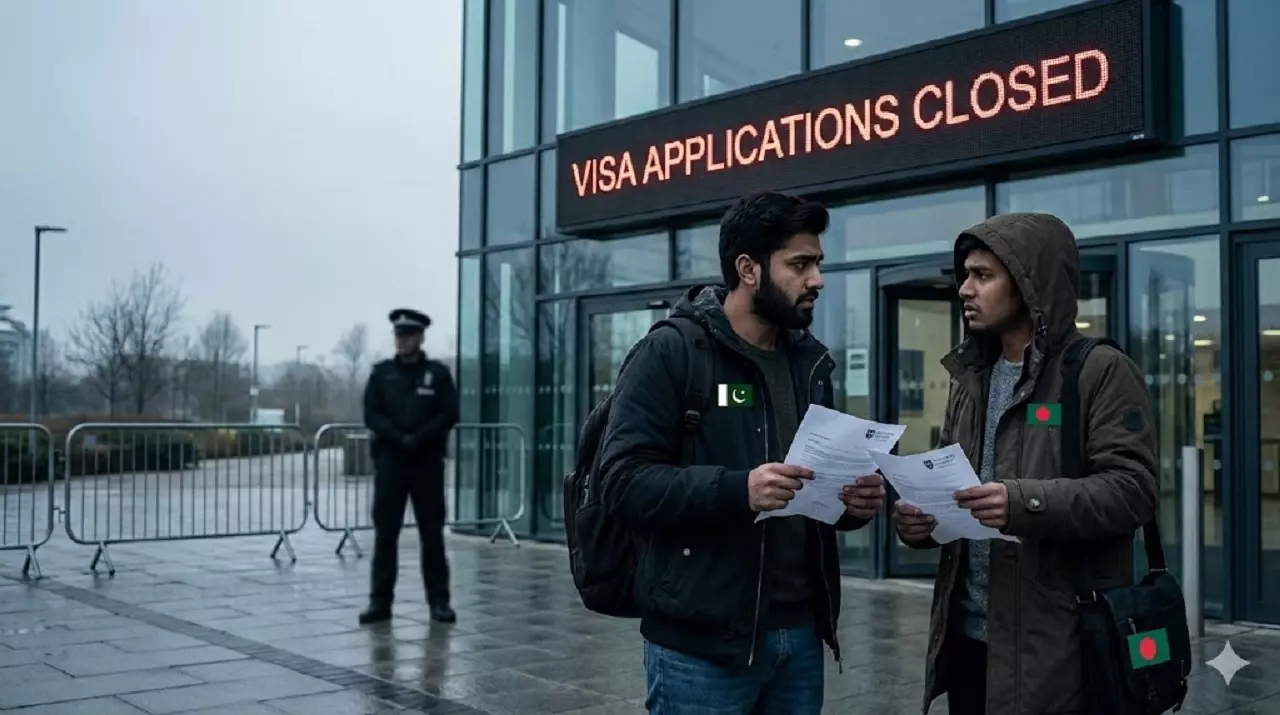
Synopsis: The UK’s tightened visa compliance rules have pushed multiple universities to suspend admissions from Pakistan and Bangladesh. Rising refusal rates, compliance risks, and the threat of losing sponsorship rights have created a crisis affecting universities, international enrolments, and thousands of genuine students seeking UK education opportunities.
UK Universities Halt Admissions from Pakistan and Bangladesh Under New Visa Compliance Crackdown
A wave of new visa compliance rules has triggered one of the most consequential shifts in UK higher education policy in years. Universities are quietly suspending admissions from Pakistan and Bangladesh as they race to meet the UK Home Office’s tightened Basic Compliance Assessment thresholds. With refusal rates climbing far beyond the new allowable limits, institutions now face sanctions severe enough to undermine both financial stability and operational survival. According to the UK Home Office, the compliance crackdown beginning September 2025 could reshape international student recruitment across the UK.
This blog explores the reforms, the data driving these decisions, the broader implications for international students, and what this moment means for the future of UK global education.

Understanding the Policy/Event
The UK Home Office has introduced a more stringent visa compliance regime aimed at reducing misuse of the student visa route and tightening institutional accountability. At the centre of this policy shift lies a new Basic Compliance Assessment threshold that will redefine how universities evaluate, recruit, and sponsor international students.
Why It Is Happening
The UK government argues that rising refusal rates and asylum claims among certain nationalities signal growing risks of visa misuse. Pakistan and Bangladesh have attracted particular scrutiny due to:
- High asylum claims
- Significant refusal rates
- Historical patterns of overstaying or switching to asylum channels
Home Office data reveals that 10,542 Pakistani nationals claimed asylum in 2024, more than any other nationality. Authorities view this trend as evidence that some applicants may be using student visas as a legal entry route before transitioning into asylum claims. This phenomenon directly impacts institutional refusal rates and puts universities at risk of breaching compliance thresholds.
Furthermore, the UK’s stated aim—according to debates recorded in the UK Parliament—is to maintain immigration system integrity while reducing non-genuine student migration. Universities, therefore, become frontline actors in ensuring compliance, even when this requires dramatic changes to recruitment practices.
Key Reforms or Changes
The most impactful reform introduced is the sharp reduction in the allowable visa refusal threshold for universities.
Detailed Breakdown
Here are the core components:
1. Reduction of Visa Refusal Threshold from 10% to 5%
Beginning September 2025, universities must maintain visa refusal rates below 5%. Previously, institutions had a 10% margin—already challenging for some regions.
Under the 5% rule:
- Pakistan’s refusal rate of 18% becomes immediately non-compliant
- Bangladesh’s refusal rate of 22% becomes even more problematic
- Universities risk immediate sanctions if they continue admissions from these markets
The significance of this policy change cannot be overstated. A refusal threshold this low effectively forces universities to suspend recruitment from any region with historically high refusal patterns, regardless of applicant volume or demand.
2. Sanctions for Non-Compliance
If a university breaches the threshold, consequences may include:
- Suspension of CAS (Confirmation of Acceptance for Studies) allocation
- Loss of sponsorship license for at least one year
- Severe reputational and financial damage
Loss of sponsorship rights is the most devastating outcome—without this license, institutions cannot host international students at all.
3. Widespread Recruitment Suspensions
Because refusal rates from Pakistan and Bangladesh far exceed the new limit, universities have started pausing or terminating admissions:
- London Metropolitan University halted all admissions from Bangladesh, citing that 60–65% of their visa refusals originate from there.
- Universities under Home Office action plans include:
- University of Essex
- Glasgow Caledonian University
- University of Central Lancashire
- Universities fully pausing recruitment from one or both countries include:
- University of Chester
- University of Wolverhampton
- University of East London
- Coventry University
- University of Sunderland
These decisions, though quiet and unannounced publicly, represent a systemic shift. The implication is clear: universities prefer to suspend recruitment rather than risk breaching the new rules.
4. Escalating Financial Risks
The stakes are enormous. International students contribute billions to the UK economy and sustain many university budgets. According to research by the Migration Observatory, international tuition revenue plays a critical role in offsetting domestic fee caps.
Compliance failures could lead to:
- Loss of tens of millions in annual tuition revenue
- Mass redundancies
- Course closures
- Inability to fund essential academic departments
Lower-fee universities are particularly vulnerable. Some rely on international enrolment for 40–60% of postgraduate funding, meaning even a temporary suspension could push them into insolvency.
5. Estimated Sector-Wide Impact
Officials estimate that:
- 22 universities are at risk of failing at least one compliance criterion
- 5 universities could lose sponsorship rights outright
- Approximately 12,000 students would be removed from the UK’s education system as a result
This is not a minor adjustment—it is a structural transformation of the UK’s international student landscape.
Data, Stats, and Trends
Understanding the statistics driving policy decisions is essential to grasping the severity of the situation.
What the Numbers Show
1. Visa Refusal Rates
- Pakistan: 18% visa refusal rate
- Bangladesh: 22% refusal rate
Both are more than triple the new allowable threshold.
These figures alone explain why universities are taking drastic steps.
2. Asylum Claims Increase
- Pakistani nationals: 10,542 asylum claims in 2024 (highest of any nationality)
The Home Office argues this suggests a link between student visa routes and subsequent asylum applications.
3. Visa Issuance Trends
- Pakistan is now the UK’s third-largest student market
- 35,045 visas issued in 2024
- Strong upward trend driven by demand for UK postgraduate programs
- Bangladesh has seen a 31% drop in visa issuances, signaling early tightening effects
4. Operational Fallout in Universities
Consequences already visible:
- Offers are being withdrawn
- Applications are placed on hold or cancelled
- Deposits—sometimes thousands of pounds—become non-refundable
- CAS issuance is slowed or paused entirely
5. Systemic Vulnerability
Universities with:
- High dependency on South Asian recruitment
- Large postgraduate taught (PGT) cohorts
- Lower domestic funding streams
are at the highest risk of falling below compliance.
The data paints a picture of both policy-driven risk and market-driven fragility, creating a perfect storm across the sector.
Impact Assessment
Social, Economic, and Human Consequences
The reforms affect not only universities but also thousands of prospective students who now face unprecedented barriers.
1. Human Impact on Students
Students from Pakistan and Bangladesh are seeing:
- Applications paused with no explanation
- Offers withdrawn at the last stage
- Deposits lost due to non-refundable institutional policies
- Dreams of UK education delayed or derailed
For many, these sudden changes carry significant emotional and financial costs. Families invest heavily—often taking loans or using savings—to fund tuition deposits and visa fees. A cancelled offer represents more than an academic setback; it is a personal crisis.
2. Economic Consequences for Universities
Universities face:
- Loss of international tuition revenue
- Reduced diversity in classrooms
- Pressure to close underfunded programs
- Job cuts among academic and administrative staff
Financial instability weakens long-term strategic planning and may push universities into a cycle of cuts and course reductions.
3. Broader Social Impact
The UK’s reputation as a welcoming destination for global talent is at stake. If major student markets lose confidence, the long-term pipeline of international skills entering the UK workforce may shrink.
Moreover, students from Pakistan and Bangladesh historically contribute significantly to social mobility within their communities; disruptions in access to UK education therefore have consequences that ripple across families, regions, and future generations.
Political Background & Stakeholder Reactions
Government, Opposition & Expert Opinions
The tightening of visa compliance thresholds did not emerge in isolation. It aligns with a wider political agenda in the UK—a drive to reduce net migration, prevent abuse of legal migration channels, and ensure universities uphold higher compliance standards. But the reforms have ignited debate across political, academic, and regulatory circles.
1. Government Position
The UK Government has consistently argued that the student visa route must not become a loophole for asylum claims or illegal overstaying. In parliamentary discussions recorded by the UK Parliament, Ministers emphasized that:
- High-risk nationalities must be scrutinized more closely
- Universities must take responsibility for “quality control”
- Non-genuine student migration is a threat to system integrity
The Government further points to the 10,542 asylum claims from Pakistani nationals in 2024, framing this as an indicator of potential visa misuse. According to Ministers, the new threshold forces institutions to “do due diligence” when admitting students from countries with historically higher refusal or asylum patterns.
2. Opposition Response
Opposition parties, while acknowledging legitimate concerns around immigration control, question whether:
- Universities are being unfairly penalized for broader geopolitical and socioeconomic dynamics
- The 5% threshold is realistic or achievable
- The reforms risk damaging the UK’s international education sector
Some MPs argue that the crackdown seems politically motivated—linked to wider narratives on migration numbers ahead of election cycles.
3. Reactions from Universities
Universities UK (UUK), sector leaders, and vice-chancellors warn that the 5% refusal threshold is “unworkable” and “punitive”, especially for institutions that rely heavily on South Asian student enrolment.
Many highlight that:
- Universities cannot control Home Office decision-making
- Genuine students are being disproportionately harmed
- Losing a sponsorship license for even one year can cause irreversible financial damage
Universities operating under Home Office action plans—such as Essex, UCLan, and Glasgow Caledonian—have expressed concern that the new rules place them in a perpetual state of operational risk, even when they comply with all other regulatory requirements.
4. Academic and Migration Experts
Analysts from the Migration Observatory note that refusal rates often correlate with:
- Local economic instability
- Document verification challenges
- Fluctuations in Home Office policies
- Rapid shifts in international student demand
They caution that applying a rigid numerical threshold without considering contextual factors may punish institutions for issues beyond their control.
5. Legal and Human Rights Concerns
Human rights organisations, including the UNHCR, warn that restricting genuine migration pathways without creating safeguards may push vulnerable individuals into more dangerous routes or exploitative conditions.
While the reforms target visa misuse, critics argue they may unintentionally marginalise legitimate students whose only “risk factor” is their nationality.
Global Comparisons
Where This Stands Internationally
The UK is not the only country tightening student visa pathways—but its approach is among the strictest, particularly in how it penalises institutions rather than individuals.
1. Canada
Canada has introduced higher financial requirements and student caps, but:
- Refusal thresholds do not penalise universities
- Institutions are not sanctioned for immigration trends among applicants
- Policies aim to balance intake rather than restrict specific nationalities
Canada’s approach is system-wide, not nationality-based.
2. Australia
Australia has introduced a risk assessment matrix, but again:
- Institutions are not threatened with sponsorship removal based solely on refusal patterns
- Countries are classified by “risk level,” but recruitment continues with added checks
- Universities collaborate with the Department of Home Affairs on compliance
Australia focuses on shared responsibility rather than punitive enforcement.
3. United States
The U.S. follows an entirely different model:
- Visa approval depends solely on consular decision-making
- Universities do not face sanctions for refusal rates
- Compliance focuses on student attendance and reporting, not admissions outcomes
The U.S. separates institutional responsibility from visa adjudication.
4. How the UK Differs
The UK stands out for:
- Setting a numerical refusal threshold (rare globally)
- Imposing severe institutional sanctions, including total sponsorship loss
- Using refusal patterns among specific nationalities to guide recruitment behaviour
In effect, the UK system is uniquely strict—and uniquely risky—for institutions with diverse student populations.
5. Long-Term Global Reputation Risks
If Pakistan and Bangladesh—two of the UK’s fastest-growing student markets—lose confidence in the system, the UK may experience long-term erosion in:
- Recruitment pipelines
- International market competitiveness
- Its reputation as an education destination
This is especially concerning given that universities in Canada, Australia, and Ireland are actively targeting the same student pools with more flexible frameworks.
Critical Analysis
Will It Work?
Whether the new visa compliance rules will achieve their intended goals remains deeply contested. A critical analysis reveals both potential benefits and significant risks.
1. Could the Policy Reduce Visa Misuse?
In theory, yes.
A stricter threshold may discourage non-genuine applicants who previously saw student visas as a low-risk entry path. Institutions will also improve pre-admission screening tools and applicant assessments, potentially reducing fraudulent applications.
However, this assumes:
- Non-genuine applicants will stop applying
- Universities can accurately identify high-risk applicants
- Visa officers maintain consistent evaluation standards
Each assumption is subject to uncertainty.
2. The Problem of the 5% Threshold
The most controversial element is the numerical threshold itself.
A 5% refusal rate:
- Does not account for Home Office policy fluctuations
- Does not consider the complexity of applicant backgrounds
- Creates undue pressure on universities to reject borderline candidates
- May incentivise institutions to avoid entire nationalities
In practice, this threshold risks becoming a blunt instrument rather than a targeted compliance tool.
3. Risk of Discrimination and Nationality-Based Decision-Making
While universities state they are motivated solely by compliance risk, the effect is unmistakable:
- Pakistani and Bangladeshi students are disproportionately affected
- High-demand markets are treated as inherently risky
- Group-level refusal data shapes admission decisions about individuals
Experts warn this creates a de facto nationality filter, even if not explicitly intended.
4. Impact on the UK Higher Education Sector
International education is a key British export, contributing billions annually. If:
- Universities pause recruitment
- Students lose confidence
- Competitor countries expand their intake
the UK may experience long-term declines in enrolments and global influence.
5. Alternative Approaches the UK Could Consider
To balance compliance with fairness, policymakers could:
- Adopt Australia’s risk matrix (targeting behaviours, not nationalities)
- Provide universities with refusal data before thresholds take effect
- Establish “warning zones” rather than immediate sanctions
- Offer training and support for university admissions teams
- Allow exemptions for postgraduate research degrees
Such reforms would ensure integrity without disproportionately harming students or institutions.
6. Is the Policy Sustainable?
Sustainability depends on whether:
- The threshold remains politically acceptable
- Universities adapt quickly enough
- Student markets absorb the shock
If refusal patterns remain unchanged, universities may permanently withdraw from key markets—harming both UK institutions and international students.
Conclusion
The UK’s decision to impose a 5% visa refusal threshold marks a significant turning point in its international education policy. While intended to safeguard the integrity of the immigration system, the reforms have triggered widespread recruitment suspensions, financial risks for universities, and major barriers for students from Pakistan and Bangladesh.
The policy may reduce certain types of visa misuse, but it also introduces:
- Operational instability
- Reputational risks
- Ethical concerns about nationality-based impacts
- Economic vulnerabilities across the university sector
As global competitors expand their international student pathways, the UK must decide whether a punitive compliance model aligns with its long-term educational and economic priorities.
Whether this policy ultimately succeeds—or backfires—will depend on future amendments, political will, and how universities navigate the next several years of compliance uncertainty.
For now, one thing is clear: the landscape of UK international education has fundamentally shifted, and both institutions and students must adapt to a far more restrictive environment.