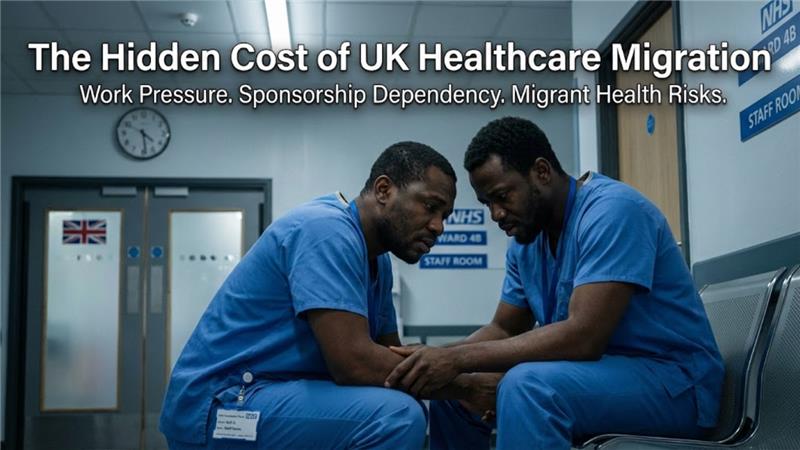
Synopsis: A tragic case involving a migrant nurse exposes deeper structural issues within the UK healthcare migration system. This analysis explores sponsorship dependency, excessive shift culture, NHS workforce shortages, migrant stress, employment rights, and policy gaps shaping the lived reality of international healthcare workers in Britain.
A 33-year-old migrant nurse prepares for his night shift. He sets his alarm for 5:45 p.m. He lies down for a short rest. He never wakes up.
While individual tragedies are often treated as isolated events, they sometimes reveal systemic pressure points within immigration and labor structures. The United Kingdom’s healthcare system relies heavily on international recruitment to address workforce shortages, as openly acknowledged in the NHS Long Term Workforce Plan.
But behind the statistics lies a more difficult question: What is the human cost of sustaining a migration-dependent healthcare system?
This article examines the structural realities facing migrant healthcare workers in the UK. It moves beyond one tragic case to explore sponsorship dependency, excessive work patterns, stress culture, employment law protections, and policy gaps.
For policymakers, migration advisors, healthcare professionals, and international workers, the issue is not emotional — it is structural. 
Understanding the Policy/Event
The UK has increasingly relied on overseas recruitment to stabilize its healthcare and social care workforce. Migrants enter primarily under the Skilled Worker route, with care workers added to the Shortage Occupation List in 2022 and later incorporated into expanded sponsorship categories.
Under current immigration rules, care workers and nurses are typically tied to employer sponsorship. Their visa status depends on continued employment with an approved sponsor.
This creates a structural dependency.
The system was designed to:
- Address staff shortages
- Stabilize care homes and NHS trusts
- Reduce vacancy rates
- Sustain public health delivery
However, it also embeds vulnerabilities. Workers whose legal status depends on employers may hesitate to refuse shifts, report excessive hours, or take sick leave.
The case that prompted this analysis involved a migrant nurse working night shifts. According to reports, he appeared healthy. He had a young family. He was preparing for work. He passed away suddenly.
His cause of death remains unknown.
Yet his story raises difficult but necessary questions:
- How many migrant healthcare workers operate under chronic exhaustion?
- How many feel unable to reduce shifts due to sponsorship dependency?
- How many are unaware of their legal working time protections?
Why It Is Happening
Several structural factors converge:
- Workforce shortages
- Sponsorship-linked immigration status
- Cost-of-living pressures
- Remittance expectations
- Cultural stigma around rest
The UK care sector has faced severe staffing gaps. According to the Migration Advisory Committee, vacancies in social care reached over 150,000 at peak levels in recent years.
To address shortages, the government expanded visa eligibility.
However, increased recruitment does not automatically translate into improved working conditions.
When labor demand exceeds supply:
- Overtime becomes normalized
- Back-to-back shifts increase
- Rest culture weakens
- Monitoring becomes inconsistent
For migrants, refusing extra shifts may feel risky.
Sponsorship dependence intensifies this dynamic.
Key Reforms or Changes
The UK government has adjusted healthcare migration policy repeatedly since 2020. Care workers were added to eligible visa categories. Salary thresholds were modified. Sponsorship compliance checks were expanded.
Recent tightening measures also aim to reduce overall migration numbers.
But do these reforms address workplace strain?
Not directly.
Current rules focus on:
- Entry criteria
- Salary thresholds
- Sponsor licensing
- Dependent restrictions
Less attention has been given to:
- Shift regulation enforcement
- Sponsorship mobility flexibility
- Mental health safeguards for migrant workers
Detailed Breakdown
Key structural elements include:
Employer Sponsorship Dependency
Workers cannot easily change employers without securing a new sponsor. The process can be complex and risky.
Working Time Regulations
Under the UK Working Time Regulations, workers should not exceed 48 hours per week unless they opt out. They are entitled to rest breaks and minimum daily rest periods.
But enforcement varies.
Shortage Occupation Framing
Healthcare and care jobs are classified as shortage roles. This encourages high recruitment volumes but does not automatically guarantee workforce sustainability.
Shift Culture
Night shifts, extended care responsibilities, and emotional labor are intrinsic to healthcare work.
When these elements combine with migration insecurity, vulnerability increases.
Data, Stats, and Trends
International healthcare recruitment has grown significantly since Brexit.
NHS staffing figures show rising numbers of internationally trained nurses. Meanwhile, care home operators increasingly rely on sponsored migrant labor.
According to the Office for National Statistics, net migration peaked at historically high levels in recent years, partly driven by healthcare recruitment.
At the same time:
- Care sector vacancies exceeded 8% of workforce positions
- Migrants represented a growing share of new NHS joiners
- Night shift dependency remained high in acute care settings
Remittance data also indicates strong financial obligations among migrant communities, particularly those from African and Asian backgrounds.
What the Numbers Show
The numbers suggest a structural reliance model:
- High vacancy rates
- Increased overseas recruitment
- Tightening immigration thresholds
- Persistent workforce strain
When workforce shortages meet sponsorship dependency, the system becomes fragile.
Workers may:
- Accept excessive overtime
- Delay medical consultation
- Minimize symptoms
- Avoid complaints
Stress becomes normalized.
Impact Assessment
The impact of this system extends beyond individual workers.
Families are affected.
Communities are affected.
Healthcare delivery is affected.
The tragic case referenced earlier involved a young father of three. His sudden death shocked colleagues and family alike. A fundraising campaign was established to support funeral costs.
But financial vulnerability is only one layer.
Chronic exhaustion can lead to:
- Cardiovascular risk
- Sleep disorders
- Anxiety
- Burnout
Research from the World Health Organization identifies workplace stress as a significant contributor to mental and physical health deterioration.
For migrant workers, stressors multiply:
- Visa insecurity
- Family separation
- Financial expectations
- Cultural adjustment
Social, Economic, and Human Consequences
Social consequences include:
- Family strain
- Community trauma
- Isolation
Economic consequences include:
- Loss of primary income
- Remittance disruption
- Funeral and repatriation costs
Human consequences are harder to quantify.
Young children lose parents.
Spouses lose partners.
Communities lose contributors.
Healthcare systems lose trained professionals.
Political Background & Stakeholder Reactions
Healthcare migration has become politically sensitive in the UK.
On one side:
- Workforce shortages demand overseas recruitment.
On the other:
- Net migration figures generate public concern.
Recent government rhetoric has emphasized reducing migration while maintaining essential services.
This creates tension.
Opposition voices argue that reducing healthcare visas without domestic workforce expansion risks system collapse.
Professional bodies warn that burnout is increasing.
Government, Opposition & Expert Opinions
Government perspective:
- Migration must be controlled.
- Domestic training must increase.
- Employer compliance must improve.
Opposition and expert view:
- Care worker visas stabilized the sector.
- Restricting migration without reforming conditions will worsen shortages.
- Sponsorship dependency requires review.
The debate remains unresolved.
Global Comparisons
The UK is not alone in relying on migrant healthcare workers.
Canada, Australia, and parts of the Gulf region actively recruit nurses internationally.
However, policy frameworks differ.
Canada offers clearer provincial mobility pathways.
Australia emphasizes employer sponsorship but provides structured regional transitions.
Some EU countries allow easier employer switching within sectors.
Where This Stands Internationally
Compared internationally:
- UK sponsorship is relatively rigid
- Care sector wages remain modest
- Enforcement of rest regulations varies
Global competition for nurses is intensifying.
Countries offering stronger worker protections may attract talent more sustainably.
Critical Analysis
Is the UK healthcare migration model sustainable?
It fills immediate staffing gaps.
But long-term sustainability requires:
- Improved working conditions
- Sponsorship flexibility
- Enforcement of rest protections
- Mental health integration
The tragic death that sparked this analysis may not have been directly caused by workplace strain.
But structural stress environments increase risk exposure.
Migration policy cannot be evaluated solely by visa issuance numbers.
It must also be evaluated by:
- Worker wellbeing
- Retention rates
- Long-term health outcomes
Will It Work?
If reforms focus only on reducing migration numbers, the workforce crisis may intensify.
If reforms expand recruitment without improving conditions, burnout may worsen.
Sustainable reform requires balance.
Policy recommendations include:
- Sector-wide enforcement audits
- Clear sponsorship transfer mechanisms
- Mandatory wellbeing assessments
- Transparent overtime monitoring
- Support networks for migrant families
Healthcare migration is not merely economic.
It is human.
Conclusion
Behind every visa approval is a life.
Behind every staffing statistic is a family.
The UK healthcare system depends heavily on migrant workers. Their contributions sustain hospitals, care homes, and community services.
But sustainability demands more than recruitment.
It demands protection.
The tragic loss of a young nurse is a reminder that workforce policy must account for human vulnerability. Immigration structures, labor enforcement, and health safeguards must align.
For international workers considering the UK, understanding both opportunity and risk is essential.
For policymakers, the question is urgent:
Can a migration-dependent healthcare model succeed without stronger worker protections?
The answer will shape not only future migration policy — but the wellbeing of thousands who keep the system running every night.