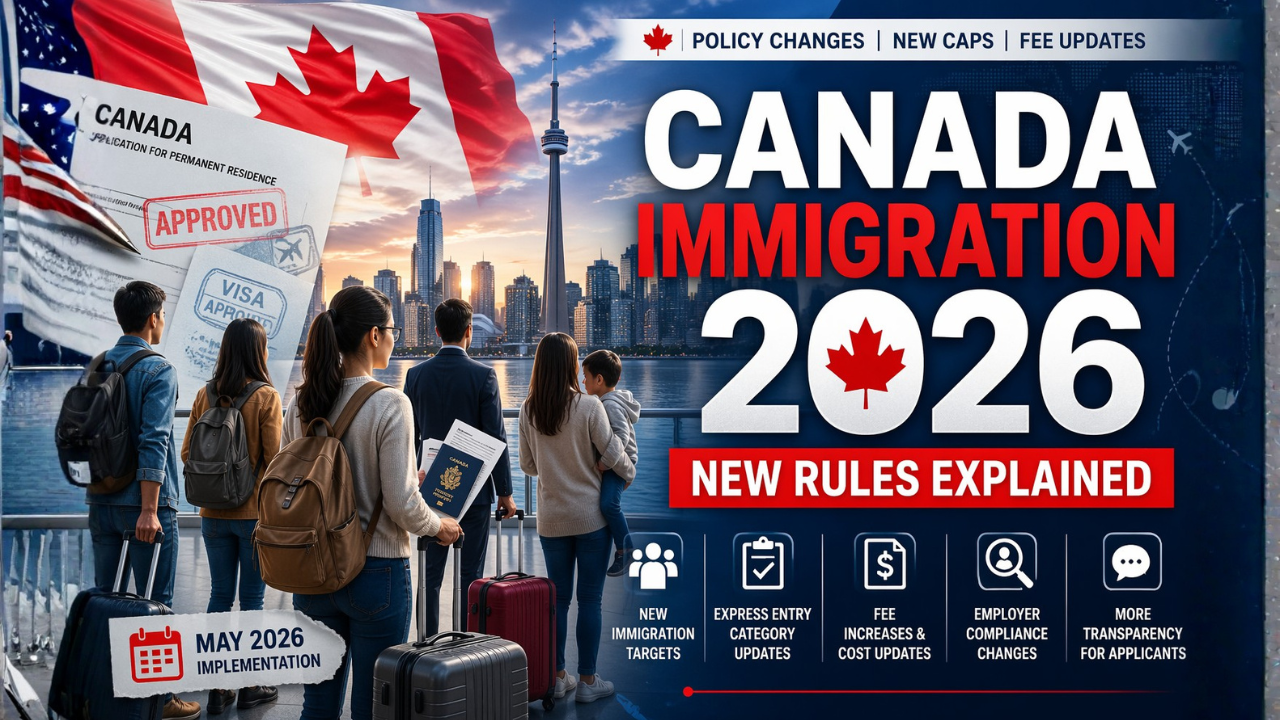
Synopsis: Canada Immigration 2025–2026 brings higher CRS cut-offs, tighter LMIA rules, and stricter student pathways. But with stronger language skills, targeted provinces, and a clear PR strategy, skilled workers and graduates can still succeed. This guide shows how to adapt quickly and improve your chances of permanent residency.
The Reality of Canada Immigration in 2025
Canada’s immigration process has never been more demanding. In the past year alone, the Immigration, Refugees and Citizenship Canada (IRCC) reduced total permanent residency targets by nearly half, citing housing shortages and labour market adjustments. Official IRCC data confirms a recalibration of the 2025–2026 Immigration Levels Plan, shifting focus toward “high-value” migrants — those with proven skills, French proficiency, or local experience.
Yet, despite these barriers, thousands still achieve permanent residency (PR) each month. What separates successful applicants from those left behind? The answer lies in adapting to Canada’s new immigration playbook. This guide explores the major pathways, policy updates, and practical steps you can take to improve your odds of success.

Express Entry in 2025: The Rules Have Changed
Rising CRS Cut-offs and Targeted Draws
The Express Entry system, once accessible to most skilled professionals, has become increasingly exclusive. CRS cut-offs now regularly exceed 525–550, focusing primarily on:
- Healthcare workers
- Tradespeople
- Educators
- French speakers
IRCC’s category-based draws introduced in mid-2024 now prioritize occupations directly tied to labour shortages. While this benefits niche professionals, it challenges others whose profiles no longer fit these targeted categories.
Language Proficiency: The Game-Changer
If your IELTS or CELPIP scores haven’t hit the 8777 benchmark, you’re already at a disadvantage. Language scores are the easiest controllable factor in your CRS ranking. Even adding French at CLB 5–6 can increase your points by 25–50 — a margin that often determines selection.
The Importance of Canadian Experience
Those already in Canada through the Canadian Experience Class (CEC) enjoy a competitive edge. In 2025, 62% of Express Entry invitations went to candidates with local work experience. Building one year of skilled Canadian work could transform your ranking overnight.
The International Student Pathway: A Harder Route to PR
Stricter Proof of Funds and Genuine Intent
The once-reliable student-to-PR pipeline is narrowing. IRCC now requires stronger proof of financial capacity and a demonstrable link between your chosen program and your long-term immigration goals. Random or low-cost study programs no longer satisfy visa officers.
Choosing the Right DLI and Program
Students must enroll in Designated Learning Institutions (DLIs) eligible for Post-Graduation Work Permits (PGWP). But eligibility alone is not enough. Choose programs that lead to employable Canadian skills, such as IT, healthcare, or supply chain management — sectors facing real labour shortages.
According to Statistics Canada, over 65% of international graduates in these high-demand fields transitioned into full-time employment within 12 months of graduation. The key? Start planning for networking and skill building from your first semester, not after graduation.
Post-Study Employment and PR Transition
The goal for international students is no longer just a diploma. It’s about obtaining a job offer and gaining one year of NOC-level experience to qualify under Express Entry or a Provincial Nominee Program (PNP). Aligning your education with employment prospects is now essential for a realistic PR strategy.
LMIA in 2025: A Tighter Labour Market Assessment
Reduced Validity and Regional Restrictions
The Labour Market Impact Assessment (LMIA) framework saw major reforms in early 2025. For low-wage roles, the validity period has been shortened from 12 months to 6 months. Provinces with high unemployment — such as Newfoundland and parts of Ontario — now face restrictions on processing certain LMIA applications.
Which Sectors Still Benefit?
Currently, only a few sectors are thriving under LMIA rules:
- Healthcare (nurses, healthcare aides, PSWs)
- Construction and infrastructure trades
- High-skilled technology occupations
- Select agriculture and logistics positions
Employers must now provide proof that they’ve exhausted local hiring options before turning to foreign candidates. For most applicants, the LMIA route is now viable only if they already have a Canadian employer willing to sponsor their position.
What’s Next for LMIA Policy?
The Employment and Social Development Canada (ESDC) is expected to announce updated LMIA caps in mid-2026, potentially giving more flexibility to industries with acute shortages. Until then, strategic targeting and employer networking remain crucial.
Provincial Nominee Programs (PNPs): Fewer Seats, Sharper Focus
Declining Nomination Quotas
PNPs remain a golden ticket for PR — providing 600 CRS points upon nomination — but the federal government has reduced provincial quotas in 2025. Provinces like Ontario and British Columbia have tightened their selection processes, prioritizing applicants in key occupations and those with existing ties to the province.
How to Align with Provincial Demand
Success with PNPs now depends on matching your skills with provincial needs. Review occupation lists from your target provinces (e.g., Saskatchewan’s Skilled Occupations In-Demand List or Alberta’s Opportunity Stream) and keep your Express Entry profile active for easy selection.
Top Tip: Build Dual Eligibility
Apply simultaneously for Express Entry and your chosen PNP. Provinces often scout from the Express Entry pool, so dual submission increases visibility.
For up-to-date information, consult each province’s immigration portal through the Council of the Federation Secretariat, which tracks interprovincial immigration coordination.
Rural and Northern Immigration Pilot (RNIP): A Hidden Gem
Why Smaller Communities Are the Future
The Rural and Northern Immigration Pilot (RNIP) offers one of the most underutilized routes to PR. Fourteen communities across Canada participate, each with its own designated employer list and occupational needs.
Roles in demand include:
- Early Childhood Educators and Assistants
- Logistics Supervisors
- Welders and Mechanics
- Restaurant Managers
- Healthcare Aides
These communities, from Thunder Bay to Vernon, actively seek workers ready to settle long term. If you can secure a qualifying job offer, your path to PR becomes significantly faster and less competitive than the Express Entry route.
Atlantic Immigration Program (AIP): Employer-Driven PR
The AIP continues to thrive across Nova Scotia, New Brunswick, Prince Edward Island, and Newfoundland and Labrador. Through designated employers, candidates can bypass LMIA requirements and obtain provincial endorsement, enabling a streamlined PR application.
The Government of Nova Scotia reports that over 12,000 newcomers gained PR through AIP in 2024 alone — a clear sign of its sustained effectiveness.
Understanding Canada’s 2025–2026 Immigration Pyramid
Tier 1: The VIP Category
At the top of the pyramid are Canada’s “priority immigrants” — skilled professionals who fill direct labour gaps in healthcare, trades, technology, and education. They often speak French, have Canadian experience, or hold provincial nominations. Their challenge is consistency, not eligibility.
Tier 2: The Strategic Movers
This middle tier includes candidates willing to relocate or re-skill. They may not have top CRS scores but can move provinces, retake language tests, or gain niche qualifications. Flexibility is their biggest asset.
Tier 3: The Strugglers
At the base are applicants with low CRS scores, older age profiles, or weak work experience. Many are international students in non-skilled roles. For them, survival depends on reinvention — upgrading skills, improving English/French, or exploring regional programs like RNIP or AIP.
The Core Lesson
Where you fall on this pyramid depends entirely on your adaptability. If you change nothing, nothing changes. But improving one key factor — such as language, experience, or mobility — can elevate your PR prospects dramatically.
Building an Action Plan for Canada PR Success
1. Pick Your Main Path and Backup
Do not rely on a single program. Combine options:
- Express Entry + PNP
- AIP + RNIP
- Study + CEC Transition
Having a secondary plan ensures you remain eligible if quotas or CRS trends shift unexpectedly.
2. Conduct an Honest Profile Audit
Use online CRS calculators to estimate your potential scores. Websites like Moving2Canada or the official IRCC tool can give you precise estimates. If you have a spouse, compare who has the stronger profile — and let them be the principal applicant.
3. Maximize Language Test Scores
Do not just “try” IELTS or CELPIP — train for it. Timed mock tests, feedback sessions, and professional coaching can improve your band scores substantially.
If you or your partner can add French language credentials, even basic proficiency gives you a competitive boost under category-based draws.
4. Target Provinces Strategically
Stop focusing only on Ontario or Alberta. Provinces like Manitoba, Saskatchewan, and New Brunswick are offering faster processing times and easier access for in-demand roles.
Being ready to relocate is a major differentiator — mobility equals opportunity in 2025.
5. Prepare a Canadian-Style Resume
When applying for jobs, ensure your resume follows Canadian formatting: one page, achievement-driven, and tailored to the job description. Mention NOC codes, quantify results, and attach a concise cover letter.
If needed, work with professionals experienced in Canadian job applications.
The Road Ahead: Strategic, Not Impossible
Canada’s 2025 immigration system isn’t broken — it’s evolving. The federal government is rebalancing economic immigration to meet labour demands while managing population growth.
For prospective migrants, this shift means:
- Higher standards, but clearer direction
- Reduced volume, but better transparency
- More competition, but fairer selection
The difference between success and failure now lies in adaptation. Whether through language proficiency, targeted skill development, or regional flexibility, the key is to align your goals with Canada’s current immigration reality.
As the OECD Migration Outlook
notes, advanced economies are redefining immigration based on long-term labour sustainability — and Canada is leading that transformation.
Conclusion: Strategy, Not Luck, Wins Canada PR
Canada’s immigration game in 2025 and 2026 demands more than patience. It demands precision. Understanding Express Entry’s new priorities, leveraging PNPs smartly, exploring RNIP or AIP, and mastering your language proficiency are no longer optional — they’re essential.
You may not control quotas or policy changes, but you can control your readiness, flexibility, and timing. The new rules may be tougher, but they reward those who learn, adapt, and act strategically.
With the right preparation, persistence, and clarity of purpose, you can still make your dream of becoming a Canadian permanent resident a reality — not by luck, but by strategy.