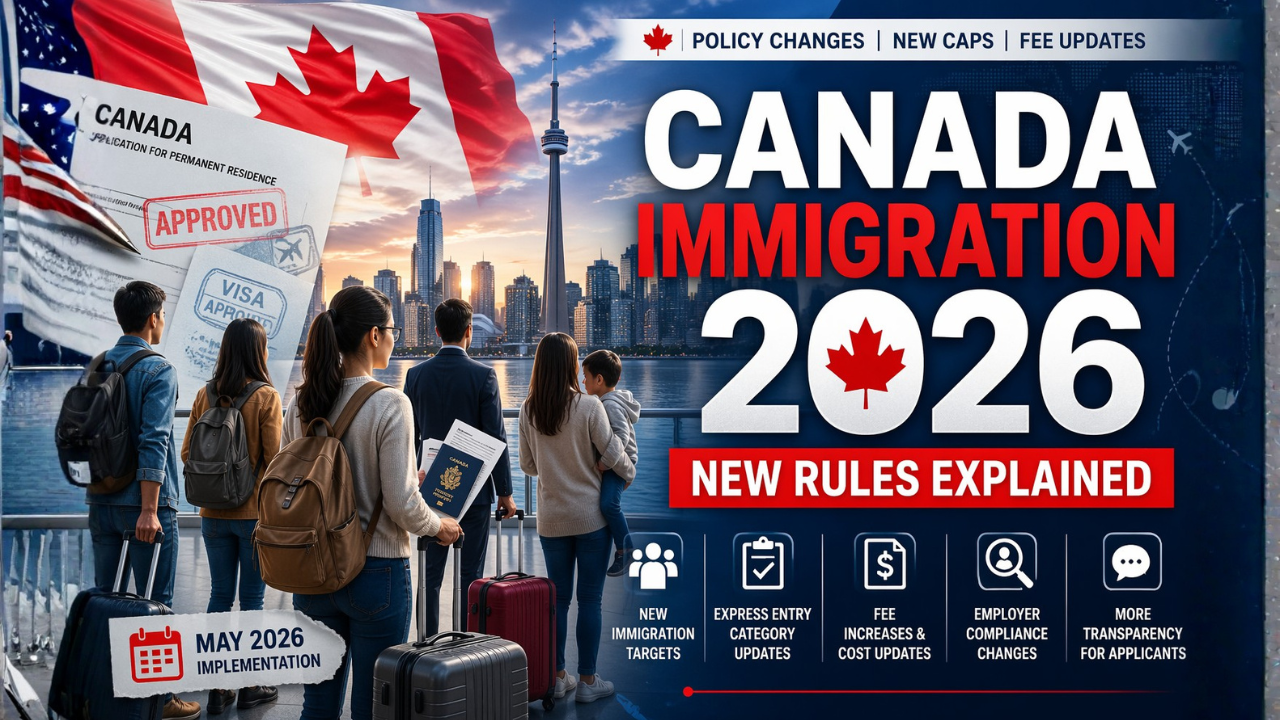
Synopsis: Canada is recalibrating immigration by reducing temporary permits while expanding targeted Express Entry categories for doctors, researchers, senior managers, and military recruits. This long-form analysis examines the policy shift, labor shortages, economic objectives, political implications, and global comparisons shaping Canada’s evolving immigration framework in 2025 and beyond.
Introduction
Canada’s immigration system is entering a decisive new phase. While temporary student and worker streams are being scaled back, the federal government is simultaneously accelerating permanent residency pathways for select high-skilled professionals. According to official data from Immigration, Refugees and Citizenship Canada, new study permit approvals dropped sharply between 2024 and 2025 — signaling a structural shift rather than a temporary adjustment.
What does this mean for international students? For foreign-trained doctors? For skilled workers abroad?
At the heart of this transformation lies a re-engineered Express Entry system — one increasingly focused on targeted economic impact rather than volume-based intake. Immigration Minister Lena Diab has made it clear: Canada will recruit “the right people” to fill strategic labor shortages, strengthen innovation sectors, and support national security priorities.
This is not merely administrative reform. It is a philosophical recalibration of how Canada defines immigration success. 
Understanding the Policy/Event
Canada’s immigration strategy has traditionally balanced three pillars:
- Economic growth
- Family reunification
- Humanitarian commitments
However, recent announcements reveal a stronger emphasis on economic optimization and sector-specific labor shortages.
In 2023, the government introduced category-based Express Entry draws. By 2025, these categories have evolved further — prioritizing:
- Physicians with Canadian work experience
- Scientific researchers
- Senior managers
- Aerospace professionals
- Skilled foreign military recruits
Simultaneously, temporary resident pathways — particularly study and work permits — have been tightened.
Is this contradictory? Or is it strategic targeting?
Why It Is Happening
Several converging pressures explain this shift:
- Post-pandemic student surge
During COVID recovery years, Canada admitted record numbers of international students. Infrastructure, housing, and healthcare systems felt the strain. - Long-term labor shortages
Healthcare gaps remain severe. Rural communities continue facing physician shortages. - Defense industrial expansion
Canada announced a $6.4 billion defense industrial strategy, increasing demand for aerospace engineers, military personnel, and transport specialists. - Economic recalibration
Immigration is explicitly tied to economic growth under the Immigration and Refugee Protection Act, which prioritizes labor market integration.
In essence, the government appears to be saying: quality over quantity.
Key Reforms or Changes
The reforms fall into two parallel tracks:
- Reduction of temporary inflows
- Acceleration of permanent residency for targeted professions
This dual-track approach creates both opportunity and uncertainty.
Detailed Breakdown
- Fast-Tracked Express Entry Categories
New and expanded draws focus on:
- Medical doctors with Canadian work experience
- Researchers contributing to innovation ecosystems
- Senior executives and managers
- Military recruits with job offers from the Canadian Armed Forces
- Pilots, aircraft mechanics, and inspectors
These align with Canada’s national defense strategy and innovation goals.
- Canadian Work Experience Emphasis
Unlike earlier category draws that accepted foreign experience, newer categories appear to favor candidates already employed in Canada.
This raises questions:
- What qualifies as “Canadian experience”?
- Will foreign-trained professionals without local licensing be excluded?
- Does this disadvantage overseas applicants?
Policy clarity remains limited, and implementation details are still unfolding.
- Temporary Permit Reductions
IRCC data shows:
- 61% decrease in new study permit holders from 2024 to 2025
- 47% decrease in new worker permits in the same timeframe
These are not marginal declines. They represent structural tightening.
Data, Stats, and Trends
Immigration statistics provide insight into Ottawa’s recalibration.
Recent reports indicate:
- International student intake has slowed dramatically
- Healthcare worker shortages remain persistent
- Canada continues to rely on immigration for population growth
According to recent data referenced by Statistics Canada, immigration accounts for nearly 100% of Canada’s net population growth in recent years. That makes any shift in intake policy economically significant.
What the Numbers Show
Consider these trends:
- Canada admitted record numbers of temporary residents during pandemic recovery
- Housing affordability pressures intensified
- Provincial healthcare systems reported staffing shortages
At the same time:
- International graduates often struggle with credential recognition
- Foreign-trained doctors face licensing bottlenecks
- Employers report skill mismatches
The government appears to be recalibrating based on outcomes rather than intake numbers.
But will prioritizing those already in Canada solve systemic licensing barriers?
Impact Assessment
The new strategy creates clear winners — and potential losers.
Who benefits?
- Doctors already practicing in Canada
- Researchers embedded in Canadian institutions
- Senior executives with Canadian work history
- Military recruits with job offers
Who faces uncertainty?
- International students planning future PR pathways
- Overseas professionals without Canadian experience
- Temporary foreign workers in lower-demand sectors
Social, Economic, and Human Consequences
Economic Effects
Targeted immigration may:
- Fill healthcare shortages faster
- Support innovation clusters
- Strengthen aerospace and defense industries
However, restricting student permits may:
- Reduce tuition revenue for universities
- Impact local economies dependent on international students
- Affect rental markets differently across provinces
Social Effects
Canada’s brand as an open immigration destination may face recalibration.
Mixed messaging can create confusion:
- Are students still welcome?
- Are overseas applicants disadvantaged?
- Is this a temporary tightening or long-term policy pivot?
Human Impact
Consider foreign-trained physicians:
Many arrive highly qualified. Yet licensing constraints often force them into unrelated employment. If Canadian work experience becomes mandatory for Express Entry categories, those unable to secure initial medical roles may remain excluded.
This is a critical tension.
Political Background & Stakeholder Reactions
Immigration policy rarely exists in isolation.
Public debates around housing, healthcare capacity, and infrastructure have intensified. Political leaders face pressure to demonstrate control while maintaining economic growth.
The federal government states it is focusing immigration “where it delivers the greatest impact.”
According to the official statement from the Government of Canada, priorities include:
- Filling labor gaps
- Strengthening key economic sectors
- Supporting communities nationwide
Government, Opposition & Expert Opinions
Government Position:
- Immigration must align with economic needs
- Targeted Express Entry improves efficiency
- Defense and healthcare priorities justify selective fast-tracking
Legal Experts:
Immigration lawyers note uncertainty around implementation details, particularly concerning Canadian work experience definitions.
Opposition Concerns:
Critics argue that:
- Reductions in student permits send negative signals internationally
- Licensing bottlenecks remain unresolved
- Policy clarity is insufficient
The debate reflects a broader tension between economic pragmatism and reputational risk.
Global Comparisons
Canada does not operate in isolation.
The UK has tightened student visa rules and increased salary thresholds. Australia has introduced student caps and stricter migration controls. The United States continues to face visa backlog challenges.
Compared to these systems, Canada still offers structured permanent residency pathways through Express Entry — a relatively transparent, points-based model often referenced in analyses by the OECD Migration Outlook.
Where This Stands Internationally
Canada’s approach can be described as:
- More selective than before
- Still more predictable than many competitors
- Increasingly occupation-specific
Unlike purely restrictive systems, Canada is not closing doors — it is narrowing them.
The question becomes: does selective targeting enhance competitiveness or reduce attractiveness?
Critical Analysis
The strategy contains strengths:
- Direct alignment with labor shortages
- Clear economic rationale
- Faster pathways for high-impact professions
However, weaknesses remain:
- Credential recognition barriers persist
- Overemphasis on Canadian experience may exclude global talent
- Reduced student inflows could affect long-term innovation pipelines
Is Canada optimizing or overcorrecting?
Will It Work?
Success depends on execution.
If:
- Doctors can integrate into healthcare systems quickly
- Researchers receive institutional support
- Military recruits meet defense objectives
- Express Entry draws remain transparent
Then the model may enhance economic outcomes.
But if:
- Licensing bottlenecks remain unresolved
- International students lose confidence
- Global competitors offer clearer pathways
Canada could risk diminishing its long-standing reputation as a premier immigration destination.
Policy outcomes will ultimately be measured in numbers:
- Permanent residency approvals
- Healthcare vacancy reductions
- Innovation metrics
- Labor force participation rates
2025 will be a decisive year.
Conclusion
Canada’s shifting immigration strategy represents a calculated recalibration rather than a retreat. By reducing temporary streams while expanding targeted Express Entry categories, the federal government is prioritizing measurable economic and national security outcomes.
The emphasis on Canadian work experience signals a preference for integration-ready candidates. Yet this also raises important questions about access, fairness, and long-term global competitiveness.
For international professionals, students, and employers, the message is clear: immigration pathways remain open — but increasingly selective.
As implementation unfolds, clarity and consistency will determine whether this strategy strengthens Canada’s economy or complicates its global standing.
The world is watching. And so are prospective immigrants.