
Synopsis: An essential breakdown of the 2026 UK student visa regulations and their impact on international applicants and universities. It balances the political migration debate with a highly practical compliance guide covering financial proof, university tracking, and genuine intent.
Are you planning to study in the UK? Then you really shouldn’t ignore this new update.
The UK government has introduced a new Student Visa system based on stricter checks, compliance and regulations. Now, both international students and the universities are under tighter scrutiny than before for admissions and enrolments.
For decades, the United Kingdom has been one of the most sought-after study destinations because of its internationally acclaimed universities, globally accepted degrees, multicultural education system, and strong post-study opportunities.
However, with the recent policy changes, the government aims for tighter immigration control, reduced misuse of visas, and stronger compliance from universities. These changes are part of a wider nationality and immigration plan to ensure that only genuine students use the student visa route.
This does not mean the UK is shutting its doors. It simply means that only deserving and eligible individuals get the chance to benefit from the UK’s prestigious educational system.
In this student guide, we will explain the latest UK student visa rules, the new traffic light rating systems for the UK universities, key requirements international students should be aware of, and how these immigration policies may impact future applicants. 
What is the UK Student Visa?
The UK Student Visa is a gateway/entry pass for international students to pursue their higher education at any of the approved and licensed institutions in the United Kingdom.
To score an admission, the students typically need:
- An offer from a recognised UK university or institution
- A CAS (Confirmation of Acceptance for Studies)
- Proof of funds
- English language test results (IELTS)
- Academic transcripts and supporting documents
The UK student visa is intended for students who genuinely want to continue their education in the UK. However, the government believes that some individuals may be using the student route as a backdoor migration pathway.
As a result, the government is introducing stricter compliance measures for both international students and the universities that sponsor them.
Why is the UK Student Visa System Changing?
Over the years, the UK government has been working towards making immigration compliant and transparent. It argues that the following three concerns drive the new changes in the UK student visa system.
- Rising net migration
- Student visa misuse
- Pressure on public services.
The recent reports indicate that the new immigration reforms have already led to a decline in migration levels. Alongside, the new rules are designed to signal that the government is actively managing immigration while protecting the integrity of the UK visa framework.
One of the major concerns the government highlights is that people enter the UK on student visas, but they do not intend to complete their education. Later, they even claim asylum.
It in turn put additional pressure on the government for provision but also on taxpayers, the NHS, and the overall immigration system. Therefore, the government now demands the universities conduct stricter application review processes to grant admissions and sponsorship only to deserving and eligible international students.
The New Traffic Light System for UK Universities
One of the biggest changes that the UK government has introduced is the new traffic light rating system for universities.
It puts universities into three categories: green, amber, and red, depending on their compliance performance and level of risk in managing international student sponsorship.
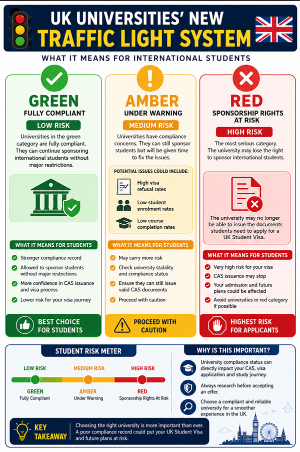
New UK Student Visa Sponsorship Requirements
In the new student visa system, the government is placing greater responsibility on the universities to ensure that the students they sponsor are genuine and compliant with the visa regulations.
The new rule book outlines three major strict benchmarks that the universities must meet, which we have discussed below:
Universities Must Keep Visa Refusal Rates Below 5%
Requirement # 1: Visa Refusal Rate <5%
This means that if the institution grants admission to a large number of international students but a significant portion of them are refused visas, the university may face penalties or increased scrutiny.
For instance, if a university issues an admission letter or sponsorship documents to an applicant who lacks financial eligibility, the visa application will be rejected, and the refusal rate for that institute could rise, putting the institution at risk.
How To Improve Refusal Rate
- Universities must screen students more carefully
- Weak applications may be filtered earlier
- CAS issuance should be stricter
What This Means for Students
International students should expect a higher level of scrutiny during the application process. Universities may now require stronger proof of:
- Academic qualification
- Financial capacity
- English language proficiency
- Clear and genuine study intent
Applications with incomplete documentation, vague study plans, unclear funding sources, or weak applications may find it harder to secure admission.
In simple words, universities will avoid unnecessary compliance risks since their sponsor licence is now under closer monitoring.
At Least 95% of Sponsored Students Must Enrol
Requirement #2: Enrolment Rate ≥ 95%
The updated UK visa system aims to eliminate fraudulent cases. It highlights that some individuals obtain sponsorship documents, secure student visas, enter the UK, and then fail to register with their university.
Why Enrolment Matters
Now the universities carry more responsibility for ensuring genuine participation in education. This rule is designed to:
- Reduce “visa-only entry” cases
- Ensures students attend courses
- Strengthens attendance tracking
Under the revised system, universities are expected to sponsor only those applicants who are genuinely committed to studying. Because if students fail to appear in classes after entering the UK, the university may face serious compliance issues. .
What It Means For International Students
Applicants should come fully prepared to start their education in the UK. Visa is just the first step but true compliance after arrival through enrolment, attendance, and adherence to visa conditions.
At Least 90% of Students Must Complete Their Course
Requirement # 3: Course Completion Rate ≥ 90%
The government has raised concerns that some students enter the UK, start their courses, but withdraw without completing the degree. In many cases, this is linked to financial pressure and difficulty managing living costs alongside academic demands.
A typical cost breakdown for international students often looks like this:
Living expenses ██████████████ 35%
Tuition fees ███████████████████ 45%
Accommodation ██████████ 15%
Other costs ████ 5%
In reality, students may later realise that living expenses are higher than expected, part-time work opportunities are limited, and balancing employment with studies is more challenging.
What Does This Mean For Students
Many international students underestimate the total cost of studying in the UK. Therefore, they need a well-drafted financial strategy that reduces stress and significantly increases the likelihood of successfully completing the course.
Why the Government is Targeting Student Visa Abuse
The UK government says these rules are designed to protect the immigration system from abuse.
| Category | Number |
|---|---|
| Student sponsorships issued | 49,954 |
| Asylum claims | 10,835 |
What This Means
The issue has also become a point of political and public debate, as asylum applications can place additional pressure on government resources, including housing provision and access to public services.
The government maintains that while genuine students are encouraged to study in the UK, misuse of the student visa pathway for unrelated purposes must be controlled.
How These Changes Could Affect UK Universities
Many universities have expressed concerns about the proposed tightening of immigration rules. As noted in the latest news article, some institutions warn that stricter policies could result in financial strain, job reductions, and in extreme cases, potential closures.
International students represent a significant revenue stream for UK universities. They pay substantially higher tuition fees compared to domestic students and also contribute to the broader economy through spending on rent, transport, retail, and other daily needs.
A latest report by London Economics estimates that international students contribute between £20 billion and £25 billion to the UK economy.
A decline in international student numbers could therefore create financial challenges for some universities, potentially impacting course availability, staffing levels, research output, and even the economic stability of certain regional areas.
Will the UK Still Welcome International Students?
The key question many applicants are now considering.
The short answer is yes, but under tighter scrutiny and more rigorous verification processes. The UK continues to value and welcome genuine international students for:
- Academic diversity
- Skilled global talent
- Economic contribution
But now the key difference is:
The government wants to make sure that the UK Student Visa route is used properly.
The Debate Around the New UK Student Visa Rules
The new UK student visa rules are under constant scrutiny from two completely different perspectives. Here’s a strong comparison of both sides.
| Supporters | Critics |
|---|---|
| Every country has the right to control its borders | New rules could damage the UK economy in the long term |
| Visa abuse damages public trust | Students may prefer other destinations like Canada, Australia, Germany, or the US |
| Students’ visas should be used for actual studying, not as a backdoor migration route | This could damage UK’s global reputation and discourage talented students |
| Reducing migration may ease pressure on housing, the NHS, and other public services | The government may mix genuine cases with fraudulent ones and punish the wrong person |
| The new system will allow universities to enrol smarter students and not just increase revenue through international admissions |
What International Students Should Do Before Applying
Applicants today need a more thorough level of preparation than before.
Select a Reliable University
Do not choose an institution solely because of fast admission offers. Evaluate its academic reputation, compliance history, student support system, course structure, and graduate outcomes. A well-established university can significantly improve both your visa approval chances and overall study experience.
Prepare Verified Financial Evidence
Ensure your funds are legitimate, properly maintained, and clearly traceable. Financial documentation is one of the most critical components of a student visa application. Avoid submitting incomplete bank statements, unexplained deposits, or unclear funding sources.
Present a Clear Academic Intent
You should be able to clearly justify your course selection, your decision to study in the UK, how the qualification aligns with your long-term goals, and why the chosen university is the right fit.
An unclear or inconsistent study rationale can raise concerns during assessment.
Understand the Financial Reality of Studying in the UK
The UK offers strong academic and career opportunities, but it comes with high living costs. Depending heavily on part-time work is not a sustainable strategy.
Plan your finances in advance to ensure you can comfortably manage both tuition fees and living expenses.
Follow Visa Requirements
After arrival, students must enrol on time, attend classes regularly, stay in contact with their university, and comply with all visa conditions. Approval is only the beginning. Continued compliance is essential throughout your stay.
FAQs
What are the new UK student visa rules in 2026?
The UK government has introduced stricter compliance for universities and students, including new requirements related to visa refusal rate, student enrolment, and course completion.
Will the new UK student visa rules affect international students?
Yes, international students may face more thorough checks on their finances, academic qualifications, English language ability, and study intentions. Universities may also become more selective when issuing admission offers and CAS.
Can I still get a UK Student Visa under the new rules?
Yes. Students who meet the eligibility requirements, provide genuine documentation, and intend to study and complete their course can still apply for and obtain a UK Student Visa.
How much money do I need to show for a UK Student Visa?
For a UK student visa, you need to show a tuition fee for up to 9 months plus, which is £1,529/month for courses in London and £1,171/month for courses outside London plus the living costs.
Can I work while studying on a UK student visa?
Yes, most international students can work part-time during their studies, subject to visa restrictions.
What happens if my university loses its student sponsorship licence?
If a university loses its sponsorship rights, it may no longer be able to issue CAS documents to new students. This could affect future applicants and, depending on the circumstances, may also impact currently enrolled international students.
Final Thoughts on the UK Student Visa Changes
Planning to apply for a UK Student Visa? Begin early, research universities thoroughly, and ensure all documentation is accurate and complete.
The UK student visa route isn’t closing, but it is moving toward stricter compliance and tighter evaluation standards.
The government aims to minimise misuse, better manage migration flows, and increase accountability among universities that sponsor international students. At the enrolments and place pressure on the higher education sector.
For genuine applicants, the direction is clear: prepare thoroughly, select institutions with care, submit transparent and verifiable documents, and approach your studies with full commitment.
The UK continues to stand as one of the world’s leading education destinations, but the tolerance for weak or unprepared applications is steadily shrinking.
For more updates on UK immigration, student visas, and study abroad news, keep following our latest guides, and share this article with anyone planning to study in the UK.