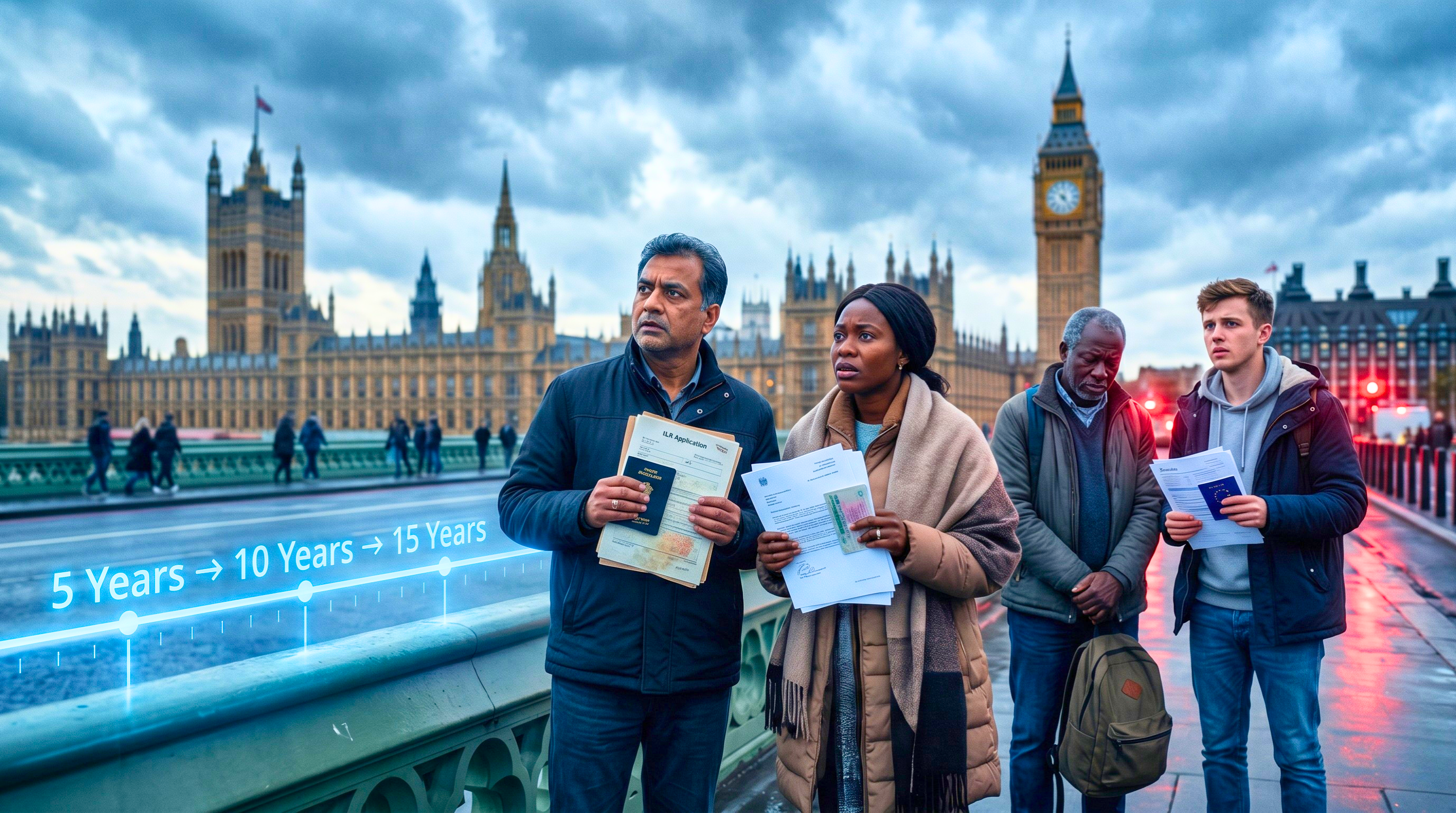
Synopsis: Shabana Mahmood migration rules 2025 tighten pathways to settlement by doubling ILR residency to ten years and adding contribution, language, and compliance tests. The reforms prioritise accountable integration but risk delaying family reunification, pressuring employers and prompting legal challenges as migrants and policymakers navigate a conditional route to permanent residence.
A Defining Moment for UK Migration Policy
The Labour government has unveiled one of the most consequential shifts in UK immigration rules in decades. In her first major speech as Home Secretary, Shabana Mahmood laid out a tougher, contribution-driven framework for migrants seeking to settle permanently in Britain. Her remarks came against the backdrop of rising political tensions, anti-immigration protests, and growing public unease about control at the borders.
Mahmood acknowledged her own family’s immigrant background but stressed that migration must be managed within the boundaries of fairness, contribution, and security. She announced that the time to qualify for Indefinite Leave to Remain (ILR) will be doubled from five years to ten years, accompanied by rigorous tests around work, tax contributions, English proficiency, and community engagement. These reforms, she argued, are essential for preserving the UK’s openness while addressing public concerns over border control and illegal working.
The proposed reforms carry weight far beyond administrative policy—they reshape the path to belonging in Britain. According to the UK Home Office’s official statistics (gov.uk), net migration exceeded 2.6 million between 2021 and 2024, fuelling widespread debate about sustainability and integration. Mahmood’s proposals mark Labour’s attempt to balance compassion with control, amid fears of rising ethnonationalism and societal division.

Patriotism, Ethnonationalism, and the Immigration Debate
The Shifting Narrative of National Identity
In her speech, Mahmood described patriotism as a force that has historically bound the nation together, rooted in pride for a country that is open and evolving. Yet she warned that this broad, inclusive patriotism is being increasingly supplanted by ethnonationalist ideologies—ones that reject the possibility of a British identity for minorities or immigrants.
She cited the 150,000-strong march in London on 13 September 2025, which was marred by violence, racist slogans, and extremist affiliations. For Mahmood, this was not simply an isolated episode of far-right anger but part of a broader crisis of trust: a belief among many working-class communities that the system no longer works for them.
Public Perceptions of Control
The issue, Mahmood argued, is not limited to ideology. It is about the perception of control. Whether it is small boat crossings in the Channel, illegal working undermining British jobs, or rising local crime, many people feel their communities are destabilised. Without control, she warned, the UK cannot sustain its values of openness, tolerance, and generosity.
This framing resonates with findings from the Migration Observatory at the University of Oxford (migrationobservatory.ox.ac.uk), which has long documented how perceptions of border chaos directly impact public confidence in immigration policy.
Border Enforcement: Cracking Down on Small Boats
The French Deal and Returns Policy
On her second day as Home Secretary, Mahmood confronted the reality of more than 1,000 small boat arrivals in 24 hours. While acknowledging that the French returns deal brokered by her predecessor Yvette Cooper was a step forward, she stressed that incremental improvements are not enough. Criminal gangs profiting from smuggling operations must face dismantling, while migrants without protection claims will face removal.
Ending Hotel Accommodation
She pledged to end the use of hotels for housing asylum seekers, describing them as a divisive legacy of the Conservative government. Instead, Labour will focus on community-based alternatives, improved processing, and partnerships with local authorities.
The urgency reflects mounting fiscal and political pressure: official Home Office data shows that asylum accommodation costs exceeded £8 million per day in 2023. By ending hotel reliance, Labour hopes to signal both fiscal responsibility and stronger integration pathways.
Migration Numbers and the Trust Deficit
The Surge Under Conservative Leadership
Between 2021 and 2024, the UK experienced net migration of 2.6 million people, including over 710,000 entrants under the health and social care visa. Mahmood highlighted abuse of this route, where many workers entered but later vanished into the shadow economy.
This erosion of trust mirrors wider frustrations. The Office for National Statistics (ONS) (ons.gov.uk) confirmed that such levels were unprecedented in modern UK history, feeding a narrative that migration is “out of control.”
Contribution as a Condition
Mahmood’s central message: contribution is the cornerstone of welcome. Just as her parents worked hard and became part of British society, today’s migrants must demonstrate tangible integration. Without such accountability, public support for migration risks collapse.
Indefinite Leave to Remain: New Rules and Requirements
Doubling the ILR Qualification Period
One of the most striking reforms is the proposal to increase the residence requirement for ILR from five years to ten years. This change fundamentally alters the settlement timeline for skilled workers, students transitioning to work, and other long-term migrants.
Proposed Contribution Tests
Mahmood outlined a series of mandatory tests for settlement eligibility, including:
- Continuous employment with National Insurance contributions
- No reliance on public benefits
- High-level English language proficiency
- Clean criminal record
- Evidence of community contribution, such as volunteering
Migrants who excel in these areas may qualify earlier, while those falling short could face extended waits or permanent ineligibility.
According to the Migration Advisory Committee (gov.uk MAC reports), such contribution-based systems are increasingly used internationally, particularly in Australia and Canada, as ways to ensure integration and fairness.
Labour Market and Fairness
Tackling Illegal Working
Illegal working, Mahmood stressed, undercuts both wages and trust. Labour will crack down on employers exploiting migrants, impose stricter compliance checks, and make companies fund training for domestic workers if hiring from abroad.
This approach echoes policies in other OECD countries where employer accountability has proven essential in balancing migration needs with labour market fairness.
Ensuring Public Confidence
The central premise is fairness: migrants who contribute are welcome, but the system cannot reward those who exploit loopholes. This dual commitment—to compassion and to control—seeks to rebuild consensus around migration in a fractured political climate.
Safer Streets, Stronger Communities
Crime and Public Confidence
Mahmood broadened her scope beyond migration, linking safety to national cohesion. Communities cannot feel open and tolerant if plagued by crime, she argued. She cited the government’s pledge to add 3,000 neighbourhood police officers by 2026 and reform policing to focus on violent crime, shoplifting, and anti-social behaviour.
Shoplifting and Everyday Crime
Drawing on her own experience in her parents’ corner shop, Mahmood dismissed the notion of “low-level crime.” Shoplifting and anti-social behaviour erode community trust and safety. Initiatives such as the “summer of action” policing campaign in 600 locations will be expanded into winter campaigns to target retail theft.
The emphasis is clear: safety is a precondition for openness.
National Security and Counter-Terrorism
Mahmood pledged unwavering commitment to national security. As a Muslim politician who lived through the post-9/11 and 7/7 climate, she acknowledged the sensitivities but stressed that the UK must be firm against terrorism regardless of origin.
The UK Security Service (MI5) (mi5.gov.uk) continues to report constant but often unseen threats to national stability. Mahmood reiterated her support for intelligence services and law enforcement, framing security as the foundation of Britain’s democratic values.
Critical Analysis: Implications of Mahmood’s Proposals
Strengths of the Contribution Model
- Reinforces fairness by rewarding integration
- Aligns with public demand for accountability
- Deters abuse of migration pathways
- Positions Labour as pragmatic, not permissive
Risks and Challenges
- Potential delays for migrants with genuine ties but precarious employment
- Administrative burdens in verifying volunteering and contributions
- Risk of creating a two-tier migrant experience, where high earners integrate faster
- Possible legal challenges under human rights and equality frameworks
Political Ramifications
By adopting a tough stance, Labour aims to outflank populist critics like Nigel Farage while retaining credibility with working-class voters. However, balancing toughness with compassion will be a delicate act—especially as Labour seeks to differentiate itself from Conservative mismanagement without appearing equally harsh.
Conclusion: Earning the Right to Belong
Shabana Mahmood’s speech signals a new era in UK migration policy—one where settlement is no longer a function of time alone but of contribution, integration, and accountability. By doubling the ILR period to ten years, cracking down on illegal working, and enforcing border control, Labour seeks to restore trust in a system many believe has failed.
At its core, the vision is of an open but controlled Britain: one that continues to offer refuge and opportunity, but only on terms that respect fairness and contribution. For migrants, the message is clear—you must earn the right to stay. For the public, the promise is equally direct: Britain will be generous, but it will also be firm.
Whether these reforms succeed will depend on implementation, public reception, and the capacity of institutions to enforce new rules effectively. But one thing is certain—the debate over Britain’s migration future is only just beginning.