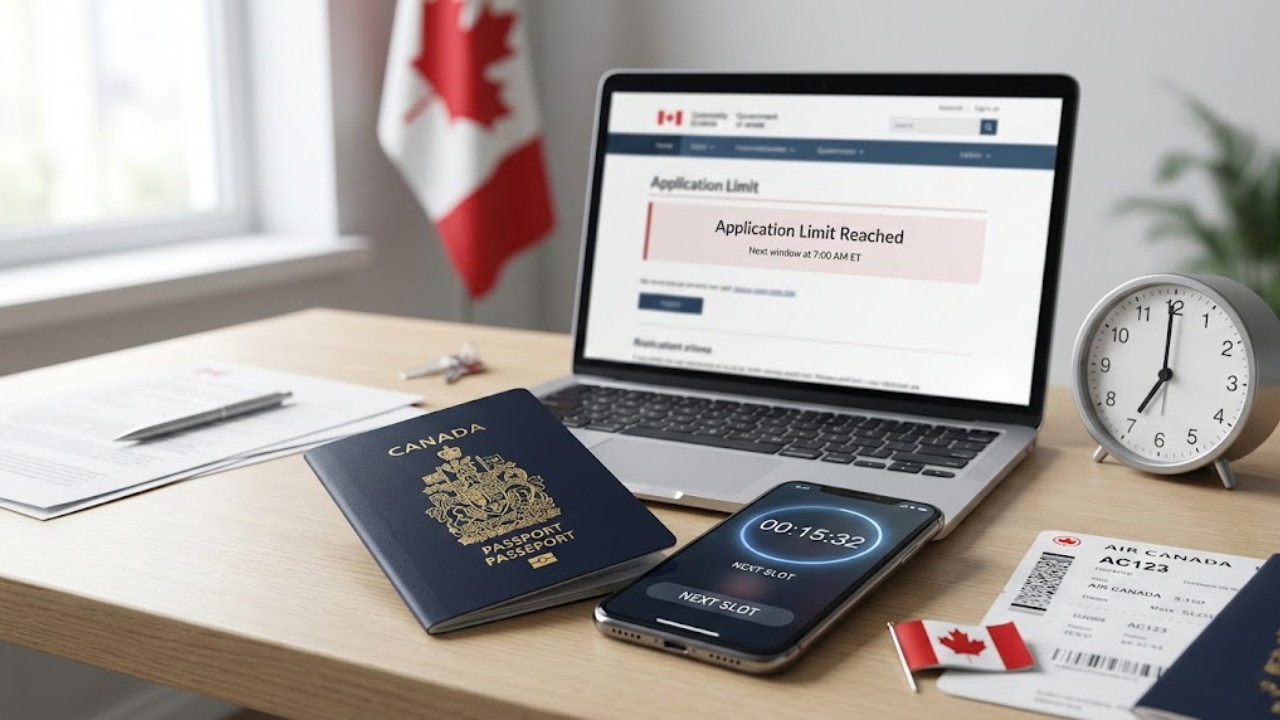
Synopsis: Canada has introduced a daily cap on online passport renewal applications, reshaping how citizens access passport services. With reset times, service standards, labour disruptions, and urgent travel provisions in play, applicants must act strategically. This analysis explores policy intent, processing timelines, broader impacts, and global comparisons.
Introduction
A quiet administrative adjustment can sometimes create nationwide consequences. Canada’s decision to impose a daily cap on online passport renewal applications is one such move—technical on the surface, but deeply significant for travellers, international workers, students, and families. According to official updates from Immigration, Refugees and Citizenship Canada (IRCC), passport services remain operational but face structural adjustments and potential delays, particularly amid labour disruptions and sustained demand.
This is not merely a digital system tweak. It reflects broader capacity challenges, service modernization efforts, and pressure on Canada’s identity document infrastructure.
For Canadians planning travel, renewing documents for study permits, permanent residency applications, or business trips, timing now matters more than ever.
What does this cap mean in practical terms?
Why was it introduced?
And how does it compare globally?
This analysis breaks down the policy mechanics, implications, and whether it represents short-term stabilization or deeper systemic strain. 
Understanding the Policy/Event
Canada has introduced a daily limit on the number of online passport renewal applications that can be submitted through its digital portal. While applicants may create an account at any time, they cannot begin a renewal application once the daily quota has been reached.
The system resets twice daily:
- 7:00 AM Eastern Time
- 7:00 PM Eastern Time
Only online renewals are capped. Mail and in-person applications remain available and uncapped.
Official service standards remain:
- Online: 20 business days
- In-person: 10 or 20 business days (depending on location)
- Mail: 20 business days
Importantly, mailing time is not included in these standards. IRCC has also warned that applications may face delays due to Canada Post labour disruptions, as reflected through Service Canada’s operational updates.
Why It Is Happening
Several structural pressures explain the move.
- Post-Pandemic Travel Surge
Global travel has rebounded sharply, with recovery trends reported by the United Nations World Tourism Organization (UNWTO) showing sustained increases in international mobility. - Capacity and Staffing Pressures
Passport systems rely on staffing, identity verification, printing facilities, and secure logistics. Any strain across these channels can cause backlogs. - Postal Infrastructure Challenges
With labour disruptions affecting Canada Post, delivery timelines remain vulnerable. - Digital Load Management
Daily caps may act as traffic-control measures to prevent system overload and cybersecurity risks.
Key Reforms or Changes
The policy does not change eligibility or legal requirements. Instead, it alters intake management.
Core adjustments include:
- Daily cap on online submissions
- Reset windows at 7 AM and 7 PM Eastern
- Expedited processing available in person
- Service standards unchanged
Applicants must now choose strategically between:
- Competing for online slots
- Visiting passport offices
- Applying via mail
Detailed Breakdown
Online Renewal
- Processing standard: 20 business days
- Subject to daily cap
- Mailing time excluded
Advantage: convenience.
Risk: limited access window.
In-Person Application
- Processing: 10 or 20 business days
- No digital cap
- Expedited service available with proof of urgent travel
Mail Application
- 20 business days standard
- Mailing delays not included
Urgent Processing
Applicants with imminent travel can request expedited service at passport centres with confirmed travel documentation.
Data, Stats, and Trends
Canada issues millions of passports annually. Following the reopening of global borders in 2022, demand surged significantly.
The passport system operates alongside a high-volume immigration framework administered through IRCC’s application services portal, which processes over a million temporary and permanent resident applications annually.
Current service standards:
- Online: 20 business days
- In-person: 10–20 business days
- Mail: 20 business days
However, effective wait times may extend beyond these benchmarks due to mailing disruptions and intake limits.
What the Numbers Show
If postal disruptions add even 5–10 extra business days, overall turnaround times increase significantly.
Three potential bottlenecks now exist:
- Submission access cap
- Processing queue
- Delivery delays
For students and skilled workers, these delays can disrupt visa processing, employment start dates, and international travel commitments.
Impact Assessment
This policy affects:
- Canadian citizens renewing expiring passports
- Dual nationals
- International students
- Skilled professionals
- Families planning travel
Social, Economic, and Human Consequences
Travel Uncertainty
Missed submission windows can delay bookings and increase airfare costs.
Economic Implications
Business travel disruptions may affect contracts, trade participation, and global mobility.
Administrative Stress
Competing for submission slots at fixed reset times adds uncertainty.
Equity Concerns
Those unable to log in precisely at reset times may face disadvantages.
Regional Variations
Processing times vary by location, creating uneven access to faster services.
Political Background & Stakeholder Reactions
Passport backlogs have historically drawn parliamentary attention in Canada. Administrative efficiency is often seen as a test of government competence.
Officials emphasize that alternative channels remain available. Critics argue capacity expansion should replace quota-based digital access.
Government, Opposition & Expert Opinions
Government messaging frames the cap as temporary stabilization.
Policy analysts view it as demand management.
Critics question whether digital services in advanced economies should operate under submission limits at all.
Global Comparisons
Canada’s situation mirrors international trends.
The HM Passport Office in the United Kingdom faced backlog pressures during peak demand periods.
Similarly, the U.S. Department of State Passport Services reported record demand and extended timelines.
Where This Stands Internationally
Compared globally:
- Canada maintains transparent service standards.
- Expedited processing remains available.
- Multiple submission pathways exist.
However, daily digital caps remain relatively uncommon internationally. Most countries extend processing times rather than limit submission intake.
Critical Analysis
Short-term advantages:
- Prevents system overload
- Controls intake
- Stabilizes digital infrastructure
Long-term risks:
- Public dissatisfaction
- Perceived access restriction
- Increased in-person congestion
Digital modernization is expected to increase efficiency, not create competition for submission access.
Will It Work?
Success depends on:
- Duration of postal disruptions
- Staffing expansion
- Infrastructure upgrades
- Seasonal demand patterns
If temporary, the cap may stabilize processing. If prolonged, it may trigger broader administrative criticism.
Conclusion
Canada’s daily cap on online passport renewals signals capacity pressures within its document processing ecosystem. While official service standards remain intact, practical timelines may extend due to submission limits and mailing delays.
Applicants should:
- Apply immediately at reset times
- Consider in-person submission
- Plan renewals well ahead of travel
In an era of high global mobility, document readiness is essential. Strategic planning remains the most reliable safeguard against disruption.