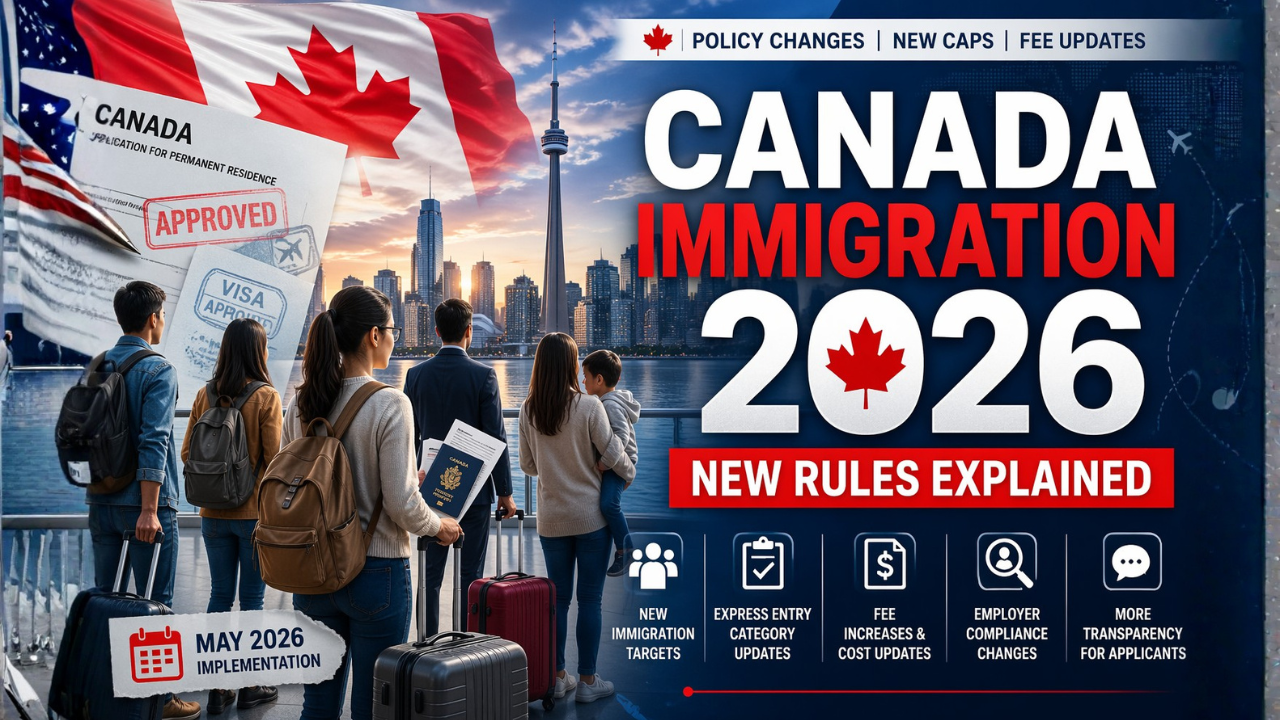
Synopsis: Canada’s December 2025 Immigration Restructure represents the most significant policy reset in a decade. With reduced PR targets, temporary resident caps, study permit limits, SOWP restrictions, and Express Entry recalibration, the reforms shift Canada from volume-based immigration to selective, capacity-driven intake. This article breaks down the policy layers, explains the structural motivations, examines economic and social impacts, compares international models, and evaluates long-term consequences. By analysing data trends and global parallels, the article reveals how Canada aims to balance sustainability, growth, and public pressure while reshaping pathways for students, workers, families, and future residents.
December 2025 marks a turning point in Canadian immigration—arguably the most transformative since the introduction of Express Entry in 2015. Temporary resident caps, reduced permanent residence targets, capped study permits, restricted spousal work rights, and the removal of CRS points for arranged employment represent a structural pivot, not a seasonal adjustment. Canada has entered a new era: slower intake, stricter prioritization, and deeper scrutiny of who qualifies to stay.
To understand this shift, we must look beyond headlines and into the policy mechanics driving outcomes. The changes align with global immigration tightening trends visible in nations such as the UK and Australia. Britain’s post-Brexit recalibration, immigration system overhauls, and parliamentary scrutiny provide a useful parallel—well-documented through institutions including the UK Home Office. Canada appears to be taking lessons from comparable economies grappling with housing pressures, labour mismatches, and public service strain.
This article builds a structured, data-based review—breaking down the reforms, exploring motivations, examining economic and social cost, comparing international policy landscapes, and questioning whether these changes deliver the outcomes policymakers expect.

Understanding the Policy/Event
Canada’s late-2025 immigration reform is not a single rule but a multi-layered approach driven by national capacity concerns, labour distribution challenges, and sustainability debates. The 2025–2027 Immigration Levels Plan (announced in October 2024) served as the blueprint, but December 2025 is when the full structure became operational.
The shift can be read in three layers:
- Permanent Residence recalibration – fewer seats, prioritization of inland candidates
- Temporary Resident population control – caps, limits, and processing discipline
- Study/work mobility tightening – selective access to labour pathways
Together, they represent a migration slowdown—not a closure, but certainly a filtration.
Why It Is Happening
Why would the most immigration-reliant G7 economy reduce entry volumes?
Several forces align:
- Housing shortages across Ontario, BC, and Alberta
- Provincial healthcare strain and workforce burnout
- Voter concerns around uncontrolled population expansion
- Economic mismatch—students entering unrelated disciplines with no labour link
- Temporary residents out-pacing permanent residency capacity
Policymakers often reference comparative jurisdictions, particularly the United Kingdom, where parliamentary pressure and public opinion have shaped restrictive measures. Political discourse and inquiry proceedings—such as those debated through the UK Parliament—echo in Ottawa. Canada’s challenge mirrors theirs: balancing growth with feasibility.
Key Reforms or Changes
December 2025 reforms fall into distinct pillars. Each must be understood not individually, but as interconnected levers controlling intake, transition and integration.
Detailed Breakdown
1. Permanent Residence (PR) Changes
Canada set its 2025 PR admissions target at 395,000, lower than preceding cycles, with further drops forecast for 2026–2027. This indicates a long-term shift rather than a temporary moderation.
Core components:
- Smaller PR quotas—tighter acceptance bandwidth
- Explicit preference for in-Canada residents
- Extended PR pathways for essential labour (caregivers, construction)
This is a survival-through-experience model: live in Canada first, integrate, then apply.
2. Express Entry Restructuring
March 2025 introduced the most disruptive change since the system’s launch:
- Arranged employment now grants 0 CRS points.
This resets competition toward skill, language, adaptability, and education—no applicant gains an advantage solely through employer sponsorship.
Category-based selection will continue with focus on:
- STEM
- Healthcare
- Agriculture
- Skilled trades
- Education professionals
- French-language speakers
This is a pivot toward demand-driven, high-value human capital.
3. Provincial Nominee Program (PNP) Allocations
Federal quotas reduced significantly in 2025. Some provinces successfully negotiated increases—but not uniformly. Result:
- High-growth provinces receive more seats
- Low-priority provinces face capped allocations
- Inter-provincial competition for skilled labour will increase
4. Temporary Resident Caps
A historic first—Canada now limits temporary residents numerically. This affects:
- International students
- Work permit holders
- Visitors transitioning to study/work pathways
The motivation is economic stabilization, particularly housing affordability and healthcare retention.
5. Study Permit Reforms
2025 cemented structural controls, including:
- National cap on study permits
- Mandatory PAL for most master’s and PhD students
- Work limit raised permanently to 24 hours/week
- Switching DLIs now requires permit re-application
This explicitly discourages program-hopping and non-strategic academic migration.
6. Spousal Open Work Permit (SOWP) Restriction
No longer universally available. Eligibility now prioritizes:
- Spouses of graduate-level students
- Spouses of workers in TEER 0–3 occupations
- Select professional programs
This reform attempts to narrow two-person inflow per seat issued.
7. Flagpoling & Application Channel Controls
Work permits can no longer be easily obtained at the border. Most applicants must apply online or inland, increasing procedural friction but reducing cross-border processing strain.
8. Special and Humanitarian Pathways
Temporary policies remain active for:
- Ukraine nationals
- Palestine nationals
- Wildfire-impacted applicants
These programs reflect Canada’s humanitarian identity—an area monitored closely by bodies such as UNHCR.
Data, Stats, and Trends
To assess what these changes mean, one must look at numerical behaviour rather than rhetoric.
What the Numbers Show
Reduced Intake vs Demand Growth
- 2025 PR Target: 395,000
- 2026 PR Forecast: Lower
- 2027 PR Forecast: Lower still
Yet temporary resident population growth in 2023–2024 rose faster than any OECD country. Canada is applying brakes to a vehicle moving downhill.
Study Pathway Trends
- 70%+ international students historically attempted PR transition
- New caps restrict entry, but demand remains globally high
- DLI switching restrictions reduce system gaming
Labour Sector Targeting
Category-based Express Entry selection implies sector priority modelling. Healthcare shortages alone reached over 100,000 vacancies nationwide in 2025, making this reform economically logical.
Reports on migration outcomes—such as those by Migration Observatory—show similar patterns internationally: nations now prioritise economically integrated applicants over volume expansion.
Housing Capacity Pressure
Temporary residents increased faster than rental stock, contributing to double-digit rent inflation in metropolitan zones. Caps aim to create breathing room.
Humanitarian Admissions
Despite restriction elsewhere, Canada retains special access for crisis-affected groups—preserving identity without overwhelming core intake capacity.
Impact Assessment
Social, Economic, and Human Consequences
1. Student Community
The largest affected demographic will be international students. Impacts include:
- Reduced seats for 2025–26 entry
- Higher scrutiny for academic relevance
- SOWP restrictions affecting spouses financially
- Reapplication requirements delaying institutional transfers
This may reduce post-secondary institution revenue but also reduce unlinked enrolment.
2. Employers and Labour Market
Benefits:
- More local applicants available for PR selection
- Stronger alignment with sectors facing shortages
Risks:
- Employers lose CRS leverage previously gained from job offers
- Small businesses reliant on international labour may experience shortages
3. Housing and Social Systems
Reduced intake could lower rental inflation and ease pressure on provincial healthcare. However, reduction in tuition-driven funding may weaken public universities.
4. Families and Dependents
Spousal work permit tightening limits two-income immigration households, potentially increasing financial stress among newcomers.
5. Humanitarian Ethics
Support for Ukrainian, Palestinian and wildfire-impacted residents shows compassion remains integrated in Canada’s architecture. This maintains alignment with international norms supported by bodies like UKVI in parallel policy environments.
6. Long-Term National Competitiveness
The tension lies here: will lower intake reduce labour supply below economic demand?
If yes, Canada may face a competitive disadvantage against liberal-pathway nations.
If no, sustainability improves and public approval stabilises.
Outcomes depend on balancing seat allocation with long-term workforce shortages.
Political Background & Stakeholder Reactions
Government, Opposition & Expert Opinions
Government messaging frames reforms as necessary population synchronisation. Ministers cite infrastructure limitations and argue sustainable growth requires periods of controlled intake.
Opposition parties counter that economic reliance on migrants makes reduction impractical. Economists warn that workforce shortages—especially in healthcare and STEM—may worsen without complementary training investment.
Educational institutions express concern over reduced enrolment revenue, warning tuition loss will affect research output and global competitiveness.
Civil rights groups worry about unequal spousal permit access, fearing gender-based disadvantages.
Analysts comparing Canadian policy to UK models reference legislative records archived through UK Parliament, noting similarities in rhetoric around capacity, security and labour fairness.
Global Comparisons
Where This Stands Internationally
Canada’s realignment resembles migration autoregulation cycles seen in:
| Country | Policy Trend | Similarity to Canada |
| UK | Reduced net migration, salary threshold increases | High |
| Australia | Student visa tightening, labour target alignment | High |
| New Zealand | Skilled migration recalibration | Moderate |
| Germany | Labour-pull policies remain more open | Low |
Like the United Kingdom’s post-Brexit consolidation—referenced through sources like Migration Observatory—Canada is shifting from volume-based intake to selectivity. The global tide is turning away from open-door frameworks toward curated pipelines.
Critical Analysis
Will It Work?
Success depends on execution.
Positive Outcomes Possible
- Housing and healthcare pressure may ease
- Labour targeting may improve vacancy alignment
- PR transition fairness increases without employer-bias points
Risks
- Reduced study permits shrink university funding
- Fewer spousal work permits reduce household financial resilience
- Skilled shortages could deepen if caps exceed capacity requirements
The core test arrives in 2–4 years. If Canada stabilises economically without diminishing innovation capacity, policymakers will call it a victory. If labour shortages widen, corrective re-expansion may follow.
The reforms are bold—but unproven.
Conclusion
Canada’s December 2025 immigration changes are not routine adjustments—they form a foundational rewrite of who gets to enter, study, work, and remain. Permanent residence intake is lower, Express Entry no longer rewards job offers, temporary resident caps reshape balance, study permit rules demand alignment, and humanitarian corridors remain open. This recalibration is strategic, corrective, and globally reflective.
Yet the long-term outcome depends on balance—economic need versus population feasibility, student revenue versus infrastructure strain, humanitarian identity versus intake volume.
For international applicants, the message is clear: Canada is still open—but selective. Immigration is no longer a one-way pipeline; it is a two-stage proving ground.