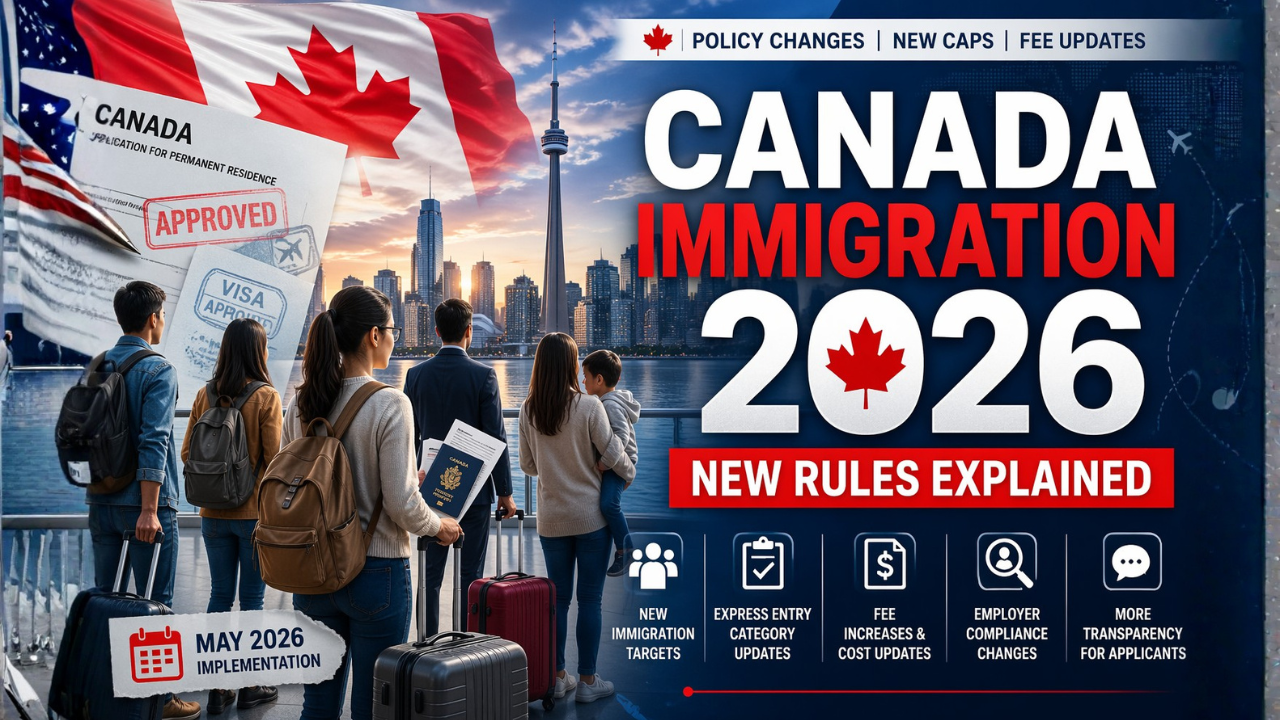
Synopsis: Canada tightening immigration 2025 has raised refusal rates across visas. This guide explains the top ten applicant mistakes—documentation errors, genuineness issues, NOC misclassification, missed deadlines, and rogue consultants—and provides practical steps to avoid denials, restore status, and improve application success under the new stricter Canadian immigration regime. and secure outcomes.
The Great Shift: Why Canada Is No Longer the Easy Destination It Once Was
For decades, Canada has been viewed as one of the most immigrant-friendly nations in the world—welcoming millions through study permits, work visas, and permanent residency programs. But the tone in 2025 has changed dramatically.
According to the Government of Canada’s Immigration Levels Plan 2025–2027, the focus has shifted from rapid population growth to maintaining economic balance, protecting housing availability, and tightening temporary resident policies.
While previous years emphasized expansion, this year marks what many experts describe as the “tightening era” of Canadian immigration. Refusal rates across nearly every category—study, visitor, work, and permanent residency—have surged. Procedural fairness letters (PFLs) are becoming more common, and even minor technical errors are resulting in denials.
Let’s begin with what’s behind this policy shift—and then explore the top 10 applicant mistakes leading to refusals in 2025.

1. Ignoring Canada’s New Immigration Tightening Policies
The most common mistake in 2025 is assuming the system remains unchanged from 2022 or 2023. It does not.
The federal government is now actively reducing the intake of temporary residents—students, visitors, and short-term workers. In 2024, over 7.3% of Canada’s population consisted of temporary residents. Ottawa now aims to lower that figure to around 5% by 2027, a move designed to ease pressure on the housing market and labor systems.
Immigration officers are therefore scrutinizing applications with new criteria. Every visa submission must demonstrate clear intent, authenticity, and compliance with Canada’s evolving immigration goals.
Failing to reflect this understanding in your application—through outdated formats, assumptions, or generic documentation—is a fast track to refusal.
2. Failing to Prove Genuine Intent or Admissibility
The “genuineness” test has become central to visa approvals. Officers must be convinced that applicants intend to comply with their visa conditions—study genuinely, work legitimately, or visit temporarily.
For instance, international students must now prove ties to their home country, adequate financial resources, and a credible reason to return. Any inconsistency between your Statement of Purpose (SOP), employment history, and financial records can be fatal.
The Immigration and Refugee Protection Act (IRPA) empowers officers to deny applications if they doubt admissibility—whether on grounds of misrepresentation, medical ineligibility, or security concerns. Even minor discrepancies, like undeclared family members or inconsistent job histories, can lead to bans lasting up to five years.
To avoid this, applicants must ensure their narratives are consistent, verifiable, and transparent across all submitted documents.
3. Submitting Incomplete or Questionable Documents—Even Tiny Errors Matter
IRCC’s online processing system automatically flags missing or invalid uploads. But many applicants still underestimate the importance of document accuracy.
A single missing signature, incorrect file format, or untranslated document can result in instant rejection. The IRCC application guides explicitly state that incomplete submissions will not be processed.
Even minor errors—such as mismatched employment letters or outdated police certificates—raise credibility concerns. In 2025, the emphasis on precision has intensified, leaving no margin for clerical mistakes.
To safeguard your application:
- Double-check every form and document before submission.
- Ensure all translations are certified.
- Maintain digital and physical copies for reference.
Accuracy is no longer a recommendation—it’s a requirement.
4. Permanent Residency (PR) Application Refusals Are Rising
PR refusals have become alarmingly common under the Express Entry and Provincial Nominee Program (PNP) streams.
In early 2025, data obtained from the IRCC Access to Information and Privacy (ATIP) system showed that refusal rates in certain PNP streams exceeded 22%, primarily due to insufficient proof of work experience or non-compliance with program-specific eligibility.
Express Entry applicants are facing stricter background verifications, especially for overseas work histories and language test validity. Even a one-day gap in claimed employment or an expired IELTS result can trigger a rejection.
To minimize risks, keep all documentation updated and maintain traceable records of your work, education, and financial stability. If invited to apply, ensure your submission matches every detail you entered in your profile—discrepancies are treated as misrepresentation.
5. Misclassifying Work Experience
Work experience misclassification has emerged as a major reason for rejection under Express Entry and PNP streams.
Applicants often claim experience under incorrect National Occupation Classification (NOC) codes, thinking similar job titles are interchangeable. They’re not.
Each NOC code has defined responsibilities, skills, and employment contexts. Misalignment between your reference letter and your chosen NOC can cause IRCC officers to question the authenticity of your entire profile.
To avoid this:
- Use the official NOC 2021 system to verify job titles and duties.
- Align employer letters with the core job tasks listed.
- Avoid vague language like “handled office duties”—be specific and verifiable.
Remember: your NOC code determines eligibility, CRS points, and nomination potential. Choose carefully.
6. Missing IRCC Deadlines
IRCC imposes strict deadlines for additional document requests, biometrics, and medical exams.
Ignoring or delaying responses—even by a day—can lead to automatic refusal. Many applicants underestimate how short the windows can be (often 7–14 days).
Set up multiple reminders, monitor your email daily, and check your GCKey or PR Tracker portal regularly. If you cannot meet a deadline, always request an extension in writing with valid reasons.
Proactivity signals professionalism. Silence, on the other hand, is interpreted as non-compliance.
7. Filing “Dummy” Applications to Buy Time in Canada
Some applicants, fearing delays or status expiry, submit “placeholder” applications just to stay longer in Canada.
This is one of the riskiest tactics under IRCC’s radar. Officers can easily detect duplicate or overlapping applications, and such filings often lead to long-term consequences including inadmissibility for misrepresentation.
According to internal policy updates shared by the IRCC Program Delivery Instructions, “intent to deceive or manipulate the processing system” now carries harsher penalties than before.
Applicants should instead apply for legitimate extensions or status restoration under authorized pathways. Buying time is not a strategy—it’s an error.
8. Overlooking Family Sponsorship Requirements
Many applicants misunderstand the financial and documentary expectations for spousal or parental sponsorships.
In 2025, family sponsorship scrutiny has intensified. Sponsors must now demonstrate consistent income, valid tax filings, and absence of prior immigration debts. Failure to do so leads to refusals even when the relationship is genuine.
Applicants also often ignore the importance of proof of relationship—shared addresses, communication records, or joint assets. Officers are increasingly using AI-assisted cross-verification tools to assess authenticity.
To strengthen your case:
- Submit organized timelines of your relationship.
- Include travel records, financial dependencies, and affidavits if required.
- Ensure your sponsor meets the Minimum Necessary Income (MNI) for their household size.
Family reunification remains a pillar of Canadian immigration—but only when backed by transparency and documentation.
9. Relying on Unverified or Unlicensed Immigration Consultants
Another growing reason for refusals is the use of unregulated consultants or agents who misrepresent client information.
Applicants often fall prey to unauthorized advisers promising guaranteed approvals or backdoor routes. These scams are illegal.
The College of Immigration and Citizenship Consultants (CICC) regulates all licensed professionals authorized to represent immigration clients. Before hiring anyone, verify their registration number on the CICC website.
If your application contains errors or fraudulent statements from an unlicensed agent, IRCC will hold you—not the consultant—responsible.
Always choose authorized representatives, retain proof of communication, and avoid anyone guaranteeing “100% success.”
10. Ignoring Application Status Updates and Communication
Finally, one of the most preventable causes of refusal is simply not checking your application status.
Applicants frequently miss update notices or document requests because they rely solely on email notifications. IRCC portals may update without sending alerts, meaning a day’s delay can result in rejection.
Make it a daily habit to:
- Log in to your GCKey or Permanent Residence tracker.
- Check spam folders for IRCC messages.
- Keep your contact information updated.
Missing a single update can jeopardize months of effort—and thousands of dollars.
Why Canada Is Tightening Immigration in 2025
The federal government’s shift stems from several interlinked factors:
- Housing affordability crisis: Major cities like Toronto and Vancouver have seen record-high rents, with average one-bedroom units surpassing CAD 2,700.
- Labour mismatch: Despite high immigration, many newcomers aren’t filling critical shortages due to credential recognition barriers.
- Public pressure: Polling from Angus Reid Institute indicates nearly 70% of Canadians want immigration caps to stabilize.
- Administrative overload: IRCC faced a backlog exceeding 2.2 million applications in 2024, slowing overall efficiency.
This recalibration is designed to make immigration sustainable, data-driven, and regionally balanced—though it inevitably makes entry harder in the short term.
How to Future-Proof Your Immigration Journey
To thrive under this tightening regime, applicants must treat immigration as a project—not a formality.
Here’s how to strengthen your odds:
- Stay updated: Follow official sources like IRCC Newsroom Updates and verify policy shifts from trusted media.
- Document precisely: Keep originals, translations, and receipts ready for audits.
- Use authorized representatives: Verify CICC registration before hiring help.
- Be proactive: Respond promptly to all requests, even clarifications.
- Align purpose with policy: Frame your intent—study, work, settle—within Canada’s stated economic and demographic goals.
Success in 2025 depends on preparation and authenticity, not shortcuts.
Frequently Asked Questions (FAQs)
What is a Procedural Fairness Letter (PFL)?
A PFL is an official notice from IRCC giving applicants a chance to clarify or correct inconsistencies before refusal. It must be answered within a given timeframe, typically 7–14 days.
Can I stay in Canada after refusal?
You may apply for a restoration of status within 90 days of a refusal if you previously held valid temporary status. Beyond that period, you must leave the country and reapply from abroad.
How can I check my consultant’s authenticity?
Visit the official CICC public register to confirm whether your consultant is licensed to represent clients.
Is Canada still accepting immigrants in 2025?
Yes. Canada continues to admit permanent residents, skilled workers, and students—but under stricter screening. The total PR target for 2025 remains around 395,000 admissions, focusing on high-skilled categories and regional balance.
Conclusion: Precision Is the New Pathway to Canada
Canada’s immigration system in 2025 demands more than eligibility—it demands excellence. The margin for error is gone, and the standards are higher than ever.
Applicants who treat immigration casually or rely on outdated information risk rejection. But those who understand the policy climate, verify every claim, and follow official guidance can still achieve their Canadian dream.
The key is simple: be accurate, be authentic, and be prepared.