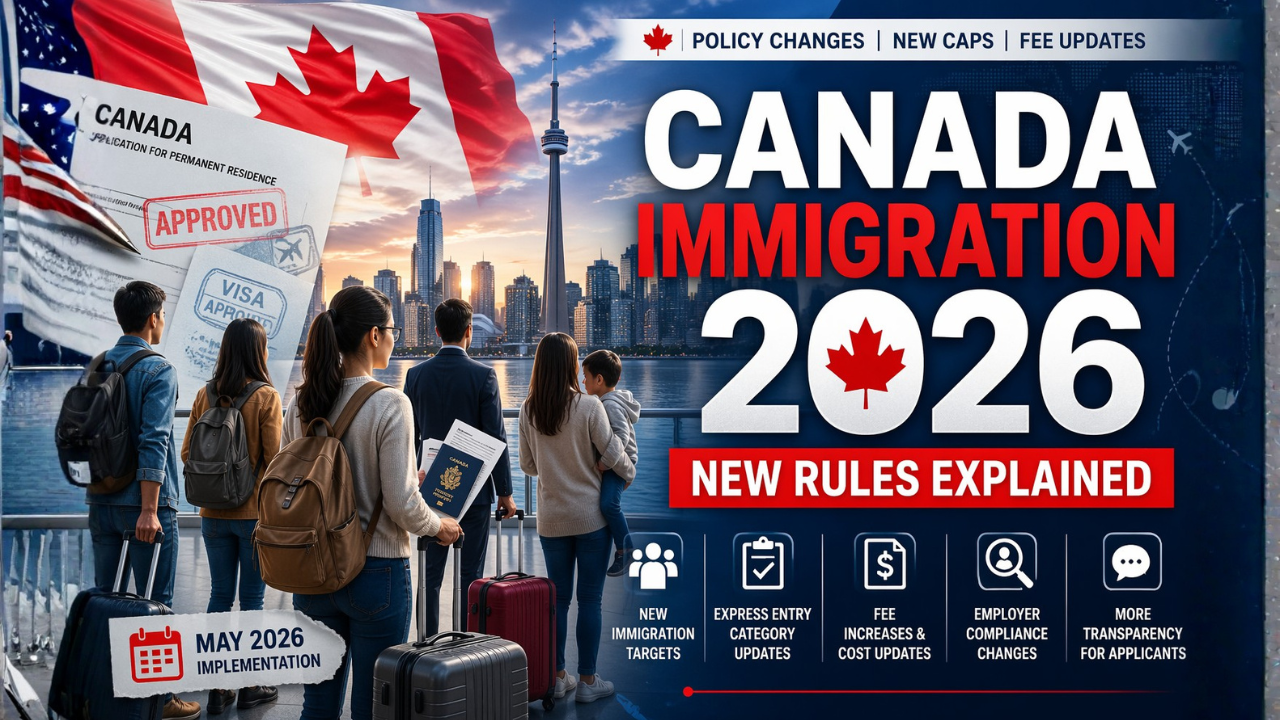
Synopsis: In July 2025, Canada paused low‑wage LMIA processing in high‑unemployment regions, Quebec halted CSQs for out‑of‑province applicants, and several PNP streams narrowed priorities. Express Entry CRS cutoffs are trending downward, while work permit refusals and processing times spike. This blog unpacks IRCC’s policy pivot and what it means for prospective immigrants
A New Immigration Era: Canada’s July 2025 Shake-Up
Canada’s immigration system is facing a pivotal transformation as IRCC rolls out significant policy updates. From halted Low-Wage LMIAs to tightened PNP eligibility and Quebec’s suspension of CSQs, these changes represent a calculated pivot toward prioritizing economic outcomes and political strategy. IRCC’s July 16 update officially confirmed many of these changes.
What do these adjustments mean for applicants in 2025 and beyond? Let’s dive into the critical developments shaping the new Canadian immigration landscape.

Key Highlights and Structural Overview
Canada’s 2025 Immigration Reform: Major Themes
- Parent and Grandparent Sponsorship Resumes with Limits
- LMIA Closures Tied to High Unemployment Rates
- Quebec Halts CSQs for Out-of-Province Applicants
- Nova Scotia PNP Prioritizes Healthcare & Construction
- Ontario Faces Student Crisis & Tuition Freeze Reversal
- Express Entry Forecasts for CEC, Trade, and French Draws
- Work Permit Timelines & Refusals Spike
- IRCC’s Policy Shift Toward Restrictive Filtering
Parent and Grandparent Sponsorship Resumes with Limits
Legacy Applications from 2020 Take Priority
The Parent and Grandparent Program (PGP) reopens on July 28, 2025, but with significant limitations. Only those who submitted a sponsor form in 2020 will be invited—marking the fifth consecutive year this lottery pool is being reused without fresh intake.
While this move is welcomed by 2020 applicants, many see it as politically driven. Analysts suggest that by granting sponsorships to permanent residents who have since become citizens, the Liberal government could secure future electoral support from these expanded family units. Statistics Canada supports the demographic shift where new citizens significantly influence civic engagement.
LMIA Closures Tied to High Unemployment Rates
Where Low-Wage LMIA Processing Has Been Halted
As of July 11, 2025, Canada’s low-wage LMIA processing has been halted in most provinces due to climbing unemployment:
- Ontario: Virtually all regions, including Toronto, Hamilton, and Windsor, are shut.
- Quebec: Montreal and Quebec City no longer qualify for low-wage LMIA processing.
- British Columbia: With the exception of Victoria Island, LMIA closures span the province.
- Nova Scotia & New Brunswick: Now well above the 6% threshold for LMIA approval.
The only exceptions exist in Thunder Bay, Greater Sudbury, and some regions in Manitoba and Saskatchewan, which remain under the 6% unemployment threshold.
These actions are aligned with the Employment and Social Development Canada (ESDC) criteria, where regional unemployment exceeding 6% justifies refusal of low-wage LMIA applications.
Quebec Halts CSQs for Out-of-Province Applicants
Effective January 16, 2025: No New Invitations for R25 or E76
The Ministry of Immigration, Francisation, and Integration (MIFI) in Quebec has ceased issuing invitations under administrative codes R25 and E76 for candidates outside the province. This impacts applicants hoping to apply for work permits via the International Mobility Program.
Officers will continue to process existing applications with letters issued by January 15, 2025, but no new CSQs will be distributed outside Quebec going forward. The decision appears tied to Quebec’s focus on internal employment stabilization and protecting regional labour demands—a policy trend in line with other provincial shifts.
Nova Scotia PNP Prioritizes Healthcare & Construction
Healthcare and Construction Now Priority for 2025 and 2026
Nova Scotia has confirmed a strategic prioritization of the following sectors through 2026:
- Healthcare
- Social Assistance
- Construction
- Regional Residency Applicants
Applications from outside Canada in non-priority sectors—such as STEM, trucking, clean energy, or resource development—will not be processed.
This realignment mirrors recent moves by British Columbia, Manitoba, and Saskatchewan, where PNP programs are narrowed to address local economic gaps rather than accommodate a broad immigrant workforce.
Ontario’s Student Crisis: Policy Overhaul Incoming
80,000 Students Will Miss Out on Preferred Programs
Ontario’s colleges and universities face financial instability, compounded by reduced international enrolment and a 7-year tuition freeze.
Key changes under review:
- Ending the tuition freeze to boost institutional revenue
- Revamping program structures to meet labour market demands
- Fewer layoffs in education sector
- Fewer spots available for both local and international students
These updates will likely go into effect by Spring 2026, affecting roughly 80,000 Ontario students in the coming five years. According to the Ontario Ministry of Colleges and Universities, the reform aims to prevent college closures and ensure economic alignment.
Express Entry Forecast: CEC and French Draws Continue
What’s Next for July–August 2025?
As of July 6, 2025, IRCC data shows:
- 22,591 applicants with scores above 501
- Over 256,000 candidates in the Express Entry pool
Recent cutoffs for Canadian Experience Class (CEC):
- July 8: 518
- Previous: 521 and 529
Projections suggest a continued decline in CRS scores, with experts anticipating a CEC draw at 515 or lower by end of July. French draws, which have already welcomed nearly 19,000 candidates in 2025, may slow down in the second half but remain integral in 2026. IRCC Express Entry statistics confirm this evolving trend.
PEI and Other Provincial Draws: Targeted Invitations Only
PEI Draw on July 17 Focuses on Labour and Economic Impact
Prince Edward Island held a draw inviting 39 candidates in key economic sectors. Other provinces like Ontario and Alberta remain silent or selective, with Ontario expected to resume OINP general or job offer streams by August 2025.
The shift toward sector-specific invitations reflects IRCC’s broader trend of controlled intake based on economic contribution rather than volume.
Work Permit Processing Delays & Skyrocketing Refusals
IRCC Acknowledges Refusals Tied to Fraud—but That’s Not All
IRCC admits high refusal rates in 2025 and attributes them to:
- Fraudulent documentation
- Misrepresentation by unlicensed agents
However, experts argue the real cause lies in undisclosed internal quotas and a politically driven strategy to restrict intake.
Updated processing times as of July 16, 2025:
- Work permits from India: 6 weeks
- Work permits inside Canada: 181 days
- Study permits inside Canada: 11 weeks
- Visitor visas from India: 29 days
This aligns with IRCC’s recent program delivery updates, tightening visa controls while maintaining plausible deniability.
Special Focus: Trade Draws, PGWPs, and Open Work Permits
Are Trade Draws Dead?
Despite growing demand in trade sectors, no trade-specific draws have occurred in 2025. The “cook” NOC code alone accounts for 20,000+ profiles, potentially crowding out other trades.
Post-Graduate Work Permits (PGWPs)
PGWPs remain safe for now but come with new conditions:
- Mandatory IELTS/TOEFL score
- Compliance with designated fields of study
- Consistent academic attendance
Vulnerable Open Work Permits: What Qualifies?
Eligibility requires proof of abuse, including:
- Verbal/mental abuse
- Non-payment of wages
- Sexual or physical harassment
Terminations alone do not qualify unless tied to exploitative conduct.
What’s Next for Canadian Immigration?
With PGP draws limited, LMIAs frozen, and PNPs narrowed, 2025 is clearly a recalibration year. Applicants must be strategic:
- Choose priority sectors (healthcare, construction, education)
- Explore rural or northern regions
- Strengthen study or work permit SOPs
- Monitor express entry trends
IRCC’s tightening grip is not just about fraud—it’s about resetting Canada’s immigration intake for sustainability and long-term economic integration.
Conclusion: Strategic Migration Is the Future
Canada’s immigration model in 2025 demands precision, adaptability, and sector-specific focus. Applicants must align their profiles with evolving labour priorities, avoid reliance on outdated pathways like general LMIA or open PNPs, and invest in thorough planning backed by verifiable credentials and logical career progression.
Stay informed, stay compliant—and above all, stay ready for a system that continues to evolve.
Frequently Asked Questions (FAQs)
1. Is the Parent and Grandparent Program (PGP) accepting new applications in 2025?
No. Only sponsors who submitted an interest to sponsor form in 2020 are eligible under the 2025 intake. IRCC has not opened new submissions since 2020.
2. Which Canadian provinces are still accepting low-wage LMIA applications in 2025?
As of July 2025, select regions like Thunder Bay, Greater Sudbury, and parts of Saskatchewan and Manitoba continue processing low-wage LMIAs due to lower unemployment rates.
3. What occupations are eligible under Nova Scotia PNP in 2025–2026?
Nova Scotia prioritizes applicants in healthcare, social assistance, and construction. Applications in non-priority sectors like STEM or trucking are not accepted for 2025–2026.
4. Why has Quebec stopped issuing CSQs for out-of-province applicants?
Effective January 16, 2025, Quebec ceased issuing CSQs to out-of-province applicants for certain work permit categories (R25, E76) under the International Mobility Program.
5. Will Ontario colleges accept international students in 2026?
Yes, but spots will be limited. Ontario plans to end its tuition freeze and restructure funding, impacting up to 80,000 international student spots over 5 years.
6. What are the current Express Entry CRS cutoff scores in July 2025?
The most recent Canadian Experience Class draw had a cutoff score of 518. Experts predict drops to the 515–513 range if bi-weekly draws continue.
7. Why is IRCC refusing more study permits and work visas in 2025?
IRCC cites increased fraud and improper documentation. Refusal trends also reflect internal caps and stricter admissibility screening.
8. Can I get a vulnerable open work permit if my employer laid me off in Canada?
No. Vulnerable open work permits require workplace abuse claims (verbal, financial, sexual). Layoffs without abuse are not covered under IRCC rules.
9. When will IRCC conduct a trade draw under Express Entry in 2025?
No trade-specific draw has occurred in 2025 yet. With over 20,000 cook-related profiles, future trade draws may prioritize cooks if resumed.
10. Is the Post-Graduation Work Permit (PGWP) being rejected in 2025?
No. PGWPs are generally approved unless there’s a violation—such as program discontinuation, unauthorized work, or failure to meet updated language requirements.