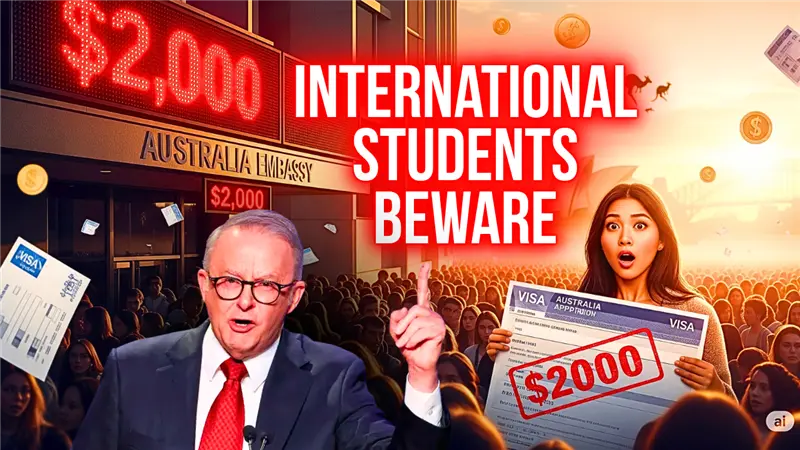
Synopsis: Australia’s student visa fee is set to rise from $1,600 to $2,000, impacting over one million international students already enrolled. While policymakers claim it ensures quality, critics argue it deepens financial strain. We explore the causes, reactions, and broader implications on migration, education, and Australia’s global standing.
Australia is known globally as a top destination for international education. But from July 1, 2025, a new policy could drastically alter its appeal: student visa application fees will jump to $2,000—a 25% hike from last year’s dramatic increase. With over one million students currently enrolled, the announcement has triggered heated debate across campuses, households, and political circles.
Is this a necessary reform for a system under strain, or a calculated barrier to reduce migration numbers?
Topics Discussed:
- Record-Breaking Student Enrolments: Boom or Bubble?
- The Visa Fee Hike Timeline and Policy Rationale
- Financial Burdens and Real Student Stories
- Is Migration Control Driving Education Policy?
- Filtering Out Non-Genuine Applicants: Boon or Bias?
- Global Comparison: How Australia Stacks Up
- Implications for Universities, Regional Economies, and Demographics
- What International Applicants Should Consider Now

Record-Breaking Student Enrolments: Boom or Bubble?
By late 2024, Australia crossed a historic milestone—over one million international students enrolled. According to the Department of Education, this marks a 15% rise compared to pre-COVID levels in 2019. At face value, these numbers signal a robust recovery. But beneath the surface lies a growing concern: Can Australia’s infrastructure, policy, and economy sustainably support this influx?
Key stats:
- 1.02 million international students enrolled by December 2024
- India, China, and Nepal continue to dominate enrolment origins
- Major growth observed in private colleges and lower-ranked universities
The question now is not just whether Australia can attract students, but whether it can support and retain them long-term.
The Visa Fee Hike Timeline and Policy Rationale
The upcoming visa fee hike is not an isolated move. It follows a precedent set in 2023 when the fee jumped from $710 to $1,600—a 125% increase. The Department of Home Affairs cited “cost recovery” and “public service funding” as key reasons. The July 2025 increase to $2,000 continues this trend, and Prime Minister Anthony Albanese’s government links it directly to broader fiscal goals.
Key reasons cited for the increase:
- Funding commitments from the 2025 federal election campaign
- Managing pressures on housing and urban infrastructure
- Aligning immigration policies with labor market priorities
While officially labeled as a financial restructuring measure, critics argue the move is a backdoor way to tighten migration without direct legislative reform.
Financial Burdens and Real Student Stories
Behind the statistics are students balancing education, work limits, and high living expenses. For Radhika, an MBA student and mother of two, the hike adds yet another financial hurdle.
“I’ll have to think carefully and plan how to manage these extra costs when it’s time to pay my visa fee,” she says.
Students are only permitted to work 48 hours per fortnight during term time. With rising rent, groceries, and tuition, the $2,000 fee becomes more than just a bureaucratic requirement—it becomes a barrier to stability.
What students are paying on average:
- Monthly rent in cities like Sydney: AUD 800–1,200
- Childcare/schooling costs: AUD 1,000+ per month per child
- International student health cover: AUD 600–1,200 annually
- Tuition: AUD 20,000–40,000 per year depending on program
Is Migration Control Driving Education Policy?
According to students like Jai Tiwari, a journalism student in Melbourne, the fee hike is part of a deliberate migration reduction strategy.
“The government is clearly trying to cut down the number of international students,” he remarks.
This aligns with recent shifts in visa rejections, cancellations, and tightening of education provider regulations. It appears the federal government is walking a tightrope: encouraging international talent while also responding to domestic concerns about overpopulation, job competition, and housing crises.
Key concerns from policy critics:
- Education being treated as a migration loophole
- Over-commercialization of student intake
- Regional strain on healthcare and transport systems
Filtering Out Non-Genuine Applicants: Boon or Bias?
On the flip side, some see this policy as a filter to weed out non-serious students.
Rahat Mirani, a finance student, believes the fee may deter those seeking visas for non-academic reasons:
“It might discourage those who aren’t serious about studying… But in the long run, it’s the genuine students who end up bearing the cost.”
This sentiment mirrors findings from the Migration Institute of Australia, which highlights misuse of the student visa route for temporary labor access.
Indicators of “non-genuine” applicants:
- Lack of academic history or English proficiency
- Suspicious financial documents
- Immediate switch to different visa categories after arrival
Global Comparison: How Australia Stacks Up
To assess whether this policy is fair, one must compare Australia’s visa costs to other popular study destinations.
| Country | Student Visa Fee (2025) | Avg. Tuition | Post-Study Work Rights |
| Australia | AUD 2,000 | AUD 20,000–45,000 | Up to 4 years depending on qualification |
| Canada | CAD 150 (≈AUD 165) | CAD 15,000–35,000 | 3 years post-study work permit |
| UK | GBP 490 (≈AUD 950) | GBP 10,000–30,000 | 2 years Graduate Route |
| USA | USD 185 (≈AUD 280) | USD 20,000–50,000 | 1–3 years OPT based on program |
Australia now leads the table in visa fees—raising the bar for entry even higher than countries with higher living costs.
Implications for Universities, Regional Economies, and Demographics
Australian universities rely heavily on international students, with up to 30% of revenue coming from tuition fees. The fee hike could:
- Reduce enrolments in lower-tier institutions
- Increase dropouts among financially stretched students
- Trigger course closures or budget cuts in regional universities
Moreover, regions like Tasmania, Darwin, and Western Australia—which depend on students for local economies—may see ripple effects.
As per the Australian Bureau of Statistics, international students contribute over AUD 40 billion annually to the economy. Any policy that risks shrinking this demographic will likely have unintended consequences.
What International Applicants Should Consider Now
For aspiring students and their families, the new fee signals a shift in the value proposition of studying in Australia. Here’s what applicants must now factor into their decision-making:
Key considerations:
- Budget Beyond Tuition: Factor in visa fees, health cover, and initial settlement costs
- Institutional Support: Choose universities offering financial assistance or scholarships
- Work Rights & PR Pathways: Verify changes to post-study work visas and eligibility for permanent residency
- Regional Options: Some states offer cost-of-living subsidies or longer stay incentives
- Financial Documentation: Expect stricter scrutiny of bank statements and sponsors
Final Thoughts: Reform or Restriction?
Australia’s rise in student visa fees is more than a policy update—it’s a test of intent. Is the country reaffirming its global education leadership by raising standards? Or is it quietly deterring migration under the guise of reform?
What remains clear is this: the decisions made today will echo across classrooms, economies, and communities for years to come.
As international stakeholders—from education providers to migration experts—watch closely, students are left doing the math: Is Australia still worth the cost?
Frequently Asked Questions (FAQs) on Australia’s 2025 Student Visa Fee Hike
- What is the new cost of applying for a student visa in Australia from July 2025?
Starting July 1, 2025, the Australian student visa application fee will increase from AUD 1,600 to AUD 2,000. This applies to subclass 500 visa applicants and those seeking to renew or extend their student visas. This fee covers the visa processing costs and is non-refundable, even if the application is denied.
- Why has the Australian government increased the student visa fee again?
The increase is part of the Albanese government’s broader fiscal strategy to fund national priorities including housing, healthcare, and education infrastructure. According to the Department of Home Affairs, the fee hike is intended to reflect the true cost of visa processing and migration system management, while also deterring non-genuine applicants.
- Will the fee hike affect existing international students or only new applicants?
The new fee will apply only to applications lodged on or after July 1, 2025. Current visa holders will not be retrospectively charged. However, any student applying to renew, extend, or change their visa after this date will be subject to the AUD 2,000 fee.
- How does Australia’s visa cost compare to other study destinations like Canada or the UK?
Australia will have one of the highest student visa application fees globally:
- Canada: CAD 150 (≈ AUD 165)
- UK: GBP 490 (≈ AUD 950)
- USA: USD 185 (≈ AUD 280)
- Australia (2025): AUD 2,000
This steep pricing may deter budget-sensitive students and shift demand toward more affordable destinations.
- Does the student visa fee include other services like health cover or biometric data collection?
No. The visa fee is separate from other mandatory expenses, including:
- Overseas Student Health Cover (OSHC): Must be purchased before applying
- Biometric appointment fees: If required, additional charges apply
- Medical examinations: For certain applicants, these are paid separately
Students should budget an additional AUD 1,000–2,000 for these related costs.
- Can international students work more to afford the new visa fee?
International students on subclass 500 visas are limited to 48 hours of work per fortnight during their academic term. While some leniency was provided during COVID-19, the work-hour cap is now strictly enforced. Relying solely on part-time work to fund visa and living costs may not be viable under current regulations outlined by Study Australia.
- Will the higher visa fee impact the chances of obtaining permanent residency in Australia?
While the visa fee itself does not directly influence permanent residency (PR) eligibility, it forms part of a wider migration tightening strategy. Students must meet PR criteria including work experience, skills assessments, and English proficiency. The hike may result in fewer enrolments in PR-favored courses like engineering, nursing, or IT, indirectly affecting migration pathways.
- Is the visa fee waiver or refund available for financially struggling students?
Currently, no broad waiver or refund policy exists for visa application fees, regardless of the applicant’s financial situation. Exceptions are limited to rare humanitarian circumstances or departmental errors. Some universities may offer financial aid or bursaries, but these typically do not cover visa-related expenses.
- Will this visa hike affect Australia’s education sector and universities?
Yes. Many education providers fear that the increased visa fee could reduce international enrolments, especially in non-Group of Eight (Go8) universities and private colleges. According to Universities Australia, the sector depends heavily on international students, who contribute over AUD 40 billion to the economy annually.
- What should prospective students do to prepare for this fee increase?
If you’re planning to study in Australia:
- Apply before July 1, 2025 to avoid the new fee
- Budget comprehensively for visa, tuition, housing, and living costs
- Check eligibility for university scholarships or government grants
- Explore regional campuses, which may offer additional benefits
- Monitor policy updates via the Department of Education and Home Affairs