Synopsis: The UK government’s taxi ban for asylum seekers attending medical appointments marks a major shift in asylum policy and spending controls. While the reform targets high transport costs and inefficiencies exposed by BBC investigations, it risks creating barriers to healthcare for vulnerable individuals. This analysis explores motivations, data, political reactions, global comparisons, and the broader humanitarian impact—offering a balanced, evidence-driven look at whether the policy improves efficiency or harms accessibility.
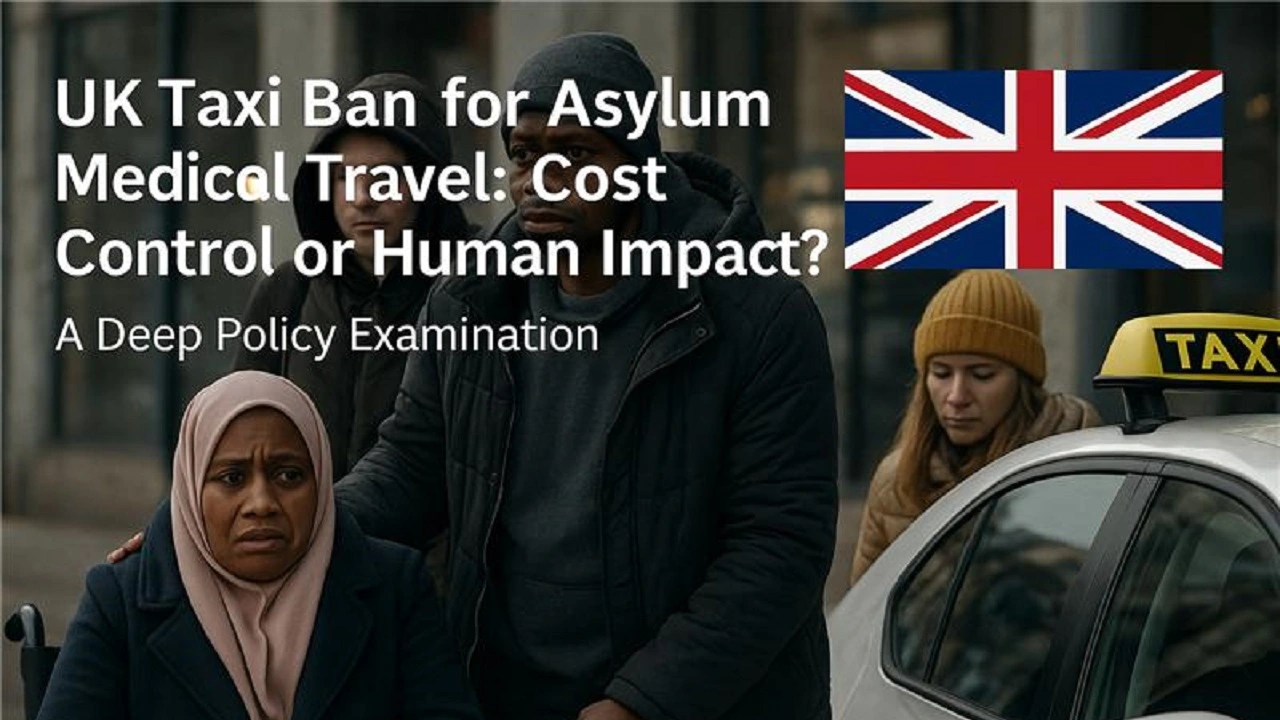
A significant shift is underway inside the UK’s asylum management framework. From February onward, asylum seekers will no longer be routinely permitted taxi travel for medical appointments — a system previously responsible for journeys costing hundreds of pounds, including 250-mile hospital round trips billed at nearly £600. This decision, emerging after BBC investigations into questionable transport usage, signals tightening controls amid mounting pressure to demonstrate efficiency and reduce taxpayer-funded immigration expenditure. According to the UK Home Office, taxis are now reserved strictly for exceptional cases such as pregnancy or disability, while most asylum seekers are expected to use public transport instead.
This blog explores the policy in depth: motivations, controversies, financial logic, political climate, and humanitarian consequences — asking the essential question many policymakers avoid: Will it work, and at what cost?

Understanding the Policy/Event
The core premise of the reform is simple — asylum seekers previously relied heavily on privately-booked taxis for GP or hospital visits. Some journeys spanned hundreds of miles, with reports of drivers being dispatched to collect passengers who ultimately refused to travel or never entered the vehicle at all, yet the fare remained payable.
From February, this practice will be restricted. One weekly bus pass will continue to be issued per asylum applicant, but further journeys must be made through public services unless medically justified. This redefinition of necessity versus convenience sits at the heart of the debate.
Why It Is Happening
A BBC File on 4 investigation uncovered repeated cases of excessive mileage, inflated routing structures, and unmanaged outsourcing contracts spanning ten years. Taxi drivers interviewed described days accumulating 250–275 miles — much of it without passengers. Some transfers occurred simply due to logistical breakdowns between contracted providers, hotel locations, and appointment routes.
In one striking report, asylum seekers were transported for dental care just 1.5 miles from their accommodation using separate drivers for outbound and return legs — a near-absurd use of public funds, and a demonstration of how fragmented systems compound cost.
The Home Office, under pressure to demonstrate fiscal discipline and resolve public distrust in migration logistics, initiated an urgent review. With transport spending averaging £15.8 million annually, the government framed the reform as both economic correction and operational modernisation.
Key Reforms or Changes
The policy package includes three functional layers of change, each targeting specific expenditure categories and loopholes.
Detailed Breakdown
1. Removal of Taxi Use for Medical Appointments
Routine GP, NHS or specialist medical visits will no longer qualify for funded taxi transport. Applicants will be expected to use public buses, trains or walking routes unless an approved vulnerability exemption is granted. Authorization must now pass documentation thresholds.
2. Exceptions for Disability & Pregnancy
The government reserves flexibility for those who physically cannot travel independently. This includes late-term pregnancy, certified disabilities, and emergency medical intervention. Advocacy groups argue, however, that not all vulnerable groups fit neatly into defined medical criteria, and case-by-case assessment is prone to inconsistency without standardized review.
3. Pending Review of Non-Medical Travel
Transport between asylum accommodations — often hotels and temporary placements — remains under review. Ministers suggest extending the taxi restriction principle further. Should this occur, the shift may redefine asylum mobility nationwide, forcing reliance on public transit even across unfamiliar regions.
Data, Stats, and Trends
The most cited figure is the annual transport spend — £15.8 million, averaged over several years. However, important context sits behind that average.
What the Numbers Show
| Metric | Previous Figures | Current Figures | Interpretation |
| Average annual asylum transport cost | £15.8m | Undisclosed current year | Real cost may be higher today |
| Hotel-housed asylum seekers (June) | 32,000 | 36,000 (Sept) | +4,000 increase within months |
| Sample taxi journey cost | £600 | Single NHS trip | Indicator of inefficiency |
| Driver-reported daily mileage | 250–275 miles | Half without passengers | Waste through routing failures |
The Home Office has not disclosed the most recent annual spending, which implies the real number may exceed the published average. With rising hotel reliance and higher accommodation occupancy, transport demand is unlikely dropping without enforced intervention — hence the timing of the ban.
Impact Assessment
Any major immigration reform creates ripples across social, economic, and administrative layers.
Social, Economic, and Human Consequences
Positive Effects
- Reduced misuse of taxpayer funds — especially with long-distance empty taxi mileage
- Increased accountability among transport contractors
- Encouragement of independence and integration with public infrastructure
Negative Risks
- Vulnerable asylum seekers may miss medical appointments
- Public transport barriers — language, stress, trauma history, disability without certification
- Longer NHS processing delays if no-show rates increase
- Potential breach of accessibility expectations under humanitarian protection norms
Human rights advocates reference UNHCR standards, noting that healthcare access must remain non-discriminatory and viable, regardless of immigration status. A bus pass may not always equal meaningful accessibility — highlighting the tension between cost efficiency and welfare adequacy.
Political Background & Stakeholder Reactions
The ban arrives in a politically charged environment where immigration dominance in polling has grown. The Shadow Home Secretary Chris Philp argues the reforms demonstrate Labour’s failure to maintain border and system control. Reform UK, led by Nigel Farage, capitalises on public frustration over perceived illegal migration escalation.
Meanwhile, policy voices worry that cost savings may overshadow humane administration. The Migration Observatory notes that structural asylum inefficiencies historically stem more from backlog processing delays than transport logistics. Critics argue this move treats a symptom rather than the systemic cause.
Government, Opposition & Expert Opinions
| Actor | Position | Core Concern |
| Government | Supportive | Reduce waste, restore efficiency |
| Opposition Conservatives | Attacking Labour | Claims lack of crisis control |
| Transport Contract Drivers | Mixed | Some welcome clarity, others fear income loss |
| Refugee Support Orgs | Critical | Accessibility and welfare inadequacy |
Global Comparisons
How does the UK’s shift compare to asylum transport norms in peer nations?
Where This Stands Internationally
- Canada: Provinces provide non-emergency medical travel only when local clinics unavailable. Bus vouchers preferred.
- Australia: Asylum seekers in community detention rely largely on public services, yet humanitarian medical transport exceptions remain broad.
- Germany: Local municipalities fund transport case-by-case, but costly long-range appointments are significantly rare due to decentralized placement.
- UK: Historically generous taxi allocation was an outlier. The reform moves Britain closer toward mainstream international models.
The UK is not alone in tightening spending; however, its sudden shift — combined with accommodation hotel dependency and rising asylum volume — creates a uniquely fragile intersection of cost-cutting and human need.
Critical Analysis
Will the policy deliver on its promise? The answer depends on whether structural weaknesses beyond transport are addressed.
Will It Work?
Reasons it may succeed:
- Immediate reduction of unnecessary travel bills
- Restriction closes loopholes enabling inflated contractor mileage
- Greater expectation of system efficiency
Reasons it may fail:
- Public transport gaps may lead to missed medical care
- If hotel numbers continue rising, cost of displacement transport may offset savings
- Lack of oversight historically — enforcement weakens if monitoring remains loose
True system reform must extend beyond taxis. Without investing in processing speed, accommodation decentralisation, and welfare assessment, transport rules alone cannot resolve asylum inefficiency.
Conclusion
The UK taxi ban on asylum-related medical travel is neither wholly misguided nor unquestionably beneficial. It acknowledges genuine fiscal leakage and operational mismanagement, yet risks creating new barriers to healthcare access for already-fragile individuals. A balanced approach must maintain humanitarian safeguards while modernising administrative control.
Future policy success hinges on oversight: tracking actual transport usage, standardising medical exemption assessment, and strengthening accountability for contract service providers. If executed with transparency and monitoring, cost savings may materialise without sacrificing care. If rushed, the burden may fall on people least able to bear it.
To follow policy developments, watch updates from UK Parliament, visa governance through UKVI, and ongoing humanitarian assessments by UNHCR and research from Migration Observatory.
The reform begins a new chapter — whether it becomes progress or a policy misstep will depend not on taxis, but on leadership.