UK Anti‑Migrant Protests 2025: Causes, Arrests & Impact
Synopsis: This in‑depth blog examines the July 2025 UK anti‑migrant protest wave sweeping UK towns from Essex to Aldershot. It thoroughly explores grassroots motivations, police responses, media underreporting, demographic shifts, and political implications. We analyze arrests, cultural preservation concerns, and the role of independent outlets highlighting the local dissent in the context of UK anti-migrant protests 2025 amid national policy debates.
UK Anti-Migrant Protests 2025: A Nation Divided, A Crisis Ignored
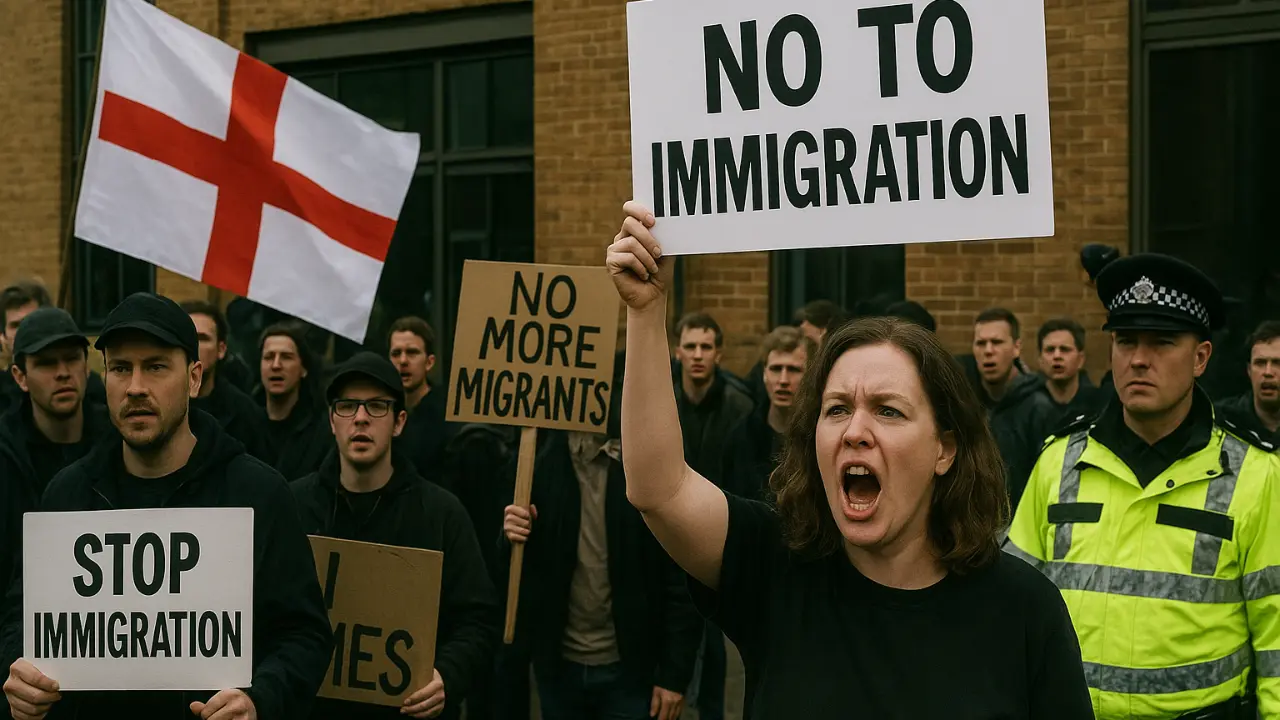
As the summer of 2025 unfolds, a growing number of British citizens are taking to the streets in protest against what they see as unchecked illegal migration and cultural transformation in their local communities. From Epping in Essex to Hull, Dover, and Aldershot, tensions are rising across the UK. While mainstream outlets downplay or ignore these events, independent media and grassroots voices are documenting a different story — one of local resistance, government crackdowns, and a country struggling to define its future.
The protests come amid intensifying frustration over the UK government’s asylum accommodation policies, the perceived demographic reshaping of rural areas, and an apparent imbalance in media coverage and police responses.

Understanding the 2025 Anti-Migrant Protest Wave
Where Did the Protests Begin?
The protest wave kicked off prominently in Epping, Essex, where locals gathered outside a migrant accommodation center — the Bell Hotel. Even before demonstrations began, riot police from both Essex and the Metropolitan Police had been deployed, a sign of rising political sensitivities and preparedness for public dissent.
Simultaneous protests emerged in Hull, Dover, and Aldershot, with footage revealing angry but largely peaceful gatherings. These towns have seen a surge in asylum accommodation placements, often without local consultation.
“People are slowly waking up,” one protestor in Hull declared, highlighting the grassroots nature of this movement.
Police Response and Arrests: Selective Enforcement?
Law and Order or Political Optics?
Footage from the protests shows a stark contrast in police behavior. Riot police preemptively deployed in Essex arrested several British demonstrators amid confrontations, while counterprotesters — often affiliated with left-wing or pro-Palestinian groups — appeared to receive more lenient treatment.
This raises questions about double standards. While the Home Office maintains that police actions are proportionate, many on the right argue that law enforcement is increasingly politicized.
As of the last weekend in July, at least 55 arrests were made in London linked to Palestine Action, a group recently banned by the UK Parliament under anti-terrorism laws.
The Role of Media: Why Are These Protests Underreported?
The Silence of Mainstream Media
Despite their frequency and intensity, these protests have received minimal coverage from legacy broadcasters like the BBC or Sky News. This media vacuum has driven alternative news outlets and citizen journalists to fill the gap.
“Mainstream media is silent. But the protests are real. The anger is palpable,” says Maya Tusi of 2C TV.
The rise of platforms like 2C TV, British Stand, and Pass49 highlights a shift in trust — with many Britons seeking out independent coverage to understand what’s unfolding on their streets.
Ofcom’s latest media consumption report confirms that under-35s now consume more news via YouTube and Telegram than through traditional TV.
Local Demographic Changes and Public Backlash
Why Are Small Towns Reacting Strongly?
While major cities like London and Birmingham have long been multicultural hubs, small towns and villages are now at the frontline of immigration policy.
In communities with 10,000–20,000 people, the sudden arrival of large groups of young, male migrants has altered the visible demographic composition overnight. Many locals argue that this has:
- Stressed public services
- Increased social tension
- Eroded traditional British culture
“It was hard to tell the demographic change in big cities. But in a small village? You notice it immediately,” remarked one Essex resident.
ONS statistics confirm that migration into rural areas has risen by 32% since 2022, largely driven by asylum housing programs.
The Political Left, Islamism, and Counterprotests
Culture War on British Streets
Amid these patriotic protests, counter-demonstrations have surfaced — often involving far-left activists, Antifa members, and Islamist groups.
Recently, left-wing demonstrators in London, some associated with Palestine Action, called for the government to reverse its ban on their organization. Police arrested multiple activists carrying placards reading “Palestine Action Are Not Terrorists.”
“Our government is complicit in genocide,” chanted one arrested activist.
Critics argue that this alliance between progressive leftists and Islamist ideologies is politically incoherent and dangerous.
Meanwhile, many protestors who identify as “British patriots” express frustration at being labeled extremists, insisting their movement is about preserving national identity, not promoting hate.
Cultural Symbols Under Threat?
More Than Immigration — A Question of Identity
Beyond the policy debate, the protests reflect a deeper anxiety: that the cultural and historical essence of Britain is being eroded.
Protesters point to:
- The closure of pubs and local community centers
- Declining participation in national traditions
- Changes in school curriculums and signage
- Proliferation of halal-only zones in some districts
As one commentator noted, “The pub is not just a place to drink. It’s the heart of a community. When it closes, something dies with it.”
The rise in pub closures across the UK, particularly in ethnically shifting neighborhoods, is symbolic of broader cultural displacement.
Local Politics and Shifting Power Dynamics
How Islamists Are Gaining Ground
According to protestors, one of the quietest but most impactful shifts is happening at the local council level. In many urban boroughs, Pakistani-origin Islamist candidates have gained seats as voter turnout among native Britons dwindles.
These new councillors are accused of:
- Prioritizing religious schools
- Enforcing halal standards in local procurement
- Opposing integration with secular norms
Electoral Commission data shows a notable shift in council demographics in areas like Luton, Birmingham, and parts of Manchester.
Local engagement has waned among traditional voters, opening the door for organized blocs to gain power, sometimes under the radar.
Public Sentiment: The Patriot Perspective
Why Are People Taking to the Streets?
Many protestors describe themselves as ordinary citizens — plumbers, teachers, small business owners — who feel betrayed by their leaders and voiceless in national policy.
Their demands often include:
- Halting illegal immigration
- Ending migrant hotel programs
- Preserving British cultural values
- Reforming media and education narratives
They criticize not just immigration policy, but the broader erosion of what they see as Western values.
“We’re not just against something. We’re for something — British values, fairness, and democracy,” one protester said.
Government Response: Crisis or Denial?
Is Westminster Listening?
The UK government has repeatedly promised to “stop the boats” and streamline asylum processing, but many locals see these pledges as performative.
The Illegal Migration Act 2023 gave the government new powers, but enforcement remains sluggish. Meanwhile, Rwanda deportation plans have stalled in the courts, adding to public frustration.
Critics argue that unless the Home Office, police, and justice system act decisively, the public may lose faith in democratic recourse — increasing the risk of radicalization on both sides.
A Growing Divide: What’s Next for the UK?
Will Summer 2025 Spark a National Reckoning?
As protests continue into August, many analysts fear the UK is heading toward a prolonged summer of unrest. Unless meaningful reforms are made — not just in immigration policy, but in media transparency, police neutrality, and civic engagement — divisions may deepen.
The signs are clear:
- Grassroots movements are growing
- Trust in institutions is eroding
- Communities are polarizing
And with a general election looming in 2026, immigration and identity could become the central battlegrounds of British politics.
Conclusion: A Country at the Crossroads
The protests of July 2025 are more than isolated incidents — they are signals from a country struggling with identity, governance, and fairness. While the UK remains a tolerant, democratic society, its foundations are being tested. From Epping to Hull, citizens are demanding not just border control, but cultural preservation and governmental accountability.
The question is: will Westminster listen, or will this growing unrest be dismissed until it erupts?
Top 10 FAQs on UK Anti-Migrant Protests and Immigration Policy (2025)
1. Why are there anti-migrant protests happening across the UK in 2025?
Anti-migrant protests have surged due to public frustration with illegal immigration, the use of hotels to house asylum seekers, and perceived demographic changes in small towns, leading to street-level demonstrations in areas like Essex, Hull, and Dover.
2. Are migrant hotels still being used in the UK in 2025?
Yes, despite pledges to end their use, hundreds of properties—including former inns and guesthouses—are still contracted by the Home Office, fueling protests and criticism from local councils and residents.
3. What is the Illegal Migration Act and has it stopped small boat crossings?
The Illegal Migration Act 2023 aimed to deter illegal entries via small boats with deportations to third countries. However, legal challenges and administrative delays have stalled its full implementation, and crossings continue in 2025.
4. Why is the UK government not reporting anti-migrant protests in the mainstream media?
Many believe mainstream outlets are downplaying the protests due to political bias or fear of inciting unrest, leading to a rise in independent platforms and citizen journalism covering these events.
5. What role are local councils playing in demographic change across the UK?
Local councils allocate housing, schools, and services impacted by rising migrant populations. Shifts in council representation in areas like Birmingham and Luton have sometimes led to accusations of cultural or religious favoritism.
6. Is the UK government planning to stop using hotels for migrants in 2025?
The government has proposed alternatives like barges and disused military bases, but as of mid‑2025, thousands of asylum seekers remain in taxpayer‑funded hotels, contributing to local tension and protests.
7. What are the rights of UK citizens to protest against immigration policies?
Under UK law, citizens have the right to protest peacefully. Police can intervene if demonstrations threaten public order or obstruct traffic. Multiple arrests occurred in 2025 under public order legislation.
8. How are Islamist groups influencing UK politics at the local level?
Concerns exist about activism from Islamist groups within local councils, including pushing religious agendas and disproportionate representation, fueling debates on integration and national identity.
9. Is there evidence that British culture is being undermined by migration?
Critics claim rising migration has led to pub closures, curriculum changes, and erosion of traditional values, while supporters argue multiculturalism enriches society. This debate is central to the 2025 protests.
10. What political parties are supporting anti-migration sentiment in the UK?
Beyond the Conservative Party’s stricter stance on illegal immigration, parties like Reform UK have gained traction by vocalizing stronger opposition to mass migration and tapping into grassroots sentiment.